Independent comparisons. We may earn from shop links. More info

Heat recovery fan vs extractor fan

Updated: 22 October 2026

The open question is whether a heat recovery fan vs extractor fan is worth the extra hardware, or whether a simple boost after a shower is enough. Heat recovery fits when the fan must run for hours and you want some of the heat back. A normal extractor fits a short, hard blast at a lower cost. This sits beside our [single room heat recovery comparison](/hub/heating/single-room-heat-recovery). Prices for ordinary intermittent fans are not in this capture. Peter F. checked the listings and public UK sources, with no lab test. A qualifying purchase can earn a commission at no extra cost to you.

The open question is whether a heat recovery fan vs extractor fan is worth the extra hardware, or whether a simple boost after a shower is enough.

Our top picks

Kair Kair K-HRV150/12RH

Best overall

Kair Kair K-HRV150/12RH
8.4/10about £323.94
LIRAST LIRAST EER100 white

Best value

LIRAST LIRAST EER100 white
7.8/10about £123.12
EUROPLAST EUROPLAST EER150S

Rank 3

EUROPLAST EUROPLAST EER150S
7.8/10about £189.90
On this page

What each fan actually does

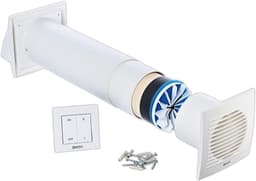
An extractor pulls room air out and dumps it outside. Makeup air comes from the rest of the house, from trickle vents, or from the gap under the door. You lose the heat in that air. The gain is a simple duty: a high rate for a short time, then off. Part F's intermittent bathroom figure is 15 litres per second. A single-room heat recovery fan, in the push-pull form that fills most of this amazon.co.uk set, puts a ceramic core in the same hole. The fan reverses, often on a cycle of about 70 seconds. Outgoing air warms the core. Incoming air picks some of that heat up. BEAMA describes this as a development of the extract fan, and warns that one grille mixes supply and extract a little. A pair of units is the usual way to balance more than one room. Left on all evening, a heat-recovery core has something to do. Used for ten minutes after a shower, the extractor's higher short rate is the clearer tool. The Centre for Sustainable Energy describes whole-house MVHR as a central system.

Heat and the cool-air complaint

You will see up to 82%, up to 85% and up to 90% on these rows. They are test-condition claims, not a percentage off your heating bill. The Centre for Sustainable Energy talks about heat recovery in a planned system, not as a discount on one sleeve. Published ceramic-core work often measures less than the boldest titles, and it did not test these twelve ASINs. UK reviews also say the incoming air can feel cool. LIRAST buyers describe rooms that stay warmer than with a window open, and they still notice the supply air. Kair's 19 cubic metres per hour converts to about 5.3 litres per second, a low continuous figure next to an 8 litre high rate and a 15 litre intermittent boost. EUROPLAST's 29 cubic metres per hour converts to about 8 litres per second. A recovery percentage with no airflow stated, the LIRAST and Envirovoid pattern, does not tell you the heat you will keep.
Kair Kair K-HRV150/12RH

Testsieger

Kair Kair K-HRV150/12RH
8.4/10about £323.94

Noise, vents and one hole

LIRAST reviews describe the unit as louder than a standard bathroom fan in a kitchen-diner. Brookvent's click every cycle is normal for a reversing core and obvious at night. Noise fields of 5 dB are not usable. Approved Document F's note, about 30 dB in bedrooms and living rooms and about 45 dB in kitchens and bathrooms, is not a result these listings have earned. A heat recovery fan can be the noisier object because it is the one you leave on. BEAMA still expects background vents where habitable rooms need fresh air. Do not tape them over because a wall fan arrived. If you will not rinse the filter, an extractor with a simple cover can be the more honest machine.

When to pick which

Choose a normal extractor for a steamy shower, a short boost towards 15 litres per second, and silence while you sleep. You give up the heat in the air you extract, and you avoid shelf prices in this set from about £123.12 to about £379.99. This capture does not price the extractor. Choose single-room heat recovery when the room needs air for hours, the wall matches the sleeve, and you accept cool supply air and a reversing click. A rate near 8 litres per second only counts if the listing states one. Kair's converted 5.3 litres per second is a reason to hesitate if the shower boost is the whole job. Two units are the usual balance if two rooms both need air. Hole and controller traps are on the single room heat recovery buying guide.

Common questions

Will I lose less heat than with an extractor?
You should, while the core is cycling, because outgoing air warms it and incoming air takes some of that heat back. You will not keep a fixed percentage of your heating bill. Reviews still call the incoming air cool, and a fan that only runs for ten minutes has little time to recover anything. Hours of running are what make the core matter.
Is a heat recovery fan quieter?
Not as a rule. LIRAST reviews say it was louder than a standard bathroom fan in a kitchen-diner, because it stays on. A reversing Brookvent clicks about every minute. An extractor that runs for a short boost and then stops can be the quieter evening, even if the boost itself is fierce. Ignore 5 dB fields on the Brookvent pages.
Do I still need trickle vents?
Often yes. BEAMA still expects background vents for habitable rooms under an extract strategy, and one heat-recovery hole does not cancel that. Do not seal vents because a fan arrived. If a designer later specifies a whole-house system, the vent plan belongs to that design, not to a single Amazon unit.
What if I only need the fan after a shower?
Buy the extractor. You want a short high rate, near the 15 litres per second intermittent idea, and then silence. A ceramic core you switch off after ten minutes is an expensive way to do a simple job. Heat recovery starts to make sense when the fan would otherwise run all evening.
When is a normal extractor the better buy?
When the moisture is a short shower, you want the higher intermittent rate, and you would rather not hear a fan all evening. Also when the wall is the wrong thickness for the heat-recovery sleeve you can afford, or when the listing you like has no airflow figure and no IP rating for the zone. Heat recovery wins on long running hours, not on every condensation complaint.

Related pages

Sources

Public UK sources named below. amazon.co.uk prices, stars and review counts on these twelve listings were taken from the listings saved on 20 October 2026. Page updated October 2026.

  1. Approved Document F Volume 1, 2021 (retrieved 20 October 2026)
  2. GOV.UK Approved Document F (retrieved 20 October 2026)
  3. Elta Trade, Part F 2021 (retrieved 20 October 2026)
  4. IET BS 7671 Section 701 FAQ (retrieved 20 October 2026)
  5. BEAMA specifier ventilation guide (retrieved 20 October 2026)
  6. Kair heat recovery room ventilator (retrieved 20 October 2026)
  7. Permagard Kair install guide (retrieved 20 October 2026)
  8. MDPI Energies, ceramic-core measurements (retrieved 20 October 2026)