Independent comparisons. We may earn from shop links. More info

How to use an oil filled radiator

Updated: 22 October 2026

The courier has left a heavy box by the door, and you want heat tonight without tripping the RCD or filling the room with an odd smell. How to use an oil filled radiator covers the socket, the first cycle and what a normal thermostat cycle feels like. This walk-through assumes a standard UK plug-in model from the [oil radiator comparison](/hub/heating/oil-radiator). Peter F. checked those listings and public UK sources. There was no lab test. A qualifying purchase can earn a commission at no extra cost to you.

The courier has left a heavy box by the door, and you want heat tonight without tripping the RCD or filling the room with an odd smell.

Our top picks

On this page

Before you switch on

Unpack on a flat floor, clip on loose castors, and tighten the feet before the first long run. Plug directly into a wall socket. Electrical Safety First advises against a coiled extension reel when a 2 kW load runs for hours. Keep about one metre between the fins and bedding, curtains, paper or clothes. Devon and Somerset Fire and Rescue Service notes that the element is hidden, but the surface still burns and can ignite furnishings if you cover it. None of these listings shows a bathroom IP rating. If the heater was stored in a cold shed, let it reach room temperature first. Bedroom clearance is on oil radiators for bedrooms.

First heating cycle

A smell on the first hours is common as factory coatings cure. Open a window and use a medium setting rather than full 2 kW until it fades. Clicking as the fins expand is normal. It is not arcing in the plug. Warm-up often takes twenty to forty minutes. If you see smoke, smell burning plastic, or see oil, switch off at the wall, unplug without pulling the cord, and contact the seller. A sealed system should not leak. Register the product if the card asks. The 2026 GOV.UK notice on a Kobe oil-filled radiator plug is why that matters.

Thermostat and power steps

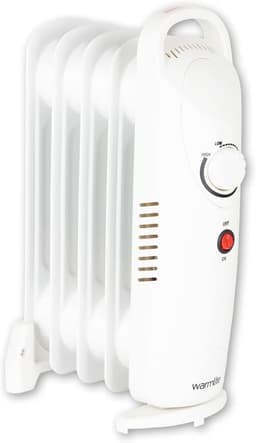
Start on the lowest step that still calls for heat, then adjust until the room holds. Russell Hobbs 2 kW models in this set list 800 W, 1.2 kW and 2 kW. De'Longhi Dragon listings are described with steps around 900 W, 1.1 kW and 2 kW. Use a lower step once the room is warm so the thermostat cycles. If the room never settles on the highest step, it may be undersized or the door is open to a cold hallway. If it overheats on the lowest step, lower the set point. UK reviews often say the dial reads warmer than a thermometer by the bed. Trust the thermometer.

Timers, ECO and day-to-day habits

De'Longhi mechanical timers use a pin wheel. Electronic Dragon models use menus. Pro Breeze and Russell Hobbs combine a power dial with timer segments. Read the leaflet for your model. Pre-heat for thirty to sixty minutes before you use the room. ECO, where listed, trims draw near the target. It does not replace a timer. On a DREO, finish the checks on the panel before you pair Wi-Fi. Close the door. At 26.32 p/kWh, one hour at 2 kW full power is about 53p. Roll the radiator when it is cold, and lift with your knees. Dust the fins with a dry cloth when cool. There is no bleed and no oil top-up on a sealed unit.

When to stop and get help

Stop if the plug is too hot to touch, the pins are brown, the RCD trips repeatedly, the unit still tips after you tightened the feet, or the base is wet with oil. That is an electrician or a warranty call. Do not open the fins, and do not disable a tip-over switch. Fixed bathroom heat needs a qualified electrician.

Common questions

Can I use an extension lead?
Avoid an extension for a long high-draw run. Electrical Safety First warns that a coiled reel overheats when a heater in the 2 kW class runs for hours. If you must use one briefly, choose an unwound heavy-duty reel rated for the load and keep it fully extended. A wall socket is the safer default, with one heater on that outlet.
What thermostat setting should I start on?
Start mid-scale on a dial, or around 18–20 °C on a digital display, on the middle power step, then adjust after an hour. Every room differs. If a room thermometer by the chair reads cooler than the dial, trust the thermometer and how you feel. A lower step after the room is warm cuts the time you spend at full watts.
Do I need to bleed or refill the oil?
No, on a sealed household unit. You do not bleed it like a wet central-heating panel, and you do not top up the oil. If oil appears at the base, the heater is faulty. Switch it off, unplug it, and contact the seller or the manufacturer. Do not open the fins yourself.
Can I mount it on the wall?
These listings are floor models with castors. Do not wall-mount one unless the manufacturer supplies a kit that says the model is for the wall. Screwing a castor radiator to a wall is not a substitute for that kit. Keep it upright on a flat floor, with air free to move around the fins.
How do I set a 24-hour timer?
Follow the paper manual for your model. There is no single sequence across these twelve listings. Mechanical timers use push pins. Electronic timers use menus. A DREO smart model uses the app after Wi-Fi pairing, and only after the panel controls already behave. Set pre-heat for thirty to sixty minutes, not a full night on the highest step.
Why is the plug warm?
Some warmth after hours on high is reported widely in UK reviews of oil radiators. A distinct hot-plastic smell, discolouration on the pins, or a loose plug is different. Stop using the heater and have the socket checked by an electrician. Do not keep running it from an extension while you wait.

Related pages

Sources

Public UK sources named below. amazon.co.uk prices, stars and review counts on these twelve listings were taken from the listing files saved on 20 October 2026. Page updated October 2026.

  1. Centre for Sustainable Energy, room heaters (retrieved 20 October 2026)
  2. Ofgem price cap, 1 October to 31 December 2026 (retrieved 20 October 2026)
  3. Devon and Somerset Fire and Rescue Service, heater safety (retrieved 20 October 2026)
  4. Electrical Safety First, portable heaters (retrieved 20 October 2026)
  5. Homebuilding, oil-filled radiator size (retrieved 20 October 2026)
  6. Regulation 2015/1188 Annex II (retrieved 20 October 2026)
  7. GOV.UK, Kobe oil-filled radiator recall (retrieved 20 October 2026)
  8. Energy.org.uk, electric heaters compared (retrieved 20 October 2026)