Independent comparisons. We may earn from shop links. More info

Oil radiators for bedrooms

Updated: 22 October 2026

The central heating clicks off before you are warm in bed, and a fan heater whines if you leave it running. An oil filled radiator bedroom setup is fanless convection once the oil is hot. It can work if you keep clearance from bedding and treat overnight use with caution. Electrical Safety First does not treat a portable heater as a leave-on-all-night appliance, even when the oil is sealed. Twelve models are in the [oil radiator comparison](/hub/heating/oil-radiator). Peter F. checked those listings and public UK sources. There was no lab test. A qualifying purchase can earn a commission at no extra cost to you.

The central heating clicks off before you are warm in bed, and a fan heater whines if you leave it running. An oil filled radiator bedroom setup is fanless convection once the oil is hot.

Our top picks

On this page

Why bedrooms suit oil-filled heat

An oil radiator has no blower, so there is no fan whirr against sleep. Heat rises from the fins. De'Longhi, Pro Breeze and Russell Hobbs rows draw UK review comments on quiet bedroom use. That is not silence. Expansion clicks still happen. Warm-up is slower than a fan heater, so a timer that starts before you get in fits better than expecting instant heat. Residual warmth after switch-off can cover the first hour if you heated the room first. You still paid for the energy in the oil. Fins stay hot after the element cuts out. Devon and Somerset Fire and Rescue Service warns that children can burn on any portable heater.

Choosing wattage for a bedroom

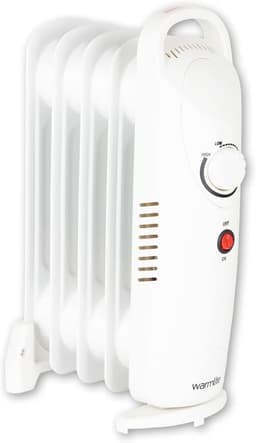
A typical UK double bedroom around 12–16 m² often lands in the 1.5–2 kW band on the 100 W per square metre rule of thumb, adjusted up for draughts. The Russell Hobbs RHOFR5001B at 1.5 kW states about 15 m². A 2 kW model, such as the Daewoo, the Russell Hobbs nine-fin or the De'Longhi Dragon 4, gives headroom if the door opens onto a cold landing. The sizing rule is in the oil radiator buying guide. A spare room under about 10 m² can work on a 650 W Warmlite or Russell Hobbs five-fin unit if the door stays shut. 650 W in a master bedroom with a high ceiling is a common miss. A 2.5 kW Pro Breeze is more heater than many sleeping rooms need unless the set point stays low.

Where to put it in the room

Keep about one metre from the mattress, a duvet overhang, curtains, and anything that could fall onto the fins. Not inside a wardrobe alcove, not under bedding, and not where fabric touches the fins. Keep the controls reachable without leaning over the hot top. Run the cable along the skirting. Do not use it in an en-suite. None of the twelve listings states a bathroom IP rating.

Overnight use, timers and alarms

Electrical Safety First advises caution overnight. If you sleep with one running, keep the clearance, test the alarms, and accept more risk than daytime use you can see. A common compromise is to pre-warm on a timer, then lower the set point or switch off at bedtime. A 24-hour timer on a De'Longhi, Pro Breeze or Russell Hobbs can start heat in the evening and cut it later. A DREO app schedule does the same if Wi-Fi stays up. Do not cover the heater after switch-off. Test smoke alarms when you add any heater on a sleeping floor. An oil radiator does not burn gas. The escape route still has to stay clear.

Families, pets and running cost

Place the unit where a crawling child cannot reach the fins, or supervise. A pet can knock a light 650 W model. Check the tip-over switch by tilting gently when the heater is cool, as the manual describes. Oil heat raises air temperature. It does not add moisture. For one cold bedroom on occasional nights, a portable radiator can cost less than heating the whole house. Every night, all winter, an efficient gas system usually costs less. The Centre for Sustainable Energy frames plug-in heat as point-of-use, not a primary system.

Common questions

How far from the bed should it be?
About one metre from bedding, curtains and other soft furnishings, following fire-service and Electrical Safety First guidance. That gap includes a duvet hanging off the mattress. Do not tuck the radiator under the bed or into a curtained alcove. Air needs a clear path around the fins.
Can I leave an oil radiator on all night?
Many people do, with a timer and a thermostat. Safety bodies still urge caution for an unattended portable heater, including an oil-filled one. If you choose an overnight run, keep the one-metre clearance, test the alarms, and use a moderate set point. Do not leave full 2 kW running against a closed door. Pre-warming, then switching off at bedtime, is the more cautious pattern.
Should I use a timer to pre-warm before sleep?
Yes, if the listing actually states a timer. Start the heat 30–60 minutes before bed, then lower the set point or switch off for sleep if you want to cut cost and follow the cautious overnight advice. The Daewoo 2 kW listing in this set does not state a timer. The Warmlite timer field may not match a simple dial, so check the live page.
Are oil radiators safe with children?
They avoid an exposed glowing coil, which is a plus next to some fan heaters. The fins still burn, and they stay hot after the element switches off. Distance, supervision and a working tip-over switch matter. Devon and Somerset Fire and Rescue Service warns that children can be burned by any portable heater. Do not disable the cut-out to stop nuisance trips.
Is a bedroom oil radiator cheaper than leaving central heating on?
For one cold bedroom on occasional nights, a portable radiator can cost less than heating the whole house. For every room, every night, an efficient gas central heating system usually costs less to run. The Centre for Sustainable Energy treats plug-in electric heat as point-of-use, not a replacement primary system. At the same wattage, the oil does not create cheaper heat than any other plug-in heater.

Related pages

Sources

Public UK sources named below. amazon.co.uk prices, stars and review counts on these twelve listings were taken from the listing files saved on 20 October 2026. Page updated October 2026.

  1. Centre for Sustainable Energy, room heaters (retrieved 20 October 2026)
  2. Ofgem price cap, 1 October to 31 December 2026 (retrieved 20 October 2026)
  3. Devon and Somerset Fire and Rescue Service, heater safety (retrieved 20 October 2026)
  4. Electrical Safety First, portable heaters (retrieved 20 October 2026)
  5. Homebuilding, oil-filled radiator size (retrieved 20 October 2026)
  6. Regulation 2015/1188 Annex II (retrieved 20 October 2026)
  7. GOV.UK, Kobe oil-filled radiator recall (retrieved 20 October 2026)
  8. Energy.org.uk, electric heaters compared (retrieved 20 October 2026)