Independent comparisons. We may earn from shop links. More info

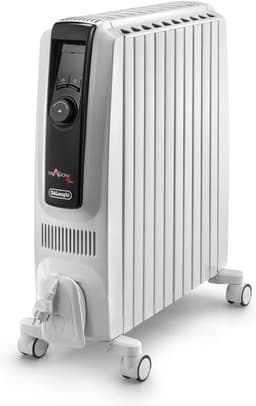
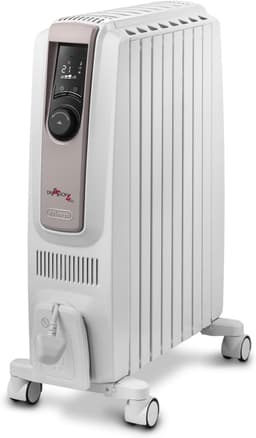
De'Longhi Dragon 4 vs Radia S

Updated: 22 October 2026

You already want a De'Longhi oil-filled radiator and are stuck between Dragon 4 chimney fins and Radia S open fins with Real Energy. This page compares the families at a fair wattage. The 500 W Nano is out of scope. Prices and every ASIN row are on the [De'Longhi radiator comparison](/hub/heating/de-longhi-radiator). Those amazon.co.uk listings were read on 20 October 2026. Peter F. compared them with public UK sources. There was no lab test. A qualifying purchase can earn a commission at no extra cost to you.

You already want a De'Longhi oil-filled radiator and are stuck between Dragon 4 chimney fins and Radia S open fins with Real Energy. This page compares the families at a fair wattage. The 500 W Nano is out of scope.

Our top picks

On this page

What each family is trying to do

De'Longhi describes Dragon 4 as vertical chimney channels that pull air up the column. Radia S pairs open fins with Real Energy, marketing language for ramping toward a set temperature rather than running at full power continuously. Neither family is a fan heater. There is no fan on the De'Longhi GB page for the TRDSX40820E.WB. Once the oil has charged, both still rely on a thermostat cycling the same 2000 W element, so the feel can be similar if you sleep across the room from a cold window. A T3 Dragon review, one writer's room and not a lab, said chimney channels warmed the space faster than a basic fin heater they owned. Forum anecdotes sometimes prefer Radia S when you sit beside the panel. Treat both as experience stories, not UK test scores.

Same watts, different body

Hold 2000 W constant or you are comparing power, not family. How to match watts to the room is in the De'Longhi radiator buying guide. Fair pairs here are TRDSX40820E.WB or TRDX40820E at 2000 W versus TRRS0920E.G at 2000 W with 60 m³ in the bullets. The grey Radia S lists 10.64 kg with folding castors. Dragon 4 rows sit around 15 to 15.6 kg, which matters on stairs. Both sides offer electronic timers: Radia S from 0.5 h to 24 h, and Dragon TRDSX40820E.WB from 0 h to 24 h with ECO Plus. TRDX40820E adds a night setting but shares review text with the white and beige listing, so the 634 reviews are not two independent samples. Radia S carries Real Energy and ECO Plus. Dragon carries chimney wording and steps such as 900 W, 1100 W and 2000 W. The Amazon title's three fan settings are not backed by fan bullets. Reviewers describe power levels, not blades.

The 2.5 kW Dragon is a different question

TRDX41025E and TRD41025T jump to 2500 W. More watts heat more air when the thermostat demands it. They do not prove chimney fins beat Radia S. A 2500 W Dragon beside a 2000 W Radia S is an unfair family duel. The Pro item field prints 1.9 kg, which is not a credible weight, so the table shows n/a. If the room fits the 60 m³ claims at 2000 W, start with the fair pair. Step to 2500 W when cold spots persist after honest thermostat use, not because Pro sits higher in a chart.

Close to the heater

Open Radia fins radiate toward a person beside the column. Chimney Dragons emphasise upward air movement along the fin stack. If your chair sits within a metre of the heater, Radia S anecdotes about gentler side radiation can matter. If the unit lives under a window across the room, chimney convection may matter more. That is still guesswork without measuring your room. Noise profiles are similar in reviews: no fan whine, an occasional creak on first cycles, and a mechanical timer tick on some T models that are not in the grey Radia E row.

Which to buy

Choose the grey Radia S (TRRS0920E.G) when 2000 W is enough, you want the lighter body and a digital timer at about £132.99, and 4.6 from 176 reviews is the star line you trust. It is the top pick on the main comparison. Accept smell reports in a minority of that sample. Choose Dragon 4 at 2000 W (TRDSX40820E.WB or TRDX40820E) when you want chimney design and will tolerate about 15 kg plus the shared 634-review pool. Confirm the model code in the box. Choose Dragon 4 Pro at 2500 W only when that 2000 W comparison is settled and you still need output. The Easytronic Radia S at about £120.00 had no review line in the listing file read on 20 October 2026, so it is not part of this duel.

Common questions

Does the Dragon 4 have a fan?
Not on the De'Longhi GB page for TRDSX40820E.WB. An Amazon title may say fan settings. The bullets list power steps.
Which one heats the air faster?
Maker and magazine anecdotes favour Dragon chimney flow in some rooms. Your insulation and furniture layout dominate. There is no lab result in this set.
Which feels warmer if you sit beside it?
Anecdotes often favour Radia S open fins for sideways radiant comfort. Dragons push air up the column.
Which is lighter?
At 2000 W, TRRS0920E.G at 10.64 kg is lighter than the Dragon 4 rows here at about 15 kg.
Is a 2.5 kW Dragon better than a 2 kW Radia S?
It is more powerful, not a fair family comparison. Match watts first, then compare fins.
Do both have timers?
The grey 2000 W Radia S and the electronic 2000 W Dragons in this set list timers in the bullets. Confirm on the row you buy.
Which is quieter?
Both are fanless. Creaks and timer clicks vary by model, not by family alone.
Which should a bedroom buy?
Often the 2000 W Radia S, for weight and a timer at mid price. A 2000 W Dragon if you prefer chimney heat. Overnight limits are on De'Longhi radiator for bedrooms.

Related pages

Sources

Public UK and De'Longhi GB sources named below. amazon.co.uk prices, stars and review counts on these seven listings were taken from the listing files read on 20 October 2026. Page updated October 2026.

  1. De'Longhi GB Dragon 4 TRD40820T (retrieved 20 October 2026)
  2. De'Longhi GB TRDX40820E (retrieved 20 October 2026)
  3. De'Longhi GB TRDSX40820E.WB (retrieved 20 October 2026)
  4. Dragon 4 instructions (retrieved 20 October 2026)
  5. De'Longhi GB Nano TRNS0505M (retrieved 20 October 2026)
  6. Electrical Safety First, portable heaters (retrieved 20 October 2026)
  7. Ofgem energy price cap, 1 October to 31 December 2026 (retrieved 20 October 2026)
  8. legislation.gov.uk, Regulation 2015/1188 Annex II (retrieved 20 October 2026)