Independent comparisons. We may earn from shop links. More info

De'Longhi radiator buying guide

Updated: 22 October 2026

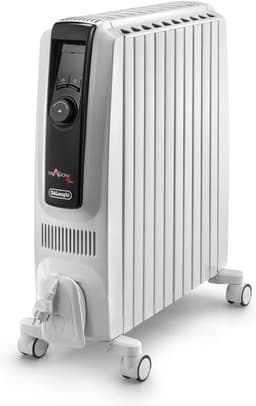
You are on amazon.co.uk with a shortlist of De'Longhi oil-filled radiators and no fixed room size yet. This buying guide is for that moment: match cubic metres and watts to the room, then decide whether you need a mechanical pin timer, an electronic panel, or nothing beyond a thermostat, before you open the model rows on the [De'Longhi radiator comparison](/hub/heating/de-longhi-radiator). Prices there, read on 20 October 2026, run from about £82.99 to £266. Peter F. compared those listings and public UK sources. There was no lab test. A qualifying purchase can earn a commission at no extra cost to you.

You are on amazon.co.uk with a shortlist of De'Longhi oil-filled radiators and no fixed room size yet.

Our top picks

On this page

Start with room volume, not the headline square metres

De'Longhi often prints 60 m³ on 2 kW Dragon and Radia S pages. That is cubic metres of air, not floor area. With a typical 2.4 m ceiling, 60 m³ is roughly 25 m² of floor, a rule of thumb only, because insulation, outside walls and how long you run the heater matter more than the label. The Radia S Easytronic title says up to 60 m², while a footnote ties an energy claim to a 45 m³ test room held at 22 °C. Those numbers are not interchangeable. Quote the unit each page uses. The Nano TRNS0505M is the small-room end: De'Longhi’s UK page talks about 15 m³, and the amazon.co.uk coverage field says 6 m². Both mean very small, not a lounge. Treat 150 square feet, 807 square feet or 75 meters on other listings as the seller’s field, not a measured room.

Pick the wattage

500 W suits a utility, a study or a very small bedroom where you accept slow warm-up and one continuous setting. Nano reviewers often describe compact storage and quiet heat, and they also say it is wrong for a large or draughty room. 2000 W is the usual step for a bedroom or home office that matches the 60 m³ claims. Many Dragons list three power steps, for example 900 W, 1100 W and 2000 W on the TRDSX40820E.WB bullets. The grey TRRS0920E.G is a straight 2000 W Radia S row with Real Energy and ECO Plus. 2500 W is the step up when the room is larger, colder or slow to answer 2000 W. The Dragon 4 Pro TRDX41025E and the mechanical TRD41025T both sit at 2500 W, with different controls and prices on the main table. Oversizing does not remove clearance rules or running cost. It only raises maximum output when the thermostat calls for it.

Pick the controls

A T in the model name often means a mechanical 24-hour pin timer. The TRD41025T bullets do not repeat that timer, yet UK reviews describe a manual timer switch, so confirm the panel in the box. An E suffix usually means an electronic timer and display. The grey Radia S lists intervals from 0.5 h to 24 h. The Dragon 4 TRDSX40820E.WB lists 0 h to 24 h electronically. Turn-and-push controls on the TRDX40820E are another electronic path, with a night setting in the bullets. ECO or ECO Plus, where listed, reduces power near the set temperature. That is control behaviour, not proof the element uses less electricity than a fan heater at full blast. The Nano bullets claim an adjustable room thermostat and anti-frost but no timer, and the manuals warn against an external timer socket. The Easytronic TRRSE0920 adds comfort modes between 14 °C and 28 °C, does not name a timer in the bullets, and had no amazon.co.uk review line in the listing file read on 20 October 2026.

What changes the bill

From 1 October to 31 December 2026, Ofgem’s cap figure for Great Britain on typical direct debit use is 26.32 p/kWh for electricity. Northern Ireland is outside that cap. A 2 kW heater at full power for one hour is about 53 p before standing charges. A 500 W Nano at full power for an hour is about 13 p on the same arithmetic. Real evenings rarely sit at nameplate watts for sixty minutes. A room thermostat cuts in and out, and oil keeps releasing heat after switch-off. Comparing a Dragon and a Radia S by one hour at 2000 W misses the point if one programme holds 20 °C and the other runs high until you turn the dial down. Ecodesign rules for electric portable local space heaters set a minimum seasonal efficiency that includes controls. That score is a regulatory floor, not a promise of a warm room in a Victorian bedroom.

What to leave out of this shortlist

These are portable oil-filled electric radiators, not bathroom heaters, not central heating and not infrared panels. Dragon instructions ban bathrooms, showers, extension leads, use under sockets, rooms under 4 m², and washing draped over the fins. Electrical Safety First asks for about one metre from combustibles and advises against leaving portable heaters on overnight. Bedroom detail is on De'Longhi radiator for bedrooms. Ignore item-dimension fields that print pocket-sized centimetres or 1.9 kg next to a 2500 W body. Use bullet dimensions and stated weight. Conditional picks are on best De'Longhi radiator. This page stops at criteria.

Common questions

Is 60 m³ the same as 60 m²?
No. 60 m³ is volume. 60 m² is floor area unless the listing explicitly converts between them. Divide volume by ceiling height for a rough floor figure, for example 60 m³ divided by 2.4 m is about 25 m², and treat that as a starting guess, not a survey.
When is 500 W enough?
When the room is genuinely small, you accept slow warm-up, and you will not ask the heater to fight a draughty lounge. The Nano listing and reviews point at studies, utilities and compact bedrooms, not open-plan space.
When should you step up to 2.5 kW?
When 2000 W rows still struggle in a large or poorly insulated room you intend to heat for long sessions, and you have space and clearance for a heavier unit. Compare like-for-like timers on the main table before paying a premium for watts alone.
Mechanical timer or electronic timer?
Mechanical pins are simple once set, but reviewers of the mechanical 2500 W Dragon mention ticking and a small switch. Electronic panels offer finer programmes but get called fiddly until you read the booklet. Pick the interface you will actually programme.
Does ECO cut wasted electricity?
It reduces output near the set point. It does not turn an oil-filled radiator into a heat pump. Your meter still reflects time at high power when the room is cold.
Why do two Dragon 4 listings show different prices?
Different ASINs, finishes and control packs sit at different prices. Two 2 kW electronic rows here are about £171 and £174.99. De'Longhi GB lists TRDX40820E at £219.99 against £174.99 on amazon.co.uk in this extract. Compare the exact model code.
Can any model here go in a bathroom?
No. The manuals forbid bathroom and wet-room use. A fixed bathroom heater is installation work, not these plug-in radiators.

Related pages

Sources

Public UK and De'Longhi GB sources named below. amazon.co.uk prices, stars and review counts on these seven listings were taken from the listing files read on 20 October 2026. Page updated October 2026.

  1. De'Longhi GB Dragon 4 TRD40820T (retrieved 20 October 2026)
  2. De'Longhi GB TRDX40820E (retrieved 20 October 2026)
  3. De'Longhi GB TRDSX40820E.WB (retrieved 20 October 2026)
  4. Dragon 4 instructions (retrieved 20 October 2026)
  5. De'Longhi GB Nano TRNS0505M (retrieved 20 October 2026)
  6. Electrical Safety First, portable heaters (retrieved 20 October 2026)
  7. Ofgem energy price cap, 1 October to 31 December 2026 (retrieved 20 October 2026)
  8. legislation.gov.uk, Regulation 2015/1188 Annex II (retrieved 20 October 2026)