Independent comparisons. We may earn from shop links. More info

Ear defenders buying guide

Updated: 21 October 2026

You have a mitre saw in a shed, or a site that already feels loud, and every tab is pushing a bigger number. This ear defenders buying guide is the rule before you open the table: match the SNR to the job, keep enough sound to hear a warning, and skip any listing that will not say what that SNR is. The twelve amazon.co.uk pairs, with prices in GBP, sit on the [ear defenders comparison](/hub/hearing-protection/ear-defenders). The Products Compared editorial team read the listings on 20 October 2026, with no lab test. A qualifying purchase can earn a commission at no extra cost to you.

You have a mitre saw in a shed, or a site that already feels loud, and every tab is pushing a bigger number.

Our top picks

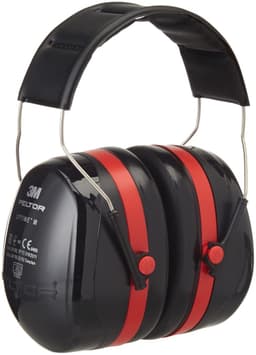
3M 3M Peltor Optime III H540A

Best overall

3M 3M Peltor Optime III H540A
9.2/10about £28.76
Peltor Peltor X2A, SNR 31

Alternative

Peltor Peltor X2A, SNR 31
9.2/10about £33.95
Peltor Peltor Optime I, SNR 27

Best value

Peltor Peltor Optime I, SNR 27
9.2/10about £19.99
On this page

Match the SNR to the noise, not to the biggest badge

The Health and Safety Executive publishes a selection guide, not a trophy. At about 85–90 dB(A) it points to an SNR of 20 or less. At 90–95 dB(A) the guide is 20–30. At 95–100 dB(A) it is 25–35. At 100–105 dB(A) it is 30 or more. A householder with a drill or a mower is usually in the middle of that guide, not at the top. The Optime III in this set states SNR 35 dB for 95–110 dB(A). That high band is the wrong default for a short cut on a domestic saw. An employer with no noise assessment still needs a competent person.

Take 4 dB off your confidence, not off the label

HSE’s real-world note is one sentence. After a proper calculation, assume the level at the ear is 4 dB higher than the catalogue figure. That factor is not used on peak noise, and it is not an instruction to scribble “minus 4” on the box. Some UK pages tell you to subtract 4 dB from the SNR. That only matches HSE if the rest of the sum is identical. Put the muffs on as you will wear them, with glasses or a cap, and start the tool. If the noise only drops when you press the cups, the printed SNR is optimistic for you. Glasses, cleaning, and flat cushions are on how to wear ear defenders.
3M 3M Peltor Optime III H540A

Testsieger

3M 3M Peltor Optime III H540A
9.2/10about £28.76

The 80, 85, and 87 dB duties

The Control of Noise at Work Regulations 2005, and the Northern Ireland regulations from 2006, use the same three levels. At 80 dB(A), or a peak of 135 dB(C), protectors must be available if a worker asks. At 85 dB(A), or a peak of 137 dB(C), if the noise cannot be reduced another way, the employer supplies suitable protectors, sees that they are worn, and marks a hearing protection zone. A householder is not an employer, so those duties do not land on a Saturday in your own garage. Several 2026 round-ups treat 87 dB(A) as the moment wearing becomes compulsory. That swaps the limit at the ear with the upper action value. Saws, grinders, and mowers are on ear defenders for power tools.

What this set actually prints

Three adult pairs state both an SNR and a noise band. The Peltor Optime I states 27 dB for 87–98 dB(A). The Peltor X2A states 31 dB for 94–105 dB. The 3M Peltor Optime III states 35 dB for 95–110 dB(A). The Portwest Classic at about £4.79 states no SNR. Stars cannot place a blank on the HSE table. The Dr.meter FM-1B prints SNR 31 dB and NRR 26 dB together. NRR is the US method. Use the SNR, then the EN data in the instructions. Do not add a plug SNR to a muff SNR.

Common questions

What SNR should I buy for DIY?
For ordinary DIY and garden tools, start in the mid-20s to low-30s and take the muffs off between cuts. HSE’s guide puts an SNR of 20–30 at about 90–95 dB(A) and 25–35 at 95–100 dB(A). The Optime I states 27 dB for 87–98 dB(A). If the saw is in the mid-90s and above, look at the X2A or the Optime III.
Is a higher SNR always safer?
No. HSE warns against taking the level at the ear below 70 dB, because speech, alarms, and the machine disappear. SNR 35 dB does not make every job safe for a full shift. The Optime III listing limits that 35 dB claim to a stated 95–110 dB(A). On a short, moderate task the Optime I, at 27 dB and 180 g, is the pair people keep on.
What do 80, 85, and 87 dB mean if I am not an employer?
You are not under the employer duties, and the numbers are still the scale in the regulations. At 80 dB(A) protectors must be available on request. At 85 dB(A) an employer must supply them and see that they are worn if the noise cannot be reduced another way. 87 dB(A) is the limit at the ear. A phone app is not a workplace assessment.
Why do two numbers appear, such as SNR 31 and NRR 26?
They are different rating systems. On the Dr.meter FM-1B the listing states SNR 31 dB and the bullets also state NRR 26 dB. NRR is the US figure. For a UK buy, use the SNR and the EN data in the instructions. Do not average the two numbers into a third rating the page never printed.
Can I trust “ASIN certified” or a listing with no SNR?
“ASIN certified” is not a conformity mark. It appears on the Floriogra page and the cumunebula two-pack beside a claim of CE and ANSI S3.19, which is a US method. EN 352-1 is the earmuff standard. The Portwest Classic at about £4.79 prints no SNR, so you cannot place it on the HSE table.
Do noise-cancelling headphones count as ear defenders?
Only if they meet the relevant part of EN 352. A headphone that feels quiet on a train is not a protector for a saw. EN 352-1 covers earmuffs and EN 352-2 covers plugs. These twelve products are passive headband muffs. Children’s pairs with high stars, including the iClever EM01 at 4.8, are for loud rooms, not for a site cup. High stars do not move that job onto a tool.

Related pages

Sources

Public UK sources named below. amazon.co.uk prices, stars and review counts are from the twelve listings in this comparison. Page updated 21 October 2026.

  1. Control of Noise at Work Regulations 2005, regulation 4 (retrieved 21 October 2026)
  2. Control of Noise at Work Regulations 2005, regulation 7 (retrieved 21 October 2026)
  3. Control of Noise at Work Regulations (Northern Ireland) 2006 (retrieved 21 October 2026)
  4. HSE, Hearing protection (retrieved 21 October 2026)
  5. HSE, real-world factors (retrieved 21 October 2026)
  6. HSE INDG362 (retrieved 21 October 2026)
  7. BS EN 352-1:2020 preview (retrieved 21 October 2026)
  8. 3M UK, PELTOR Optime I (retrieved 21 October 2026)