Independent comparisons. We may earn from shop links. More info

How to use a VDE screwdriver

Updated: October 2026

A red handle is not permission to start. How to use a VDE screwdriver begins with the circuit proved dead, and with the sleeve on that driver still intact. A 1,000 V line is an insulation rating for a skilled person. On a nominal 230 V UK supply it does not authorise live work. The sets are on the [VDE screwdriver comparison](/hub/hand-tools/vde-screwdriver). Marks and tip family, before you buy, are in the [buying guide](/hub/hand-tools/vde-screwdriver/sub/vde-screwdriver-buying-guide). Products Compared wrote this from UK public guidance and these listings on 16 October 2026. There is no laboratory test. If you buy through our links, a qualifying purchase can earn a commission at no extra cost to you.

A red handle is not permission to start. How to use a VDE screwdriver begins with the circuit proved dead, and with the sleeve on that driver still intact. A 1,000 V line is an insulation rating for a skilled person.

Our top picks

On this page

What the driver is allowed to do

Regulation 14 of the Electricity at Work Regulations 1989 allows work near a live conductor only when it is unreasonable for the circuit to be dead, reasonable to work on it live, and suitable precautions are in place. A sleeved screwdriver is one precaution. HSG85 treats BS EN 60900 tools that way. Insulated tools do not by themselves make live work lawful. For a house socket the first condition usually fails, because you can isolate. The AC limit in the standard is 1,000 V. Nominal UK mains are 230 V.

Check the driver in your hand

Read the marks before you look at the screw: double triangle, a voltage figure, and a standard number on that driver, not only on the carton. A crack, a peel, a cut, or a bare patch means the driver is finished. Do not tape the nick, shorten the insulation, or grind a rounded tip. A driver is not a pry bar. A second colour under the sleeve is a wear system some makers use. Do not require it on every brand here. If the cross no longer fills the recess, it will cam out. Pozidriv and Phillips are different recesses. If the screw shows extra radial ticks and you only have a Phillips tip, stop and change the driver. That geometry is on the Pozidriv versus Phillips page.

Prove the circuit dead without the neon screwdriver

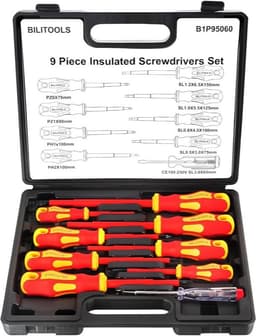
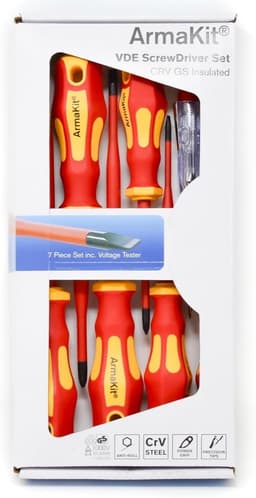
A neon screwdriver is a single-pole detector. HSE GS38 says that class of device can help you identify live equipment, and it does not prove a circuit dead. Non-contact volt sticks are the wrong instrument for the same job. Prove a two-pole tester or test lamp on a known live source, isolate and lock off, prove the circuit dead, then prove the tester again. Wera's safety note says its voltage tester is not for working on live installations, and that it has to be kept dry. Gunpla, ArmaKit, Anesty, and both BILITOOLS sets include a tester, and reviews already call some of those pens cheap. With no two-pole tester you can prove before and after, you do not have a method.

When you stop

Stop when the job is no longer one screw on a proved-dead accessory. Replacing a consumer unit, or opening the meter, cut-out, or service head, is notifiable work or the distributor's equipment. A sleeved driver does not certify it. Stop after a shock, if the sleeve is cut or taped, and if anyone treats 1,000 V on the handle as a reason to work live. If you cannot lock the circuit off and prove it dead, book an electrician. A recessed terminal on a board is a reason to ask whether you should be in that board at all. The consumer unit page separates the screwdriver from the qualification and from a torque tool. This page does not describe a way to work live.

Common questions

Can I work on a live socket because the driver says 1,000 V?
No. The 1,000 V AC figure is the working limit in the insulation standard, for a skilled person, with the other precautions in place. Regulation 14 still requires that it is unreasonable for the circuit to be dead. A domestic socket can be isolated. The red handle is one precaution, not a permit, and nominal 230 V mains do not change that.
How do I check the sleeve before I start?
Read the marks on that driver, then look for cracks, peeling, cuts, and a tip that no longer fits the recess. If the sleeve is damaged, retire the tool. Do not tape it, shorten it, or grind the tip. A second colour under the sleeve is a wear system some makers use. It does not save a damaged driver.
What is wrong with the tester that came in the box?
It is a single-pole neon, and GS38 says that kind of detector does not prove a circuit dead. Gunpla, ArmaKit, Anesty, and both BILITOOLS sets include one. Use a two-pole tester proved on a known live source, then again after the circuit.
What is the order for proving a circuit dead?
Prove the two-pole tester on a known live source, isolate and lock off, prove the circuit dead, then prove the tester again. That before-and-after check stops a dead reading from being a failed instrument. The neon in the case is not a substitute.
Can I tape a nick or grind a rounded tip?
No. A nick in the sleeve is the end of that driver. Tape hides the damage without restoring the insulation. Grinding a rounded tip changes the fit and invites cam-out. Shortening the sleeve to bare more blade does the same harm. Replace the driver. Do not keep a damaged one for light work.
When do I put the driver down and call someone?
Call a registered electrician for a consumer-unit change, for the meter, cut-out, or service head, and after a shock. Also stop if the tool is damaged or you have no two-pole tester. A faceplate on a locked-off, proved-dead circuit is the scale this page is about.

Related pages

Sources

Public UK sources and the amazon.co.uk listings in this comparison. Listings captured 15 October 2026. Page updated October 2026.

  1. Electricity at Work Regulations 1989, regulation 14 (retrieved 15 October 2026)
  2. HSE HSG85 (retrieved 15 October 2026)
  3. HSE GS38 (retrieved 15 October 2026)
  4. BSI, BS EN IEC 60900:2018 (retrieved 15 October 2026)
  5. Professional Electrician on insulated tools (retrieved 15 October 2026)
  6. GOV.UK competent person schemes (retrieved 15 October 2026)
  7. IET consumer-unit FAQ (retrieved 15 October 2026)
  8. BAuA GS mark FAQ (retrieved 15 October 2026)