Independent comparisons. We may earn from shop links. More info

Phillips vs Pozidriv

Updated: 22 October 2026

You are building a flat-pack wardrobe with a PH2 bit, and the screw looks like every other cross you have ever turned. It is not the same recess. Phillips vs Pozidriv is the difference between a plain cross and a cross with four extra ticks, and mixing them is how UK cupboard screws end up bright and round. The twelve rows are on the [screwdriver comparison](/hub/hand-tools/screwdriver). Peter F. wrote this on 22 October 2026 from ISO’s description of the two forms, from UK fastener guides, and from the amazon.co.uk listings in this comparison. It is not a lab test. A qualifying purchase can earn a commission at no extra cost to you.

You are building a flat-pack wardrobe with a PH2 bit, and the screw looks like every other cross you have ever turned. It is not the same recess.

Our top picks

On this page

Tick marks mean Pozidriv; a plain cross means Phillips

Pozidriv has the cross plus four short ticks at 45 degrees. Phillips is the cross alone. PH is the Phillips form and PZ is the Pozidriv form under ISO 8764-1:2004. The recesses sit under ISO 4757. You need the ticks, not the text of the standards. UK packets often say Pozidrive or Pozi. Those spellings mean the same recess when the ticks are there. If you can see even two marks, stop using the PH2 that started the scar. A lot of British flat-pack carries the ticks. Drywall screws often do not, so it is also wrong to treat every UK cross as Pozidriv. A PZ2 stamp is the size, not proof that this screw is Pozidriv.

The fit only works one way

Phillips flanks taper and push the tip out as torque rises. Pozidriv flanks are parallel, so a matching PZ tip is meant to stay down. PB Swiss, bolts.co.uk and Shop4Fasteners describe the same one-way fit. A Phillips tip can enter a Pozidriv screw with play, then chew the ticks off. A Pozidriv tip does not seat in a plain Phillips screw. It sits proud, and force rounds the cross. A light turn with the wrong Phillips driver is the last resort those pages allow, and they still warn of damage. A set with only PH2 feels almost right in flat-pack and still ruins it. Supadriv is named on some UK trade packs. Sellers often say a Pozidriv tip will drive it. That is trade talk, not a test we ran. If the head does not match, do not guess.

PZ2 is the usual cupboard size; the number still has to match

PZ2 is the size most cupboard screws want once the ticks are confirmed. PZ1 is finer. PZ3 is larger. Either number in the wrong head cams out, even though both say Pozidriv. Accu mentions PZ0 to PZ5. BuildWiz says you mostly meet PZ1 to PZ3. Those stay two statements. The band of about 3.5 mm to 5.0 mm for PZ2 is on the screwdriver buying guide. A 4 mm chipboard hinge screw wants ticks, a PZ2 that fills the recess, and a slow turn. The same PZ2 will not save a Phillips drywall screw. Read the ticks, then the number. When to stop because the tip is rising is on how to use a screwdriver.

A printed PZ on the listing is not the same as PZ in the case

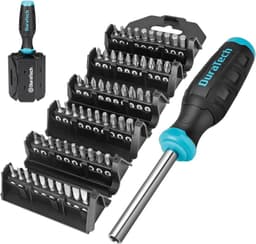
Duratech at £14.99, 4.6 from 629 reviews, prints PZ0 to PZ3. That is the clearest Pozidriv list in the twelve. The extending Jorest at £9.99 prints PZ1 and PZ2. Amazon Basics, 4.4 from 8,987 reviews, lists slotted, Phillips, Torx and hex, and a UK review says the missing Pozidriv is the flaw. The Stanley six-way at £7.66 is Phillips and slotted only, plus two nut drivers. Sharden names Pozidriv, and UK reviews inside 4.4 from 2,082 ratings say square drive arrived instead. The Jorest precision kit is small electronics tips, with no Pozidriv. Stanley’s stubby names Pozidriv without printing PZ1 or PZ2. Start from a listing that prints the size, then check the bits against a screw you trust.

Common questions

How do I see which screw I have?
Count the marks. Four extra ticks at 45 degrees mean Pozidriv. No ticks means Phillips. Wipe the head and use a light, because paint or a previous slip hides them. Packaging may say Pozidrive or Pozi. If you can only see a mashed circle, stop. Another guess will make it worse.
Can I use PH2 on a Pozidriv screw just this once?
You can make it turn, and you can ruin it. A Phillips tip enters with play, then cams out and shears the ticks. UK guides call a light turn a last resort and still warn of damage. For a hinge you want to reuse, change to a PZ bit that fills the head.
Can I use PZ2 on a Phillips screw?
No. The Pozidriv tip sits proud in a plain Phillips recess, because the flanks do not match, and force rounds the cross. Keep a PH2 for plain crosses, including many drywall screws, and a PZ2 for ticked heads. One driver will not honestly cover both.
What does PZ2 mean?
PZ is the Pozidriv form. The 2 is the size, finer than PZ3 and coarser than PZ1. It is what most cupboard screws need, not a promise that every cross is PZ2. Match the ticks first, then the largest PZ tip that sits fully in the recess.
Is it spelled Pozidrive?
Often, on UK packets, yes. Pozi is the short form. Pozidriv is the spelling used here and on the ISO form PZ. The ticks decide, not the vowel. If a listing says Pozidrive PZ2, still check that the bits in the case carry that stamp.
What about Supadriv?
Some UK sellers say a Pozidriv driver will turn a Supadriv screw. Treat that as seller practice, not a test here. If the head is a standard ticked Pozidriv, use PZ. If it matches neither cross you know, do not force a PH2.
Which drivers in this comparison actually include Pozidriv?
Duratech prints PZ0 to PZ3. The extending Jorest prints PZ1 and PZ2. Amazon Basics and the Stanley six-way do not print Pozidriv. Sharden names it, and UK reviews say square drive arrived. The precision kit is for electronics, not cabinet Pozidriv. Read the stamp in the case.

Related pages

Sources

Public sources listed below. Shelf prices and star lines for the twelve listings are the amazon.co.uk figures in the saved listings from 19 October 2026, not a fresh check on 22 October 2026.

  1. Electricity at Work Regulations 1989, regulation 14 (retrieved 22 October 2026)
  2. HSE GS38, electrical test equipment for use on low voltage systems (retrieved 22 October 2026)
  3. HSE INDG291, providing and using work equipment safely (retrieved 22 October 2026)
  4. GOV.UK, General Product Safety Regulations 2005 (retrieved 22 October 2026)
  5. ISO 8764-1:2004, screwdriver tips for cross-recessed screws (retrieved 22 October 2026)
  6. IEC 60900:2018, live working hand tools (retrieved 22 October 2026)
  7. BSI, BS 2559:1994 specification for screwdrivers (retrieved 22 October 2026)
  8. PB Swiss Tools, Phillips and Pozidriv explained (retrieved 22 October 2026)