Independent comparisons. We may earn from shop links. More info

Insulated screwdriver 1000V

Updated: 22 October 2026

You have seen 1000 V printed on a screwdriver set and you are wondering whether that makes it acceptable to open the consumer unit while the circuit is still live. It does not. An insulated screwdriver 1000V claim is a statement about the handle and the blade, and only when the tool actually carries the right mark. It is not permission. Dead working is the normal job in a UK home. The row itself is on the [screwdriver comparison](/hub/hand-tools/screwdriver). Peter F. wrote this on 22 October 2026 from legislation.gov.uk, HSE guidance, and the amazon.co.uk listing in this file. It is not a live-work method. A qualifying purchase can earn a commission at no extra cost to you.

You have seen 1000 V printed on a screwdriver set and you are wondering whether that makes it acceptable to open the consumer unit while the circuit is still live. It does not.

Our top picks

On this page

Dead working is the normal job

Make the circuit dead and prove it dead before a screwdriver touches a conductor. Regulation 14 bars work on or near a live conductor unless three conditions are all met: it is unreasonable for it to be dead, it is reasonable to work live, and suitable precautions are in place. An insulated handle does not satisfy those tests by itself. GS38 says few circumstances justify live work. HSG85 says inconvenience rarely justifies it. A screwdriver is not the proving-dead meter. Regulation 13 says dead equipment must not be re-energised if that would put people in danger. The regulation 14 text is marked for England, Wales and Scotland. If you cannot decide the three conditions, do not open the board.

1000 V next to a double triangle is the mark

IEC 60900:2018 covers insulated hand tools for work on or near live parts up to 1 000 V AC and 1 500 V DC, for skilled users. The buyer-facing check is a mark you can see: a double triangle, symbol IEC 60417-5216, with 1000 V beside it. A numeral only in the product title is not that symbol. VDE and VDE-GS are German test marks, not a UK statute. A tool can meet IEC 60900 without those letters, so a missing VDE logo is not automatically illegal. GS is a different German product-safety mark, not the double triangle and not British electrical law. Absence of both the standard and the double triangle is what you should refuse to guess through. The duty on the legislation.gov.uk text we used is still regulation 14.

This comparison’s 1000 V set does not show that mark

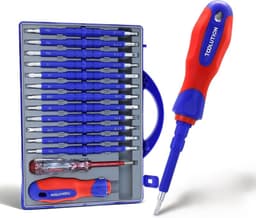
The only insulated claim here is the TOOLUTION TL142 at £27.90. The bullets rate each blade to 1000 V and do not name IEC 60900, VDE, GS or a double triangle. The line is 3.8 from eight reviews, and the written texts are from the United States. Pieces falling out of the case is a storage fault, not a standard. A tester in the lid does not prove the blades. The cross tips are called Phillips, not Pozidriv, which is the wrong tip for a typical UK wood screw. If you need a marked tool, you need the symbol on the steel after the circuit has been made dead.

A kitchen hinge does not need any of this

UK mains are 230 V. A 1000 V figure is an insulation rating, not a lower risk because 230 is smaller. Flat-pack, a hinge, a battery cover and a drawer runner do not call for that driver. Recess, size, reach and magnet are on the screwdriver buying guide. A soft handle is not IEC 60900. Do not take the TOOLUTION set into a consumer unit because the title says 1000 V. If a fitting sparks, smells, or will not reset, that is an electrician's visit. The point where a rounded head means you stop is on how to use a screwdriver. Leave the board closed unless you already know how to prove that circuit dead. The wardrobe driver is a Pozidriv size, not a voltage rating.

Common questions

Does 1000 V on the box mean I can work live?
No. Regulation 14 requires three things together before work on or near a live conductor: it is unreasonable for it to be dead, it is reasonable to work live, and suitable precautions are in place. An insulated screwdriver is at most one precaution. HSE guidance treats live work as rarely justified. Make the circuit dead and prove it dead, or leave the job.
What is the double triangle?
It is the mark, symbol IEC 60417-5216, that BS EN IEC 60900 tools carry next to the voltage figure, commonly 1000 V. IEC 60900:2018 covers insulated hand tools up to 1 000 V AC and 1 500 V DC for skilled users. A numeral only in a product title is not that symbol.
Is VDE British law?
No. VDE and VDE-GS are marks from the VDE test institute, not a clause in the Electricity at Work Regulations. A tool can meet IEC 60900 without those letters. Regulation 14 is the duty this page describes for England, Wales and Scotland. A VDE logo does not by itself authorise live work.
What is GS?
GS is a German product-safety mark. It is not the IEC 60900 double triangle, and it is not a UK electrical approval. Seeing GS, or not seeing it, does not answer whether a screwdriver is insulated to the standard. Look for the double triangle and 1000 V on the tool.
Does a voltage tester in the case prove the blades?
No. The TOOLUTION listing includes a tester and still does not name IEC 60900 or VDE. A tester in the box is not a certificate for the blades, and it is not the proving-dead instrument GS38 describes. A screwdriver, magnetic or not, is not that detector.
Is the TOOLUTION set in this comparison certified?
The file does not show certification. The bullets claim insulation up to 1000 V and do not name IEC 60900, VDE, GS or a double triangle. The listing is 3.8 from eight reviews, and the written texts are from the United States. Do not buy it as a certified live-work set.
What should I do before I touch a consumer unit?
If you are not competent to make the circuit dead and prove it dead, do not take the cover off. Regulation 14's three conditions are an electrician's judgement, not a shopping decision. A 1000 V title does not shorten those steps. For a hinge in the kitchen, you do not need this page at all.

Related pages

Sources

Public sources listed below. Shelf prices and star lines for the twelve listings are the amazon.co.uk figures in the saved listings from 19 October 2026, not a fresh check on 22 October 2026.

  1. Electricity at Work Regulations 1989, regulation 14 (retrieved 22 October 2026)
  2. HSE GS38, electrical test equipment for use on low voltage systems (retrieved 22 October 2026)
  3. HSE INDG291, providing and using work equipment safely (retrieved 22 October 2026)
  4. GOV.UK, General Product Safety Regulations 2005 (retrieved 22 October 2026)
  5. ISO 8764-1:2004, screwdriver tips for cross-recessed screws (retrieved 22 October 2026)
  6. IEC 60900:2018, live working hand tools (retrieved 22 October 2026)
  7. BSI, BS 2559:1994 specification for screwdrivers (retrieved 22 October 2026)
  8. PB Swiss Tools, Phillips and Pozidriv explained (retrieved 22 October 2026)