Independent comparisons. We may earn from shop links. More info

How to use a screwdriver

Updated: 22 October 2026

The screw in the hinge was fine until the driver climbed out and left a bright, rounded cross. You are about to try again, and the next slip will finish the head. This page is how to use a screwdriver so the tip stays seated: match the recess, choose the largest tip that fills it, push along the screw, and stop the moment the driver rises. Prices and which box to buy stay on the [screwdriver comparison](/hub/hand-tools/screwdriver). Peter F. wrote this on 22 October 2026 from those listings and from UK guidance by Accu, Axminster, Toolstation and the Health and Safety Executive. A qualifying purchase can earn a commission at no extra cost to you.

The screw in the hinge was fine until the driver climbed out and left a bright, rounded cross. You are about to try again, and the next slip will finish the head.

Our top picks

On this page

Clockwise tightens, if the tip actually fits

Clockwise tightens a normal right-hand screw. Anticlockwise undoes it. Direction does nothing if the tip is the wrong shape. Four ticks beside the cross mean Pozidriv. A plain cross means Phillips. A slotted screw needs a flat blade that fills the slot. The largest tip that seats fully is the one to use. Press the tip in and look. Daylight around the flanks means step up a size or change family. A screw already started with the wrong bit often cams out on the second turn. Stop and swap. A polished edge is a blunt tool. If you are unsure of the direction, a quarter-turn each way with the tip seated tells you before you lean. The ticks are on Phillips vs Pozidriv.

Push in line, then turn

Cam-out is the tip climbing out under torque. Accu’s order is right size and type, steady pressure, stay perpendicular, and stop when the tip rises. Seat the bit until it stops, keep your wrist on the screw’s axis, and push before you twist. On a small chipboard screw the push is firm and the turn is slow. Phillips flanks taper and push the driver out as torque rises. Pozidriv’s parallel flanks reduce that climb only when the tip matches. If the tip rises, stop. More speed will not seat it. An extra half-turn on a hinge strips the pilot in chipboard. Hold a long driver shorter, or use a stubby, so the force stays in line. The number on the tip is on the screwdriver buying guide.

Two mechanisms in this comparison change the undo

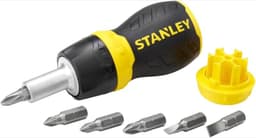
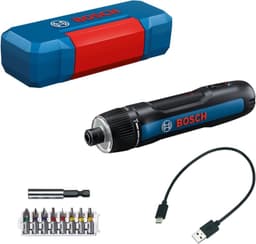
On the Stanley stubby, 0-66-358, UK reviews say the storage cap loosens when you undo a screw and the bits fall out. Hold the cap, or pick a driver that does not store bits behind that thread. Pushing harder does not keep them in. The Stanley six-way has a bolster the listing says will take a spanner. That helps a seized nut and snaps a small screw in chipboard. Use it only when the fitting is stronger than the screw. There is no ratchet, so you reset your hand each swing. The Bosch GO 3 has seven torque settings and no newton-metre figures. UK reviews say it stalls and is wrong for tiny screws. A numbered clutch is not a torque wrench. Finish a screw that matters by hand, and check the rotation before the bit touches the head.

A shiny, round recess is the moment you stop

If the cross is still visible, Toolstation’s guide treats a wide elastic band as a first friction trick: lay it over the head, seat the largest tip that still fits, and turn slowly anticlockwise. Once the recess is a smooth dish, stop. This page is not a drill guide. If the rounded screw holds a door or anything structural, a joiner is the next call. Do not open a consumer unit, a boiler casing or a gas fitting to try the driver. Prove the circuit dead, or leave it. Do not pry a swollen battery. HSE asbestos essentials sheet A27 treats screws through old textured coatings as an asbestos task. If you suspect that coating, stop. This page will not list removal steps. The same limit applies to a pre-2000 artex-style ceiling.

Common questions

Which way do I turn a screw?
Clockwise tightens a normal right-hand screw. Anticlockwise undoes it. A quarter-turn each way, with the tip fully seated, shows the direction before you lean on a long handle. If it will not move, the tip is probably wrong. More force is how the cross becomes round.
How hard do I push?
Push along the screw hard enough that the tip cannot climb, then turn slowly. On a flat-pack screw that is a firm push, not your full weight. Stop as soon as the tip rises. If you slip at a light turn, the size or the family is wrong. Pressure will not turn a PH2 into a PZ2.
How do I know the bit is the right size?
It is the largest tip of the right family that sits fully in the recess, with little daylight around the flanks. Ticks mean Pozidriv. A plain cross means Phillips. If the bit looks polished, retire it. A worn edge is the wrong size even when the number matches.
What if it starts to rise out of the head?
Stop. Reseat the tip, check the family and the largest size that fits, and turn by hand. Do not speed up. Pozidriv still cams out if the tip is small, worn, or a Phillips bit in a ticked screw. If the corners are gone, stop rather than drilling.
Why does my stubby lose its bits when I undo a screw?
On the Stanley stubby here, UK reviews say the storage cap unscrews anticlockwise, the same way as the undo, and the bits fall out. Hold the cap, or use a driver that does not store bits behind that thread. Pushing harder does not fix a cap.
Can I put a spanner on the Stanley bolster?
The listing says the bolster can take a wrench, which helps a nut the screw can survive. On a small hinge screw the same leverage snaps the head or rips the insert from chipboard. Do not add a spanner until the fitting is the stronger part. The six-way does not ratchet.
When do I stop and call someone?
Stop when the head is a smooth dish, when the screw holds a structure you cannot lose, or when the fitting is a consumer unit, boiler or gas case. Stop if you suspect asbestos in a textured coating, and do not sand or drill it. An elastic band is only for a cross you can still see.

Related pages

Sources

Public sources listed below. Shelf prices and star lines for the twelve listings are the amazon.co.uk figures in the saved listings from 19 October 2026, not a fresh check on 22 October 2026.

  1. Electricity at Work Regulations 1989, regulation 14 (retrieved 22 October 2026)
  2. HSE GS38, electrical test equipment for use on low voltage systems (retrieved 22 October 2026)
  3. HSE INDG291, providing and using work equipment safely (retrieved 22 October 2026)
  4. GOV.UK, General Product Safety Regulations 2005 (retrieved 22 October 2026)
  5. ISO 8764-1:2004, screwdriver tips for cross-recessed screws (retrieved 22 October 2026)
  6. IEC 60900:2018, live working hand tools (retrieved 22 October 2026)
  7. BSI, BS 2559:1994 specification for screwdrivers (retrieved 22 October 2026)
  8. PB Swiss Tools, Phillips and Pozidriv explained (retrieved 22 October 2026)