Independent comparisons. We may earn from shop links. More info

How to use a ratchet: set the lever before you pull

Updated: 24 October 2026

The handle is in your hand and the nut is on a car, a bike or a piece of furniture. What usually goes wrong is the direction lever, which is not the same way round on every brand, or a tube on the grip that loads the pawl until it skips. Test the lever, seat the socket, pull, and stop when the click means the mechanism is giving up. The seven listings are on the [ratchet comparison](/hub/hand-tools/ratchet). Peter F. wrote this on 22 October 2026 from UK retail steps and the Health and Safety Executive's vehicle-support guidance. There was no filmed strip-down. A qualifying purchase can earn a commission at no extra cost to you.

The handle is in your hand and the nut is on a car, a bike or a piece of furniture.

Our top picks

On this page

Set the lever before the socket is on the car

Right-hand threads, most fasteners on a UK car, tighten clockwise and undo anticlockwise when you look at the bolt from the end you are turning. That rule is about the fastener, not about which side of the head the lever sits on. UK forum owners found Britool-style and King Tony levers working opposite ways. RS Components simply says set the head, then pull. Before the socket goes near the car, fit it on the square, hold the socket, and try both directions. One way the handle should drive. The other way it should click back and leave the socket still. One DAYUAN review calls the lever stiff. If it will not select either direction, stop. A Shall buyer returned the smallest ratchet because it only clicked one way. That is a faulty tool, not a technique.

Seat it and pull

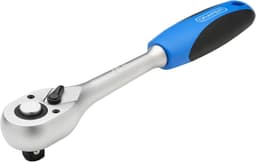
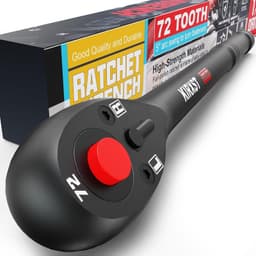
Put the socket fully onto the square and do not lift it off on the return stroke. The handle swings back, the pawl clicks, and the socket stays on the nut. The quick-release button takes the socket off. The spring ball keeps it there. A socket that drops every time is a fault. One KIRXST review says the square does not hold the fitting tightly enough. The Draper names the ball as well as the button. Use the button only to release. Pull smoothly on a fastener that is already willing to move. A breaker bar, which has no pawl, cracks a seized nut. On a wheel nut that has not moved, fetch the breaker. A short swing on an awkward caliper bolt is a tooth-count limit, on the 72 vs 90 tooth ratchet page. If there is no button, as on HOYETO, ease the socket off by hand.

When the click means stop

A working return click keeps the socket still while the handle comes back. A bad click is the handle moving and the nut not moving, in the direction that should have driven it. On a modest pull, with no tube on the grip, stop. Forcing it grinds the pawl and rounds the bolt. Do not add a pipe. The tube multiplies the load past the pawl. It is still how these handles get wrecked. A flex head is a worse place to hang a tube, because the hinge takes the load as well. That limit is on the flex head ratchet page. The 150 Newton metre row on the US PRO, and the 160 Nm line on the HOYETO, are not a click-type torque wrench.

Oil, a skip, and the car overhead

Oil is a light touch. Sealey's sheet, for its own kits, marks pawls L and R. If you cannot reassemble the head, leave it closed. At work, the Provision and Use of Work Equipment Regulations are why a skipping handle comes out of service. At home, a skip on day one, with no pipe and no hammer, is a Consumer Rights Act 2015 point: satisfactory quality. A skip after a cheater pipe is a weak complaint. Under the car, axle stands rated for the car are the support, and a trolley jack only lifts. Get a professional if you lack the torque figure, the car is unsupported, or the bolt is rounding.

Common questions

Which way do I push the lever?
Whichever way makes the socket turn in the direction you want, tested in your hand before the socket is on the car. Clockwise tightens a normal right-hand thread when you look at the head of the fastener. The lever only selects the pawl. Britool-style handles and King Tony handles in UK forums work opposite ways, so there is no single left-for-tight rule.
How do I get the socket off?
Press the quick-release button and pull the socket off the square. The button is for release. The spring ball is what held it on. If the socket falls off without the button, the square is not holding, which one KIRXST review in this comparison already reports. If the listing states no button, ease the socket off by hand.
The handle clicks but the nut does not move. What now?
Check the lever with the hand test, then check you are not lifting the socket off on the return. If the driving direction still clicks and the nut is still seized, stop. That click is the pawl giving up. Use a breaker bar to crack it, then come back to the ratchet to run the thread.
Can I put a tube on the handle?
No. A tube skips the pawl by adding leverage the mechanism was not asked to take. Use a breaker bar, which has no pawl, for the first movement. The ratchet runs the fastener after that. A flex head is an even worse place to hang a tube, because the hinge takes the load as well.
When is a skip a faulty tool rather than misuse?
A skip on day one, on a normal pull, with no tube and no hammer, is a fault to raise with the seller. Satisfactory quality is the Consumer Rights Act point at home. A skip after a cheater pipe is misuse. At work, take a skipping handle out of service rather than keeping it in the van for emergencies.

Related pages

Sources

Public UK sources and the Draper 16429 maker page, checked on 22 October 2026.

  1. ISO 3315:2018, hand ratchet driving parts (retrieved 22.10.2026)
  2. ISO 1174-1:2011, hand driving squares (retrieved 22.10.2026)
  3. HSE, PUWER overview (retrieved 22.10.2026)
  4. HSE, motor vehicle repair: support the vehicle (retrieved 22.10.2026)
  5. GOV.UK, General Product Safety Regulations 2005 (retrieved 22.10.2026)
  6. Consumer Rights Act 2015, sections 19 and 23 (retrieved 22.10.2026)
  7. Draper 16429, 1/2 inch ratchet (retrieved 22.10.2026)
  8. Citizens Advice, return faulty goods (retrieved 22.10.2026)