Independent comparisons. We may earn from shop links. More info

Ratchet buying guide: square before the tooth count

Updated: 24 October 2026

A 90-tooth badge and a flex head both look like upgrades until you check the square. This ratchet buying guide puts the decision in the order that saves the return: the square that fits the sockets you already own, then the swing you can actually make, then the head. Brand and price sit on the [ratchet comparison](/hub/hand-tools/ratchet), which keeps seven amazon.co.uk listings. Peter F. wrote this on 22 October 2026 from those listings and the UK review texts filed with them. There was no lab test. A qualifying purchase can earn a commission at no extra cost to you.

A 90-tooth badge and a flex head both look like upgrades until you check the square.

Our top picks

On this page

What you are buying

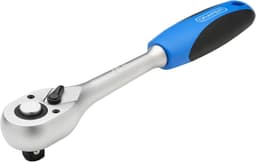
A square-drive ratchet is a handle. The square pushes a socket, an extension or a universal joint, and the pawl lets you swing back without lifting the socket off the fastener. It is not a socket set. Shall and DAYUAN are three handles. Only the HOYETO kit names nine metric sockets. A flare nut wants a spanner, not a square. It is not a torque wrench either. Torque in the Draper 16429 title is not a Newton-metre setting. A breaker bar has no pawl and takes the first crack. The ratchet runs the fastener once it is moving. ISO 1174-1 names the squares as 6.3, 10 and 12.5 mm, while UK shelves still say 1/4, 3/8 and 1/2 inch. Draper's page says the 16429 is generally in accordance with DIN 3122 and ISO 3315. That sentence is not printed on the other six listings.

Which drive size

Buy the square that matches the fastener and the sockets you already own. A finer tooth count does not change it. A 90-tooth 1/4 inch handle will still not undo a hub nut. Haynes' UK notes are a rule of thumb: about 12 mm on 1/4 inch, about 8–17 mm on 3/8 inch, and wheel bolts on 1/2 inch. If you own nothing and the car is the job, start with 3/8 inch and add 1/2 inch. If you already own 1/2 inch sockets, buy a 1/2 inch handle. US PRO, Draper and KIRXST are 1/2 inch only. Shall and DAYUAN are three handles with no socket rail. HOYETO includes 14 mm to 27 mm and skips 10 mm and 13 mm. An adaptor between squares is an extra joint.

Teeth, the button and the handle

Seventy-two teeth is a 5 degree swing and 90 teeth is a 4 degree swing, because 360 divided by the tooth count is the arc. That one degree is not a strength grade. When the handle hits a bulkhead after a short swing, use the 72 vs 90 tooth ratchet page. Shall's bullet says 4 degrees. KIRXST's 72-tooth bullet says 5 degrees. DAYUAN prints 72 teeth and no degree figure. Quick release takes the socket off. The spring ball holds it on. One KIRXST review says the square does not hold the fitting. The Draper prints 26 cm, KIRXST prints 280 mm, and US PRO prints no length. A pipe on the grip loads the pawl. A flex head reaches a bolt with no straight pull, and it is the wrong place to crack a seized nut. That limit is the flex head ratchet page.

What to leave for the comparison

Once the square, the swing and the head are chosen, price is a comparison. These listings run from the US PRO at £10.88 to HOYETO at £49.99, on amazon.co.uk figures from 22 October 2026. Halfords lists an Advanced 1/2 inch handle near £27.50. That does not make £10.88 a weak tool. No impact standard is printed on these listings. Shall's non-sparking row is a catalogue field, not a certificate for petrol vapour. If you own 1/2 inch sockets and want the largest UK sample, the top pick is the Draper at £12.79, 4.7 from 665, and it is still only a handle. The best value is the US PRO at £10.88. Three squares means Shall or DAYUAN.

Common questions

Do I buy 1/4, 3/8 or 1/2 inch first?
If the car is the job and you own nothing yet, 3/8 inch covers a lot of metric DIY fasteners, and you will still want 1/2 inch before wheel bolts. If you already own a rail of sockets, buy the handle that matches that square. Haynes' ranges, about 12 mm on 1/4 inch and about 8–17 mm on 3/8 inch, are a rule of thumb for modern metric cars.
If I own sockets, what must match?
The square on the handle must match the square in the socket. Drive size is the first check, ahead of tooth count, colour and whether the grip is soft. An adaptor can join two sizes, and it adds a joint. In this comparison, US PRO, Draper and KIRXST are 1/2 inch handles only, so they do not drive a 1/4 inch rail unless you meant to change size.
Is 72 teeth enough to start?
Yes, when you can swing the handle through more than a few degrees. Seventy-two teeth is a 5 degree arc and 90 teeth is 4 degrees. That one degree matters when the handle hits a bulkhead. It does not make a 1/4 inch square into a wheel-nut tool, and it is not a published strength ranking of these seven listings.
Do I need a quick-release button?
You need a square that keeps the socket on while you turn the drive over. The button is how you get the socket off at the end. A spring ball that does not hold is a fault. One KIRXST review in this comparison describes that fault. Most of the other handles here name a quick release, and HOYETO does not state one.
Does chrome molybdenum mean I can use an impact gun?
No. The steel name on a hand-ratchet listing is not an impact rating. These listings do not print an impact standard. Crack a seized nut with a breaker bar, run it with the ratchet, and keep chrome hand sockets off an impact gun.

Related pages

Sources

Public UK sources and the Draper 16429 maker page, checked on 22 October 2026.

  1. ISO 3315:2018, hand ratchet driving parts (retrieved 22.10.2026)
  2. ISO 1174-1:2011, hand driving squares (retrieved 22.10.2026)
  3. HSE, PUWER overview (retrieved 22.10.2026)
  4. HSE, motor vehicle repair: support the vehicle (retrieved 22.10.2026)
  5. GOV.UK, General Product Safety Regulations 2005 (retrieved 22.10.2026)
  6. Consumer Rights Act 2015, sections 19 and 23 (retrieved 22.10.2026)
  7. Draper 16429, 1/2 inch ratchet (retrieved 22.10.2026)
  8. Citizens Advice, return faulty goods (retrieved 22.10.2026)