Independent comparisons. We may earn from shop links. More info

Flex head ratchet: reach an angle, spare the hinge

Updated: 24 October 2026

The bolt is in sight and the handle is not. A flex head ratchet puts a hinge in the head so the grip can sit off the line of the fastener. It does not make the pawl stronger, and it does not replace the breaker bar on a seized nut. The fixed handles live on the [ratchet comparison](/hub/hand-tools/ratchet). Peter F. wrote this on 22 October 2026 from that listing. These hinges were not loaded on a test bench. A qualifying purchase can earn a commission at no extra cost to you.

The bolt is in sight and the handle is not. A flex head ratchet puts a hinge in the head so the grip can sit off the line of the fastener.

Our top picks

On this page

What the hinge changes

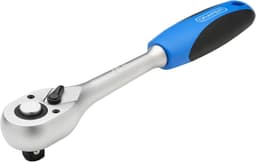
A fixed head wants the handle roughly in line with the pull. A flex head pivots, so the handle can lean while the socket stays on the bolt. The pawl still advances by its own arc. Seventy-two teeth on a flex head is still a 5 degree click. If the limit is a short swing in a straight line, that is the 72 vs 90 tooth ratchet page. If there is no straight line, the hinge is the point. A 26 cm fixed handle, the length on the Draper, can draw its arc through a pipe. Pivot the head and the same handle can lie flatter and still turn. The hinge is where the load concentrates. A UK note on flexi ratchet spanners says the hinge should not take a fixed head's load, and that note did not rank these handles. Use a flex head when the socket fits and you have no straight pull. Use a fixed 1/2 inch when you are leaning on the fastener and the handle has room. Use a breaker bar when the nut will not move. A pipe on a flex head loads the pawl and the hinge together. That ban is on the how to use a ratchet page.

Locking heads, flop, and the listing we have

Flex can mean a free pivot or a locking head. A free pivot flops until load or friction holds it. A lock is a stated feature. Milwaukee's UK page describes a lockable 3/8 inch flex head with a free mode. That tool is not in this comparison. The flex listing here is PRIDE&CRAFT, at £39.99: 1/4, 3/8 and 1/2 inch, plus a 3/8 inch stubby, an EVA organiser and no sockets. The bullet says 180 degrees, 72 teeth, a 5 degree arc and quick release. It does not say the head locks. One hundred and eighty degrees is the claimed travel, not a British Standard. Five UK texts sit against 5.0 from nine reviews. One buyer says the heads do not flop. That is one person, not a lock specification. None of the five describes a broken pawl. Check on the bench that the head stays put on a modest fastener.

A stubby, and an offset bar that is not a hinge

The stubby is the short 3/8 inch handle for a bolt where even a pivoted full-length handle is too long. It is a poor lever. Do not crack a hub nut with it. The 29.5 cm and 1.8 kg figures are for the set, not the stubby. An offset bar is not a flex head. HOYETO, at £49.99, is a 430 mm offset wrench with nine sockets from 14 mm to 27 mm and a 160 Nm cap. There is no 180 degree pivot. The written reviews are American.

Where you still want a fixed head

Break a seized wheel nut on a breaker bar, or an impact with impact-rated sockets. The flex head comes in after the thread is moving, if the angle is why a fixed handle could not run it. Do not lean on that hinge because one review mentioned weight. The ordinary spend is a fixed head. The Draper 16429 at £12.79 is 26 cm, 72 teeth, 4.7 from 665, and it does not pivot. The US PRO at £10.88 has no printed length. Shall's end-style row says swivel and the head-style row says fixed square. Do not buy that £29.90 set as a flex head. Axle stands hold the car. The hinge does not.

Common questions

When is a flex head worth it?
When the socket is on the fastener and you cannot pull the handle in a straight line without hitting something. The hinge moves the grip off that line. It is a poor buy when you already have a clear swing, because a fixed head is simpler and, in this set, much more heavily reviewed. PRIDE&CRAFT is the only flex-head set among the seven listings.
Does it lock or does it flop?
The PRIDE&CRAFT bullet claims 180 degrees of flex and does not claim locking positions. One of five UK texts says the heads do not flop. That is not a lock specification. Milwaukee's UK flex ratchet describes locks and a free mode, and that tool is not in this comparison. If you need set positions, buy a listing that prints them.
Can I break a wheel nut with it?
No. Break a seized wheel nut with a breaker bar or a proper impact setup, then run the thread with a ratchet if you still need one. A flex head adds a hinge, which is the wrong place to take that first crack. A 3/8 inch stubby is a worse lever again.
What is a stubby flex head for?
Short reach where a full-length handle, even pivoted, is in the way. The PRIDE&CRAFT set includes one 3/8 inch stubby beside the three longer flex heads. Use it to run a fastener that is already loose. Do not use it as a miniature breaker.
Which listing in the comparison is actually flex?
Only the PRIDE&CRAFT four-piece at £39.99, 5.0 from nine ratings. Shall's swivel row is not a flex bullet. HOYETO is an offset extension. The other handles are fixed squares. Five UK texts are the written sample, and they do not describe a broken pawl.

Related pages

Sources

Public UK sources and the Draper 16429 maker page, checked on 22 October 2026.

  1. ISO 3315:2018, hand ratchet driving parts (retrieved 22.10.2026)
  2. ISO 1174-1:2011, hand driving squares (retrieved 22.10.2026)
  3. HSE, PUWER overview (retrieved 22.10.2026)
  4. HSE, motor vehicle repair: support the vehicle (retrieved 22.10.2026)
  5. GOV.UK, General Product Safety Regulations 2005 (retrieved 22.10.2026)
  6. Consumer Rights Act 2015, sections 19 and 23 (retrieved 22.10.2026)
  7. Draper 16429, 1/2 inch ratchet (retrieved 22.10.2026)
  8. Citizens Advice, return faulty goods (retrieved 22.10.2026)