Independent comparisons. We may earn from shop links. More info

How to use a paving hammer

Updated: 23 October 2026

The mallet is in your hand, the slab is on the mortar, and the next blow is either a tap that levels it or a crack along the arris. How to use a paving hammer is the minute before that blow: the bed has to be right, and the head must not move. This sequence is for the hand mallets on the [Paving hammer comparison](/hub/hand-tools/paving-hammer). It does not rank them. A qualifying purchase can earn us a commission at no extra cost to you. Peter F. used UK paving guides and saved reviews on 22 October 2026. We did not lay a patio.

The mallet is in your hand, the slab is on the mortar, and the next blow is either a tap that levels it or a crack along the arris.

Our top picks

OX OX Trade rubber mallet twin pack

Best overall

OX OX Trade rubber mallet twin pack
9.4/10about £12.49
S&R S&R rubber paving hammer 910 g

Alternative

S&R S&R rubber paving hammer 910 g
9.4/10about £20.97
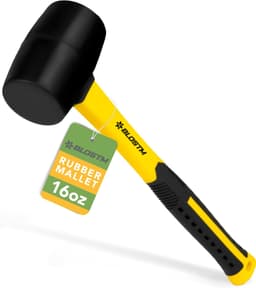
BLOSTM BLOSTM 16 oz rubber mallet

Best value

BLOSTM BLOSTM 16 oz rubber mallet
8.9/10about £10.49
On this page

Check the bed and the mallet first

Flags need a full mortar bed, not dots with a hollow in the middle. Pavingexpert puts that bed at about 25–40 mm. If the flag rocks onto a dab, another blow loads the arris. It does not fill the gap. Block paving is 25–40 mm of unbound grit sand with no cement. The mallet is not a compacting plate. BS 7533-102:2025 does not tell you how hard to swing. A head that shifts is a stop. One BOOSDEN review describes a cover coming off after a week of flags. If the mass is wrong, that choice is the paving hammer buying guide, not a harder swing.

Place the unit and tap it level

Set the flag on the full bed, then tap the face in from the arris with the palest face you have if the surface will be seen. S&R calls the white side trace-free and the black side the outdoor face. Work from a string line and a spirit level. When the flag meets the line, stop. On blocks, tap the unit into the sand until it sits with its neighbours. You are seating it, not driving it through the laying course. One permeable-bed example is about 7–10 mm, and that figure is not a target on every porcelain slab. Which face belongs on which slab is rubber mallet for paving slabs.

Blows that cause the damage

Spot bedding is the common failure. The flag spans a gap, you hit the middle, and the slab cracks or the corner lifts. The repair is a full bed and a new unit if the first one has gone. A steel hammer is the next way to lose an edge. Rubber spreads the blow. It does not make an unsupported slab safe. Tent pegs ruin a paving face. One BOOSDEN review says both heads were ruined after 40 to 50 medium pegs. After the slabs are down, put the paving mallet away and use a peg mallet for the guy lines. A white face cut up on pegs will mark the next sandstone slab.

When you put the mallet down

Fetch a plate compactor when a block drive needs the whole surface compacted. A hand mallet seats a unit. It does not replace the plate. Use a slab cutter when the flag is too big. Change tool when the unit is a thick concrete kerb or a heavy flag that will not move. That tool is a paving maul, about 6 kg, sold outside this amazon set. At work, PUWER 1998 treats the hammer as work equipment. A householder tapping a dozen flags is not that assessment. The mass comparison is paving hammer vs paving maul. Send the mallet back if the head comes off in the first jobs. The Consumer Rights Act 2015, section 9, includes durability.

Common questions

Do I hit the middle of the slab or the edge?
Tap the face in from the arris, on a slab that is already supported across its bed. Hitting the extreme edge is how a corner spalls. Hitting the middle of a spot-bedded flag is how the slab bridges a void and cracks. Once a spirit level and the string say the flag is down, further blows are wasted risk.
How do I know the bed is ready before I tap?
For flags, you want a full mortar bed, in the region of 25–40 mm in Pavingexpert’s account, and the priming step The Paving Experts describe, so the slab meets mortar rather than fresh air. For blocks, you want 25–40 mm of unbound grit sand and no cement. If the unit rocks onto a dab, the bed is not ready, and a heavier blow will not finish it.
Can I close a hollow under a flag by hitting harder?
No. A harder blow loads the slab across the gap. The hollow is missing mortar. Lift the flag, remake the bed as a full contact layer, and set it again. The mallet only levels a unit that already has support. That limit is the same whether the mallet is 16 oz or a Halder insert near 1.5 kg.
What do I do if the rubber head moves?
Stop. A head that twists on the handle, or a cover that has lifted, is finished for this job. One saved review describes a cover coming off during flag laying, and another describes a head coming adrift. Put the mallet down, seat the rest of the units with a sound tool, and take the failed one back to the seller. Do not tape it and carry on over porcelain.
When do I stop and use a plate compactor?
Use the plate when a block surface, especially a drive, needs compacting as a whole after the blocks are in place. The hand mallet has already done its job if each block sits level with its neighbours. A plate is the wrong tool to finish a single porcelain slab you are still tapping by hand, and a mallet is the wrong tool to compact a driveway.

Related pages

Sources

Sources from the research digest, last checked on 22 October 2026. Prices and review counts are the saved amazon.co.uk listings, not a fresh crawl.

  1. Pavingexpert, tools: maul and mallet (retrieved 22.10.2026)
  2. Pavingexpert, block laying course (retrieved 22.10.2026)
  3. Pavingexpert, full bed rather than spots (retrieved 22.10.2026)
  4. BS 7533-102:2025, pavement installation (retrieved 22.10.2026)
  5. Consumer Rights Act 2015, section 9 (retrieved 22.10.2026)
  6. GOV.UK, UKCA and CE marking (retrieved 22.10.2026)
  7. HSE, PUWER overview (retrieved 22.10.2026)
  8. HSE, assessing manual handling (retrieved 22.10.2026)