Rubber mallet for paving slabs
You are about to tap a sandstone flag, a porcelain slab, or a kerb edge, and you are worried the rubber will print a mark or knock a corner off. A rubber mallet for paving slabs is the right hand tool when the slab already has a full bed and you use the palest face. It is the wrong tool for a hollow, or for a concrete kerb that wants a maul. Listings and prices are on the [Paving hammer comparison](/hub/hand-tools/paving-hammer). A qualifying purchase can earn us a commission at no extra cost to you. Peter F. used saved amazon.co.uk listings on 22 October 2026. There was no mark test.
You are about to tap a sandstone flag, a porcelain slab, or a kerb edge, and you are worried the rubber will print a mark or knock a corner off.
You are about to tap a sandstone flag, a porcelain slab, or a kerb edge, and you are worried the rubber will print a mark or knock a corner off. A rubber mallet for paving slabs is the right hand tool when the slab already has a full bed and you use the palest face. It is the wrong tool for a hollow, or for a concrete kerb that wants a maul. Listings and prices are on the Paving hammer comparison. A qualifying purchase can earn us a commission at no extra cost to you. Peter F. used saved amazon.co.uk listings on 22 October 2026. There was no mark test.
Our top picks
| Badge | Product | Face on the slab | Mass | What the file says about slabs | Note | Price | Offer |
|---|---|---|---|---|---|---|---|
| Best overall |  OX OX Trade rubber mallet twin pack | Black; non-marking claimed | Title 32 oz / 900 g; item 950 g | Daily slabs and kerbs in a review | 9.4 | about £12.49 | View offer |
| Alternative |  S&R S&R rubber paving hammer 910 g | White side called trace-free | Head 910 g, 75 mm | Patio slabs named; reviews shared | 9.4 | about £20.97 | View offer |
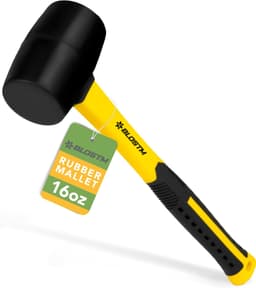
| Best value |  BLOSTM BLOSTM 16 oz rubber mallet | Leaves no marks claimed | 16 oz matches 453 g | A review beds sandstone slabs | 8.9 | about £10.49 | View offer |


On this page
The bed under the slab comes first
Black face, white face, nylon
What these listings were used on
Kerb edges and porcelain limits
Common questions
Will a rubber mallet mark new sandstone?
Which side of a black and white head should hit porcelain?
Can I bed slabs with the BLOSTM 16 oz or do I need the heavier S&R?
Is a nylon face kinder on a kerb edge than black rubber?
Why did a rubber cover come off while laying flags?
Will any mallet in this set bed a thick concrete kerb on its own?
Related pages
Sources
Sources from the research digest, last checked on 22 October 2026. Prices and review counts are the saved amazon.co.uk listings, not a fresh crawl.
- Pavingexpert, tools: maul and mallet (retrieved 22.10.2026)
- Pavingexpert, block laying course (retrieved 22.10.2026)
- Pavingexpert, full bed rather than spots (retrieved 22.10.2026)
- BS 7533-102:2025, pavement installation (retrieved 22.10.2026)
- Consumer Rights Act 2015, section 9 (retrieved 22.10.2026)
- GOV.UK, UKCA and CE marking (retrieved 22.10.2026)
- HSE, PUWER overview (retrieved 22.10.2026)
- HSE, assessing manual handling (retrieved 22.10.2026)