Independent comparisons. We may earn from shop links. More info

Hand joggler for sheet metal

Updated: 23 October 2026

You have a thin patch of mild steel and a listing that says 2-in-1 and car body. A hand joggler for sheet metal, also sold as a joddler, an edge setter or a panel flanging tool, steps the edge so a second piece can sit in a lap, then punches a hole for a plug weld. This page checks thickness, punch size, and the FreeTec colours that share one review pool. The [panel flanging tool comparison](/hub/hand-tools/panel-flanging-tool) ranks the nine amazon.co.uk rows. Prices are GBP as captured on 22 October 2026 by the Products Compared editorial team, which did not lab-test these pliers. A qualifying purchase can earn a commission at no extra cost to you.

You have a thin patch of mild steel and a listing that says 2-in-1 and car body.

Our top picks

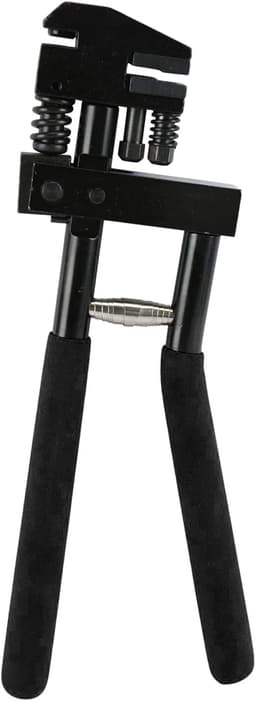
FreeTec FreeTec EL7750 black

Best overall

FreeTec FreeTec EL7750 black
8.6/10about £19.95
Nielsen Nielsen CT2288

Alternative

Nielsen Nielsen CT2288
6.4/10about £25.49
AB Tools AB Tools TE159

Best value

AB Tools AB Tools TE159
6.6/10about £20.27
On this page

What you are actually buying

A hand joggler for sheet metal is a plier, not a roller and not an air hammer. You squeeze the jaws along an edge and the die leaves a step, so the patch and the old panel overlap instead of meeting in an open butt. Turn the head and the same tool punches a hole in the upper sheet for a plug weld. A trim pry, a pipe-flange wedge or a plaster spatula can share the search and still be the wrong aisle. Entry prices in the nine run from £19.95 to £20.79. The mid band is £25.49 to £32.60. DSD’s DS1240 at £22.50 including VAT states up to 0.8 mm. ASTA’s S-JF51P is £23.50. Frost’s TAMA at £78.99 still states mild steel up to about 1 mm. A higher shelf price does not buy a structural flanger. If the panel is bonded, high-strength or structural, stop before you sort by stars. A long edge is a different purchase on the hand joggler vs air flanger page.

Thickness the listings print, and thickness reviewers argue about

UK trade pages cluster around mild steel of about 0.8–1.2 mm, and that band is a sales claim until scrap or a review says otherwise. ASTA’s page says both up to 19 gauge (1 mm) and 17–19 gauge, with a 13 mm fold depth, an 11 mm width and a 22 mm throat. Those figures belong to that ASTA tool. None of the nine amazon.co.uk files states a step depth or a throat, so do not copy them onto a FreeTec, a Nielsen or a Veyera row. FreeTec EL7750 and both Veyera rows print ceilings: aluminium around 1.6 mm, iron around 1.3 mm, titanium around 1.1 mm, and stainless under 0.8 mm. Treat those lines as the listing, not as a test. Veyera GSS56, 3.0 from two reviews at £19.99, left a mark and two lines on 1 mm steel. Nielsen CT2288, 3.8 from 88 at £25.49, has one review that flanged 1.2 mm in several passes and others that say the step will not form on 1 mm. Hole charts stay on the 5 mm plug weld hole page.
FreeTec FreeTec EL7750 black

Testsieger

FreeTec FreeTec EL7750 black
8.6/10about £19.95

Punch size and the three FreeTec colours

Eight of the nine listings state a 5 mm punch. That is the hole in the upper sheet of a lap, not every maker’s plug-weld specification. AB Tools AN053 (B01N6900LS), at £29.99, says 5 mm in the title and 7 mm in the details and in the half-turn bullet. Both figures stay in the file. They are not the same hole. FreeTec black (B0GDF3J4GB), blue (B0F3X6R225) and red (B07KSQL1XL) are model EL7750 at £19.95, with the same rank and the same review text: 4.2 from 307. Count that pool once. The red file also prints a cutting width of 22 cm beside the shared 5 mm punch. Colour is a finish, not a second sample. Veyera GDS210 at £32.60 has no star line, and its image matches GSS56 while the part numbers differ. micblaco, at £20.79 with 2.5 from three reviews, sheared for one UK buyer after about ten holes in 0.8 mm sheet. Two texts are not a failure rate.

When this page’s answer is not this tool

Stay with a hand joggler when the edge is short, the sheet is thin mild steel, and you can waste an offcut of the same thickness. Leave the class when hand reviews already describe giving up on a long run. A roller such as the Sykes-Pickavant Rolastep, stated around 0.5–1.2 mm, is a different mechanism. An air punch needs a compressor, and often a hammer, before you have a flange. Weekly bodyshop work points at air, or at hand tools around £55–£79, such as CJ Autos at £66 including VAT. Those prices are context, not rows, and they still talk about sheet around 1 mm. The Health and Safety Executive expects welding fume, including mild steel, to be controlled on the weld that follows. The plier does not weld. If you cannot control fume, or the manual specifies a joint you cannot make, call a body shop.

Common questions

Is a joggler the same as a panel flanging tool?
On these UK listings, yes. Joggler, joddler, edge setter and panel flanging tool are names for a hand plier that steps thin sheet and, with the head turned, punches a hole. The comparison is that class only. A roller flanger and an air tool do a related job with a different drive, and they are not rows in the nine. A trim tool or a pipe wedge remains a different aisle, even when the search results mix them in.
What thickness of mild steel is a hand joggler sold for?
Trade pages in this research cluster around 0.8–1.2 mm, depending on the model. DSD states up to 0.8 mm. ASTA states up to 1 mm and also 17–19 gauge on the same page. Frost’s dearer TAMA still states about 1 mm. Inside the amazon.co.uk set, some rows print higher ceilings for aluminium, iron, titanium and stainless, and UK reviews often stop near 1 mm mild steel. Buy the figure you can check on scrap, not the highest number in a bullet.
Why do three FreeTec listings show 307 reviews?
Black, blue and red are model EL7750 at £19.95, with the same rank and the same review wording. The 4.2 from 307 is one pool. Opening all three pages does not give you 921 opinions. The comparison treats the black row as the single copy of that evidence. The red page adds a 22 cm cutting-width line that the shared bullets do not use as the punch size.
Is the punch always 5 mm?
Eight listings state 5 mm. AN053 states 5 mm in the title and 7 mm in the details and in a bullet, and the file does not choose between them. A 5 mm punch is also not a repair specification for every panel. Thicker mild steel on one maker’s chart uses a larger hole, and that chart is not UK law. Read the punch line on the exact ASIN you open.
Can the listing’s stainless and titanium lines be treated as tested?
No. FreeTec and Veyera print those ceilings. The UK review texts used here talk about mild steel, and one GSS56 review failed to move about 1.5 mm steel and only marked 1 mm. A printed ceiling is the seller’s limit, not a result from this comparison. If you work stainless, this set does not show that the jaw will step it.

Related pages

Sources

Sources from the research digest, last checked on 22 October 2026.

  1. HSE, mild steel welding fume (retrieved 22.10.2026)
  2. HSE, protect your workers from welding fume (retrieved 22.10.2026)
  3. HSE WL3, coatings off before welding (retrieved 22.10.2026)
  4. HSE, PUWER overview (retrieved 22.10.2026)
  5. Consumer Rights Act 2015, section 22 (retrieved 22.10.2026)
  6. ASTA S-JF51P panel flanging tool (retrieved 22.10.2026)
  7. Frost, joggler with hole punch (retrieved 22.10.2026)
  8. Club 80-90, general joggler notes (retrieved 22.10.2026)