Independent comparisons. We may earn from shop links. More info

One-handed clamp vs screw clamp

Updated: 23 October 2026

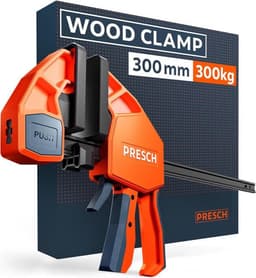
The mitre is still open and the trigger has stopped clicking. That is the one-handed clamp vs screw clamp decision: speed while you position the work, against a screw that keeps adding pressure after a ratchet has given up. The [one-handed clamp comparison](/hub/hand-tools/one-handed-clamp) lists the triggers in this set, mostly light bars claiming about 63–68 kg, plus a Presch single that claims 300 kg. How to seat a trigger is on the [how to use](/hub/hand-tools/one-handed-clamp/sub/one-handed-clamp-how-to-use) page. Which opening to buy is on the [buying guide](/hub/hand-tools/one-handed-clamp/sub/one-handed-clamp-buying-guide).

The mitre is still open and the trigger has stopped clicking.

Our top picks

On this page

When the one-handed clamp is the better tool

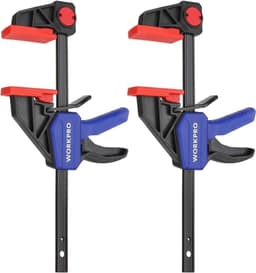
A one-handed clamp earns its place when your other hand is busy. You are offering a shelf to a bracket, holding a fence while the drill starts, or keeping two pieces that already meet from drifting while glue grabs. UK Workshop users describe that job as offering the work up, then reaching for F clamps once it is in place. Jorgensen at £29.99 is four 150 mm clamps with a claimed join to 400 mm. The £12.99 WORKPRO pair states a 285 mm spreader. IRWIN’s £14.90 twin is a 300 mm mini at 63 kg, with no spreader. If the faces already touch, the trigger is the right tool. If you are still pulling them together, it is not.

When the screw clamp is the better tool

A screw clamp, an F clamp or a sash cramp wins when the timber is proud of the joint and you need pressure after the last ratchet tooth. A bowed board, a tabletop seam, or a frame that has to be drawn square will stall a 68 kg trigger while the gap is still there. The handle clicks and the jaw does not advance. More muscle on that handle twists the pad and can chew the bar. SIIIXS reviews describe a jaw that slips under load and cuts a spot that will not hold again. Put the trigger on to keep the pieces offered up. Fit the screw clamp or the sash cramp to close the joint. You should not expect triggers alone to flatten a panel. None of these listings ratchets and then screws.

What the kilogram claims do not settle

Printed kilograms are claims, and they do not turn a trigger into a sash cramp. uk.my-best.com uses about 60–70 kg for triggers and about 100–300 kg for screw clamps. Those are round numbers, not a test of Jorgensen or WORKPRO. IRWIN’s mini states 63 kg and the WORKPRO and Jorgensen bars state 68 kg. Presch states 300 kg at £42.99, with three short UK texts under a count of 65. That is still a quick-release bar, not a sash cramp. Use the trigger when the joint already fits. Use the screw when you are forcing timber into line. Updated 22 October 2026 from these amazon.co.uk listings. We did not measure either class of clamp. A qualifying purchase through our links can earn a commission at no extra cost to you.

Common questions

When is a one-handed clamp the right tool?
Use it when you are alone and one hand must stay on the work. Holding a fence, a shelf end, or two pieces that already meet is the job the light bars in this set are bought for. It is the wrong moment if you are still closing a gap. Speed is the advantage only while the joint is already fitted.
When does a glue-up need a screw clamp?
A glue-up needs a screw clamp or a sash cramp when the joint is open, the board is bowed, or the panel is wide enough that a 68 kg ratchet stalls. Triggers can pin the pieces while you fit the screw clamps. If the handle clicks and the jaw does not move, that trigger is finished.
Can I pull a bowed board flat with a trigger?
Not reliably. A bowed board needs pressure after the ratchet’s last tooth, which is what a screw provides. The light claims here, 63 kg and 68 kg, sit in the holding band UK guides give ordinary triggers. Presch’s 300 kg line is a higher claim, not proof you can straighten stock.
Is 300 kg on one listing the same class as a sash cramp?
No. Presch prints 300 kg, a 300 mm opening and a 90 mm throat. A sash cramp is a long screw clamp for panels, and this set does not include one. The 300 kg figure was not measured against a sash cramp or against the 68 kg bars. Treat it as a listing claim on a fast clamp.
Why do workshop users own both?
They use triggers to offer work up quickly, often one-handed, and F clamps or a sash cramp when the joint needs more pressure. Owning both matches the tools, not a brand contest. If you already have F clamps, a pair of light triggers is still useful when your second hand is on the timber.
Do I still buy triggers if I already own F clamps?
Yes, if you work alone and you spend time holding pieces in place before the screw clamp goes on. A £12.99 WORKPRO pair or the Jorgensen four-pack covers that positioning. You do not need another trigger to replace a sash cramp you already trust.
What fails if I only own a cheap ratchet?
The failure in this set is a jaw that will not stay locked. SIIIXS UK reviews describe slip, a bar chewed by the jaw, and packs in which most clamps would not hold. If a new clamp will not lock, the Consumer Rights Act 2015 is the route for a refund.

Related pages

Sources

Public UK sources from the research digest. Shelf prices and star lines are the amazon.co.uk figures in those comparison sources, not a live re-price.

  1. HSE, PUWER overview (retrieved 22 October 2026)
  2. HSE L114, safe use of woodworking machinery (retrieved 22 October 2026)
  3. Consumer Rights Act 2015, section 22 (retrieved 22 October 2026)
  4. GOV.UK, refunds for faulty or misdescribed goods (retrieved 22 October 2026)
  5. Spear & Jackson, Eclipse one-handed bar clamps (retrieved 22 October 2026)
  6. Bessey UK, EZS30-8 one-handed clamp (retrieved 22 October 2026)
  7. IRWIN workholding brochure (retrieved 22 October 2026)
  8. UK Workshop, one-handed clamps thread (retrieved 22 October 2026)