Independent comparisons. We may earn from shop links. More info

How to use a one-handed clamp

Updated: 23 October 2026

This is how to use a one-handed clamp from this amazon.co.uk set without denting the face or trusting a ratchet that already slips. The [one-handed clamp comparison](/hub/hand-tools/one-handed-clamp) is the table if you have not chosen a bar. Pushing is on the [bar clamp spreader](/hub/hand-tools/one-handed-clamp/sub/one-handed-clamp-spreader) page. If the joint still needs pressure after the last click, read [one-handed clamp vs screw clamp](/hub/hand-tools/one-handed-clamp/sub/one-handed-clamp-vs-screw-clamp). For 150 mm or 300 mm, use the [buying guide](/hub/hand-tools/one-handed-clamp/sub/one-handed-clamp-buying-guide).

This is how to use a one-handed clamp from this amazon.co.uk set without denting the face or trusting a ratchet that already slips.

Our top picks

On this page

Set the clamp before you squeeze

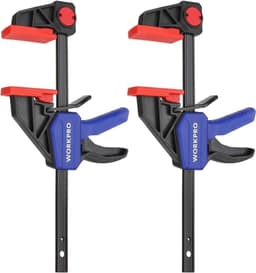
Support the work so the clamp is not the only thing stopping a fall. Open the jaw wider than the timber plus any packing. On a 150 mm WORKPRO or Jorgensen bar that travel is short. On the IRWIN mini or the 305 mm WORKPRO you have more room, and you still should not start with the pads jammed. Seat both pads flat. WORKPRO reviews say the pads come loose. If a pad is gone, fit a scrap of plywood as a caul. Keep the clamp square so one corner does not dig in. A 60 mm throat only reaches the edge of a wide panel. Presch’s 90 mm throat reaches further, and it is still one clamp. Support the work, open the jaw, squeeze, check the pads, then release.

Squeeze, check, and stop

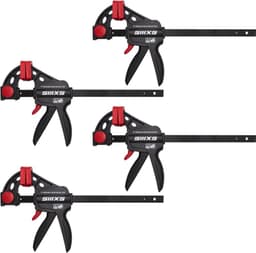
Squeeze in steps. Bring the jaw up until it touches, look along the joint, then add clicks until the piece does not move under a fingertip. That holds a shelf while you drill, or keeps a fitted glue line from drifting. It will not pull a bowed board flat. If more clicks do nothing, stop. Leaning on a failed ratchet is how a bar gets chewed. SIIIXS UK reviews show that failure. The jaw slips, cuts a spot in the bar, and that spot will not hold. Take that clamp off the work. Do not use these clamps as a hold-down on a spindle moulder or a saw bench. A stair or a structural lining is a joiner’s job. If the joint is still open, fit a screw clamp.

Release and look after the pads

Support the timber, then press the release so the jaw walks back instead of jumping off. Push a loose pad back before you hang the clamp up. WORKPRO reviews lost pads and picked up rust in a damp shed. If you need to push, follow that listing’s own method, and do not invent a wingnut step for a button clamp. Updated 22 October 2026 from the amazon.co.uk listings. We did not stand at your bench. A qualifying purchase through our links can earn a commission at no extra cost to you.

Common questions

What order do I set a trigger clamp in?
Support the work, open the jaw past the timber and any caul, seat both pads flat, then squeeze until the piece no longer shifts under a light push. Sight the joint before you drill or leave wet glue. Release only when the timber is supported. Ignore any torque number that is not on your own listing.
How do I avoid denting or staining the wood?
Put a caul, a scrap of plywood or hardboard, between the pad and a show face. Soft pads still mark if they are cocked or missing. A UK Workshop thread on other clamps fixed oily marks with a barrier. Do not treat that stain as a finding against WORKPRO or IRWIN. If the pad has fallen off, do not clamp bare metal onto finished timber.
How tight is tight enough?
Tight enough means the work does not move while you drill, screw, or wait on a glue line you have already closed. Add clicks until that happens, then stop. A trigger adds nothing after the last tooth. If the jaw will not advance, you are at the limit or the ratchet has failed.
What do I do if the pad is missing?
Stop, refit the pad, or put a caul across the jaw so the casting does not bite. WORKPRO reviews say pads come loose and are hard to replace, so a spare scrap in the box is the practical fix. One hard jaw will dent an edge. If both pads are gone, leave that clamp until you can pad it.
Why might it let go while I saw?
A ratchet that walks back lets go when the timber vibrates. SIIIXS reviews describe that slip, including a jaw that chews a groove and then will not hold there. Push the work before you start the saw, and stand so a released piece cannot fall on you. One Roughneck note of a 6 inch clamp holding is one report, not a promise.
When do I add a screw clamp?
Add a screw clamp or a sash cramp when the joint is still open after the trigger stops clicking, or when you are pulling a bow out of a board. The one-handed clamp can hold the pieces while you fit the screw clamp. It should not be the only pressure on a wide glue-up.
Where should I not use it, and how do I stop rust?
Do not use it as a machine hold-down, or on a stair or a structural opening. Those jobs need proper equipment and a joiner, not a light DIY bar. Store the bar dry. WORKPRO reviews link rust to a damp garage, particularly near the coast. If the bar is bent, or the jaw has cut a groove, retire that clamp.

Related pages

Sources

Public UK sources from the research digest. Shelf prices and star lines are the amazon.co.uk figures in those comparison sources, not a live re-price.

  1. HSE, PUWER overview (retrieved 22 October 2026)
  2. HSE L114, safe use of woodworking machinery (retrieved 22 October 2026)
  3. Consumer Rights Act 2015, section 22 (retrieved 22 October 2026)
  4. GOV.UK, refunds for faulty or misdescribed goods (retrieved 22 October 2026)
  5. Spear & Jackson, Eclipse one-handed bar clamps (retrieved 22 October 2026)
  6. Bessey UK, EZS30-8 one-handed clamp (retrieved 22 October 2026)
  7. IRWIN workholding brochure (retrieved 22 October 2026)
  8. UK Workshop, one-handed clamps thread (retrieved 22 October 2026)