Independent comparisons. We may earn from shop links. More info

How to use a club hammer

Updated: 23 October 2026

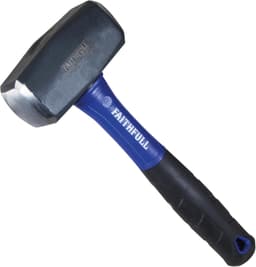
You have a bolster or a cold chisel and a short, heavy hammer, and the usual job is a brick you want to split on a line rather than shatter. Stop if the head moves, mark every face, support the brick on something that can give, then strike the chisel with the face of the hammer. The weight band for this work is about 2.5 lb to 3 lb. DIY Doctor suggests a club or small lump around 3 lb. The [Lump hammer comparison](/hub/hand-tools/lump-hammer) is the product table. Products Compared did not run a lab test. A qualifying purchase through our amazon.co.uk links can earn us a commission at no extra cost to you.

You have a bolster or a cold chisel and a short, heavy hammer, and the usual job is a brick you want to split on a line rather than shatter.

Our top picks

On this page

Set the hammer up before you swing

Put eye protection on before the first blow. HSE treats flying fragments as an eye hazard, and BuildWiz points at an EN 166 mark. INDG229 says to reject a split, broken, or loose shaft and a chipped head. Hold the head and twist. If it clicks or rocks, that hammer is finished for the day. One WORKPRO review says a fibreglass hammer broke within three hours. That is one report, and it is enough to look at the joint. Grind or replace a cold chisel whose head has mushroomed. Sealey’s sheet says do not hit with the cheek, and do not strike two hammer faces together. The face meets the chisel.

How to stand and hold it

Stand so the chisel is below your chest, and hold the end of the handle, not up under the head. Handles that state a length here are already short, about 220 mm on the hickory Faithfull and about 310 mm on the WORKPRO bullets. Keep the chisel hand low and your eyes on the top of the chisel. Overhead chasing, a ladder, and anything near cables or pipes is where this description stops. A 2.5 lb head is manageable for a run of placed blows. If the hammer is twisting in your hand, stop and change the tool.
OX OX Trade 2.5 lb club hammer

Testsieger

OX OX Trade 2.5 lb club hammer
8.6/10about £12.00

Score the brick, then split it

Mark the cut on every face. A brick scored on one side breaks toward the unscored arris. DIY Doctor’s sequence is to increase the blows only after the line has started. Support the brick on sand or earth, not on concrete, then one firm blow. A concrete path reflects the blow and sends chips back at your glasses. The scoring passes cut a groove. When the groove runs right round, one firmer blow with the face square splits a common brick. If it does not, score again. On dense engineering brick, expect more passes. Keep the bolster upright.

When to put the hammer down

Stop when the head moves, when the handle cracks, or when the chisel mushrooms faster than you will grind it. Stop when the cut is overhead, beside a cable, a pipe, or a flue, or when the piece is a slab. A club hammer will chip a paving slab and will not break it cleanly. Stop when the opening is load-bearing. A garden wall, a single brick, or a stake is what this method is for. Do not tape a loose head and carry on.

Common questions

How do I cut a brick with a bolster?
Mark the line on all four long faces, rest the brick on sand or earth, and score a groove with the bolster and a club hammer around 2.5 lb to 3 lb. Increase the blows only once the line is visible. When the groove runs right round, one firmer blow splits a common brick. If it cracks off the line, you hit too hard too early, or the brick was on a hard slab. Score a fresh brick rather than chasing a wild break.
How hard should I hit?
Hard enough to mark, then hard enough to split, in that order. DIY Doctor’s point is to start gentler so the brick does not shatter off the line. A 4 lb hammer tempts you to skip the scoring. If dust is not appearing in the groove, you are too light. If the brick is jumping off the sand, you are too heavy for this pass. The last blow is one firm strike, not a wind-up from the shoulder.
Where do I hold the hammer?
At the end of the handle, with the chisel hand kept low and your eyes on the chisel head. Holding up by the head shortens the tool until you are punching. Lengths stated in this set are already short, about 220 mm on the hickory Faithfull and about 310 mm on the WORKPRO bullets. If the grip is slick, dry it. Do not tape over a crack.
Do I need safety glasses?
Yes. Brick and chisel chips leave the cut faster than you can blink, and HSE treats that kind of projectile as an eye hazard. Ordinary spectacles are not a substitute. BuildWiz points at an EN 166 mark. Wear eye protection for the scoring blows as well as the split. Gloves do not replace glasses.
What if the chisel head is mushroomed?
Stop and grind the mushroom off, or replace the chisel, before you strike it again. INDG229 flags a mushroomed cold chisel because the curled edge sheds splinters. Do not blue the steel on a grindstone. If you cannot dress the head, that chisel is out of the job. Hitting a mushroom to knock it off is how the splinter happens.
When should a builder take over?
When the wall carries load, when you are opening for a door or a window, when the work is overhead or next to services, or when you are trying to break a slab rather than a brick. Also when the hammer head already moves. If you do not know whether a wall is structural, ask before you score. Replacing one common brick in a garden wall is still a job you can finish with the method above.

Related pages

Sources

Sources from the research digest, last checked on 22 October 2026.

  1. BS 876:1995, specification for hand hammers (retrieved 22.10.2026)
  2. InterDIY, hammers buyer's guide (retrieved 22.10.2026)
  3. Screwfix, hammer buying guide (retrieved 22.10.2026)
  4. BuildWiz, club hammer (retrieved 22.10.2026)
  5. HSE, INDG229 Using work equipment safely (retrieved 22.10.2026)
  6. HSE, using the right type of PPE (retrieved 22.10.2026)
  7. PUWER 1998, regulation 4 (retrieved 22.10.2026)
  8. Consumer Rights Act 2015, section 9 (retrieved 22.10.2026)
  9. DIY Doctor, using a brick bolster (retrieved 22.10.2026)
  10. CMT, club hammers with a hickory handle (retrieved 22.10.2026)
  11. Sealey, hammer instructions (retrieved 22.10.2026)