2.5 lb or 4 lb club hammer
You are choosing between the usual general club hammer and the heavy head, and the heavier one feels as if it will finish the brick in fewer blows. It will, until your arm drops and the bolster walks off the line. A 2.5 lb or 4 lb club hammer is that trade: control against mass. In this amazon.co.uk snapshot of 22 October 2026 the two clear examples are the OX Trade at 2.5 lb and the Faithfull FAIFG4 at 4 lb. Both are fibreglass. The [Lump hammer comparison](/hub/hand-tools/lump-hammer) lists every kept hammer. Products Compared did not lab-test either head. A qualifying purchase through our links can earn us a commission at no extra cost to you.
You are choosing between the usual general club hammer and the heavy head, and the heavier one feels as if it will finish the brick in fewer blows. It will, until your arm drops and the bolster walks off the line.
You are choosing between the usual general club hammer and the heavy head, and the heavier one feels as if it will finish the brick in fewer blows. It will, until your arm drops and the bolster walks off the line. A 2.5 lb or 4 lb club hammer is that trade: control against mass. In this amazon.co.uk snapshot of 22 October 2026 the two clear examples are the OX Trade at 2.5 lb and the Faithfull FAIFG4 at 4 lb. Both are fibreglass. The Lump hammer comparison lists every kept hammer. Products Compared did not lab-test either head. A qualifying purchase through our links can earn us a commission at no extra cost to you.
Our top picks
| Badge | Product | Head weight | Item-weight row | Handle | Note | Price | Offer |
|---|---|---|---|---|---|---|---|
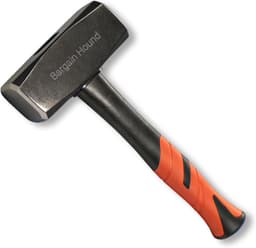
| Best overall |  Bargain Hound Bargain Hound 3 lb lump hammer | 3 lb / 1,385 g | 1.28 kg | Rubber, fibreglass | 7.1 | about £8.99 | View offer |
 OX OX Trade 2.5 lb club hammer | 2.5 lb / 1.1 kg | 133 g, ignore it | Fibreglass, 25.7 cm | 8.6 | about £12.00 | View offer | |
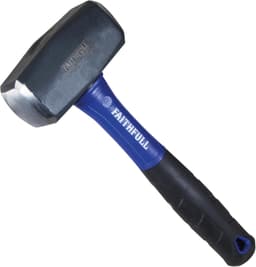
| Best value |  Faithfull Faithfull FAIFG4 4 lb club hammer | 4 lb / 1.8 kg | 1.97 kg | Fibreglass | 8.4 | about £8.99 | View offer |

On this page
What the two weights are for
The 2.5 lb OX in this set
The 4 lb Faithfull in this set
Which to buy
Common questions
Is 2.5 lb enough to cut a brick?
When is 4 lb the right head?
Will a 4 lb hammer hurt my wrist?
Is the OX actually 2.5 lb if the item weight says 133 g?
Is the Faithfull 4 lb really 4 lb if the item weight is 1.97 kg?
When do I need a sledge instead?
Related pages
Sources
Sources from the research digest, last checked on 22 October 2026.
- BS 876:1995, specification for hand hammers (retrieved 22.10.2026)
- InterDIY, hammers buyer's guide (retrieved 22.10.2026)
- Screwfix, hammer buying guide (retrieved 22.10.2026)
- BuildWiz, club hammer (retrieved 22.10.2026)
- HSE, INDG229 Using work equipment safely (retrieved 22.10.2026)
- HSE, using the right type of PPE (retrieved 22.10.2026)
- PUWER 1998, regulation 4 (retrieved 22.10.2026)
- Consumer Rights Act 2015, section 9 (retrieved 22.10.2026)
- DIY Doctor, using a brick bolster (retrieved 22.10.2026)
- CMT, club hammers with a hickory handle (retrieved 22.10.2026)
- Sealey, hammer instructions (retrieved 22.10.2026)