How to remove silicone sealant and leave the joint dry
You already have a scraper, or you are about to use one, on a cured bead that has split or gone mouldy along a sink, a worktop or a frame. How to remove silicone sealant is an order of work: cut and peel the bulk, clear the film, dry the joint, then gun and tool once before the skin forms. The [joint scraper comparison](/hub/hand-tools/joint-scraper) is only for choosing the edge. This page does not rank stars. Peter F. is following UK maker sheets, not a lab trial of your joint. A qualifying purchase can earn us a commission at no extra cost to you.
You already have a scraper, or you are about to use one, on a cured bead that has split or gone mouldy along a sink, a worktop or a frame.
You already have a scraper, or you are about to use one, on a cured bead that has split or gone mouldy along a sink, a worktop or a frame. How to remove silicone sealant is an order of work: cut and peel the bulk, clear the film, dry the joint, then gun and tool once before the skin forms. The joint scraper comparison is only for choosing the edge. This page does not rank stars. Peter F. is following UK maker sheets, not a lab trial of your joint. A qualifying purchase can earn us a commission at no extra cost to you.
Our top picks
| Badge | Product | Metal removal edge | Profiling pads | Handle | Note | Price | Offer |
|---|---|---|---|---|---|---|---|
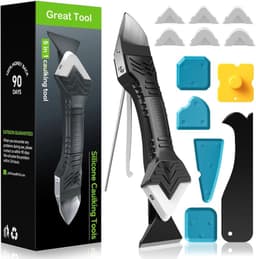
| Best overall |  ORHOMELIFE ORHOMELIFE 4-in-1 sealant kit | Stainless steel scraper | 4 multi-angle silicone tools | Full silicone wrap, detachable head | 6.9 | about £16.99 | View offer |
 ORHOMELIFE ORHOMELIFE 5-in-1 caulk kit | Stainless steel scraper | 6 (3R, 6R, 10R, 13R, 15R, 17R) | Plastic, push-pull pad button | 8.9 | about £11.89 | View offer | |
| Best value |  Lookka Lookka 3-in-1 caulk set | Stainless head | 5 silicone pads | n/a | 8.4 | about £7.45 | View offer |


On this page
Cut the bead, then peel it
The film, and the remover that is a separate product
Dry the joint before the gun
One tooling pass
Common questions
In what order do I remove a cured silicone bead?
Should I push the scraper or pull it?
Why is a thin film still there after the bead comes off?
Can I seal over the old silicone?
Do I tool the new bead with a finger or a tool?
How long do I have before the skin forms?
What solvent should I avoid in a bathroom?
Related pages
Sources
Public UK sources listed below, last checked in October 2026. Shelf prices and star lines are the amazon.co.uk figures used on this page.
- Screwfix — How to remove silicone sealant (retrieved October 2026)
- Homebuilding — Specialist tool trial for silicone and caulk (retrieved October 2026)
- Bostik UK — S31 sanitary sealant technical data sheet (retrieved October 2026)
- illbruck UK — Wet rooms and bathrooms, the fillet (retrieved October 2026)
- HSE — DCM2, dichloromethane in bathrooms (retrieved October 2026)
- HSE — INDG463, silica dust and the workplace limit (retrieved October 2026)
- Soudal UK — Sealing around a bath (retrieved October 2026)
- legislation.gov.uk — Consumer Rights Act 2015, section 22 (retrieved October 2026)