Independent comparisons. We may earn from shop links. More info

Grout rake or silicone tool: which joint you actually have

Updated: 23 October 2026

A basket that mixes a 22-piece saw set with a silicone profiling kit is two jobs, not a preference. A grout rake or silicone tool follows the joint. Cement grout is hard and sandy, and it powders. A silicone bead peels or smears. If the joint moves when the bath fills, you are on the sealant pages. A grid of tile joints needs a rake. The [joint scraper comparison](/hub/hand-tools/joint-scraper) lists both because the search does. They are not rivals. Peter F. scored listings, not a dust sample. A qualifying purchase can earn us a commission at no extra cost to you.

A basket that mixes a 22-piece saw set with a silicone profiling kit is two jobs, not a preference. A grout rake or silicone tool follows the joint. Cement grout is hard and sandy, and it powders.

Our top picks

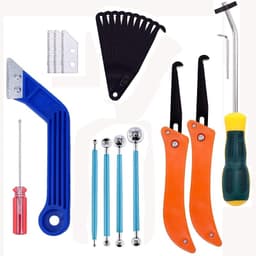
NkHui NkHui 22-piece grout rake

Alternative

NkHui NkHui 22-piece grout rake
5.5/10about £12.99
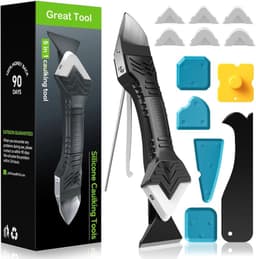
Lookka Lookka 3-in-1 caulk set

Best value

Lookka Lookka 3-in-1 caulk set
8.4/10about £7.45
On this page

Two materials, two tools

Cement grout feels gritty and does not stretch. A silicone bead gives, and a nick pulls into a strip. A title that names both does not make a tungsten saw safe on a bead, or a profiling pad able to cut sound cement. A carbide or tungsten rake is for a small cement joint. A sealant kit is a cutter and pads. Chemical gel is for sealant residue, not mortar.

What the 22-piece set is for

The only grout row is NkHui at £12.99, with 4.1 from four reviews and a score of 55. It claims gaps of 1–3 mm, a tungsten scraper and 1 mm saws. The box lists a screwdriver, ball tools, twelve saws, one scraper and four angled saws. Weight prints 400 g and 120 g. Both stay as printed. Pads are not stated. The only written review says the grout stayed. The 1 mm figure is saw thickness. The 1–3 mm figure is claimed joint width. Neither is rake depth.

What a sealant kit will not do

The other six listings are sealant kits from £7.45 to £19.99. A silicone pad will not cut sound cement. A tungsten saw tears a bead and can mark acrylic. NkHui sits last in the sealant score because it has no pads and four reviews. Last there is not a verdict on every rake in the UK. Match the tool to the material in the joint.

Dust on a small hand job

For a small area, Toolstation’s guide is about 2–3 mm of grout removed so the new grout has a key, then vacuum the joint. That depth is not the 1–3 mm joint claim or the 1 mm saw. Lay sheets and wear eye protection. Powered mortar raking is the HSE silica task in INDG463, at 0.1 mg/m³ over 8 hours. If the patch is a whole room, or you have no extraction, stop.

Common questions

How do I tell cement grout from a silicone bead?
Cement grout is the hard, sandy fill in a grid of tile joints, and it powders when you rake it. A silicone bead is flexible, usually at a bath, tray, sink or worktop, and it peels or smears. If the joint moves when the bath is filled, treat it as sealant. If you can see the same hard line around every tile, treat it as grout. Colour alone is a weak test, because both can look grey.
Will a silicone profiling kit rake out hard grout?
No. The six sealant kits are cutters and pads for a bead. A pad does not cut sound cement, even when a retail title mentions grout in the same breath as silicone. You will skim the surface and leave the joint full. Use a carbide or tungsten rake for a small cement patch, and keep that rake off a silicone bead and off acrylic.
Will the NkHui set smooth a new silicone bead?
No. Profiling pads are not stated. The box is a screwdriver, ball tools, saws, a tungsten scraper and angled saws, at £12.99. A caulking edge in the title is not a radius pad. It will not tool a 4–5 mm fillet. Four reviews, one of which says the grout would not come out, are not a reason to try it as a finisher.
What does 1–3 mm on that listing mean?
NkHui claims tile gaps of 1–3 mm. The saws are described as 1 mm blades. Those are a joint width and a blade thickness. Toolstation’s hand-rake depth for a small area is about 2–3 mm of grout removed so the new grout can bond. Do not collapse the three numbers into one. If your joints are wider than the listing claims, this set may be the wrong width even when the material is cement.
How deep should a hand rake go?
For a small area, Toolstation’s guide is about 2–3 mm, raked back and forth, so the fresh grout has a key. That is not an instruction to chase the joint out to the board on a whole wall. Vacuum or brush the dust out before you regrout. If you cannot hold that depth without a power tool, the patch is no longer a hand job.
What dust control does a small hand job need?
Lay sheets, vacuum or brush the joint as you work, and wear eye protection. A hand rake still makes cement dust. The 0.1 mg/m³ limit over 8 hours in INDG463 applies to powered chasing and mortar raking. Do not dry-brush a bathroom and assume the air is clear.
When is a power grout tool the wrong DIY?
When the area is really a whole room, or when you have no on-tool extraction. HSE describes powered raking as a high-dust task for grinders and chasers, not as a weekend method to improvise. Stop and call someone. The same stop applies if the joint has failed twice or you are no longer sure the fill is cement. This page does not set up a multitool.
Which of the other six listings is a grout rake?
None. From £7.45 to £19.99 they are sealant kits with pads or silicone tips. NkHui is the only grout saw set in the table. A high score on a pad kit does not make it a rake. Match the tool to the material in the joint.

Related pages

Sources

Public UK sources listed below, last checked in October 2026. Shelf prices and star lines are the amazon.co.uk figures used on this page.

  1. Screwfix — How to remove silicone sealant (retrieved October 2026)
  2. Homebuilding — Specialist tool trial for silicone and caulk (retrieved October 2026)
  3. Bostik UK — S31 sanitary sealant technical data sheet (retrieved October 2026)
  4. illbruck UK — Wet rooms and bathrooms, the fillet (retrieved October 2026)
  5. HSE — DCM2, dichloromethane in bathrooms (retrieved October 2026)
  6. HSE — INDG463, silica dust and the workplace limit (retrieved October 2026)
  7. Soudal UK — Sealing around a bath (retrieved October 2026)
  8. legislation.gov.uk — Consumer Rights Act 2015, section 22 (retrieved October 2026)