Independent comparisons. We may earn from shop links. More info

How to use an electric nail file

Updated: 23 October 2026

You have a pen that can thin a nail plate, and you want to know how to use an electric nail file on your own nails. Start low for the job, keep the bit moving, and stop at heat, pain or broken skin. The stated maximum is headroom. The [electric file comparison](/hub/hand-tools/electric-file) lists the twelve pens. Gel bits are on the [electric nail file for gel polish removal](/hub/hand-tools/electric-file/sub/electric-file-gel-removal) page. Peter F. updated this on 22 October 2026. A qualifying purchase can earn us a commission at no extra cost to you.

You have a pen that can thin a nail plate, and you want to know how to use an electric nail file on your own nails. Start low for the job, keep the bit moving, and stop at heat, pain or broken skin.

Our top picks

POFIBO POFIBO upgraded cordless pen

Best overall

POFIBO POFIBO upgraded cordless pen
9.4/10about £22.99
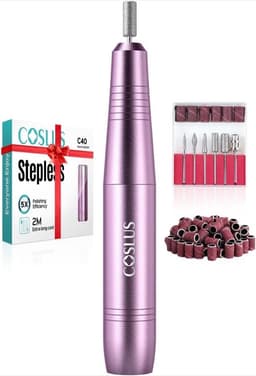
COSLUS COSLUS C40 at £9.98

Best value

COSLUS COSLUS C40 at £9.98
9.0/10about £9.98
MelodySusie MelodySusie PC120I

Alternative

MelodySusie MelodySusie PC120I
8.9/10about £8.29
On this page

Set the speed for the job, then stay under the maximum

Professional Beauty’s rule of thumb, a trade guide and not a test of these amazon.co.uk pens, runs in bands. A fine sanding band on the natural nail sits around 1,000–5,000 RPM. Thinner enhancements sit around 10,000–15,000 RPM, and bulk gel or acrylic around 15,000–35,000 RPM. Use the lower end of the band. A stated 20,000 RPM maximum is headroom. Parking the dial at that maximum on a bare nail is the mistake the bands are written to prevent.

Light contact, keep moving, lift off

Hold the handpiece so the bit stays parallel to the plate, and keep it moving. PBL Magazine treats a parked bit as the way heat builds. Lift off when the nail feels warm. Dwelling near the cuticle is how a smooth plate becomes a groove. A sanding band refines and can lift thin product. A carbide shaves bulk, and Women’s Health UK describes carbide on the natural plate as the usual route to a ring of fire. Keep carbide off a bare nail. If the bit drags, change a clogged band before you lean on it. If the chuck will not hold the bit that came in the box, describe the fault rather than forcing it. Shank size is on the electric nail file buying guide.

Heat, a ring of fire, and the rest notes

Heat means stop for the day on that nail. A warm plate, a sting, or a white or pink ring means the bit has stayed too long or pressed too hard. Women’s Health UK describes a ring of fire as thinned, sensitive nail plate from incorrect e-file use. Nothing fills it back in. Keep the nail short and let it grow out. Do not buff the ring with the same drill. Only a few listings print a minute cap. The PC120I says rest after 20 minutes of continuous use. The Scamander, part SC320H, says no more than 20 minutes, and hard pressure can trip a protection stop. A saved COSLUS UK review says the nail burns after about 10 minutes. Other ASINs have no numbered cap, so this page does not invent one. A new faulty unit falls under the Consumer Rights Act 2015, section 22, normally within 30 days. Leave the housing closed.

Dust, infected nails, and when a professional takes over

The Health and Safety Executive says dust from filing artificial nails can cause wheezing, chest tightness and asthma. In a salon the control in guidance SR13 is local exhaust. At home, ventilate. If you file clients’ nails for pay, you are in that workplace guidance. A fungal toenail is a pharmacist job over months. The NHS describes antifungal treatment for 6–12 months. Filing can reduce bulk. It is not the cure. Keep separate bits for an infected nail. Do not self-file if the skin is hot or swollen, or if you have diabetes or poor feeling in your feet. See a professional when you have cut or lifted the nail, or when a ring of fire is already deep.

Common questions

What speed should you start at on your own nails?
Start at the low end of the band for what is on the nail, not at the printed maximum. Professional Beauty puts a fine sanding band on the natural nail around 1,000–5,000 RPM, thinner enhancements around 10,000–15,000 RPM, and bulk gel or acrylic around 15,000–35,000 RPM. A stated 20,000 RPM home pen has that range as headroom. If product vanishes under light contact, the speed is too high.
How hard should you press, and what if the bit drags?
Use light contact and keep the bit moving parallel to the plate. Extra pressure heats the nail when the speed is too low or the band is blunt. If the bit drags, stop, change the band, and resist leaning on it. A clogged band drags even at a sensible speed. Forcing a bit that does not sit in the chuck is a return, not a technique. Lift off as soon as the nail feels warm.
What is a ring of fire, and can you file it smooth?
A ring of fire is a thinned, sensitive nail plate from incorrect e-file use. Women’s Health UK links it to over-filing, often with a carbide on the natural nail. Nothing cures it. Keep the nail short, use cuticle oil, and let the plate grow out. Do not buff the ring with the same drill, and avoid further e-file work on a deep ring. Stop at the first heat, and keep carbide off the bare plate.
How long can you run a home pen before a rest?
Use the cap the listing prints. The PC120I says rest after 20 minutes of continuous use. The Scamander says no more than 20 minutes, and hard pressure can trip a protection stop. A COSLUS review describes heat at about 10 minutes, so treat warmth as the earlier stop when the bullet is silent. Other pens here have no numbered cap. Do not invent one, and do not run to the maximum because the barrel allows it.
When must you stop and see a professional?
Stop on the day if the nail is hot, painful, or shows a ring of fire, and do not file that ring smooth. See a professional if you have cut or lifted the nail, if the skin is infected, or if diabetes or poor feeling in the feet is part of the picture. A new pen that is dead or too hot to hold stays closed. The Consumer Rights Act 2015, section 22, is the short-term right to reject, normally within 30 days.

Related pages

Sources

Public UK sources are listed below. Shelf prices, stars and review counts are the amazon.co.uk figures captured on 19 October 2026. This page did not lab-test the electric files.

  1. HSE, COSHH and beauticians (retrieved 21 October 2026)
  2. HSE SR13, nail bars (retrieved 21 October 2026)
  3. GOV.UK, Electrical Equipment (Safety) Regulations 2016 (retrieved 21 October 2026)
  4. Consumer Rights Act 2015, section 22 (retrieved 21 October 2026)
  5. NHS, fungal nail infection (retrieved 21 October 2026)
  6. Professional Beauty, e-file speed and grit (retrieved 21 October 2026)
  7. PBL Magazine, e-file mastery (retrieved 21 October 2026)
  8. Which?, faulty goods (retrieved 21 October 2026)