Independent comparisons. We may earn from shop links. More info

How to use a bar clamp

Updated: 22 October 2026

You already have a one-handed bar clamp on the bench and glue in the joint. How to use a bar clamp is a short sequence: dry fit, pads or a scrap caul, jaw square, squeeze until the joint closes, then stop. The failures in the reviews are a lost pad, a dent from one more squeeze, and a rusty bar in a damp shed. This page does not rank the listings. The [clamp comparison](/hub/hand-tools/clamp) holds the prices and the sizes. Peter F. read those amazon.co.uk cards on 21 October 2026. We did not run a glue-up trial. A qualifying purchase through our links can earn us a commission at no extra cost to you.

You already have a one-handed bar clamp on the bench and glue in the joint. How to use a bar clamp is a short sequence: dry fit, pads or a scrap caul, jaw square, squeeze until the joint closes, then stop.

Our top picks

On this page

Set the clamp before you add force

Dry fit with no glue. If the joint will not close now, it will not close after you wet it, and a harder squeeze will bow the bar or bruise the face. Put the soft pad on if it is still on the jaw. If the pad is missing, or if the Amazon Basics pads are the hard polished plastic a UK review says can mark hardwood, put a scrap of plywood between the jaw and the work. Seat the fixed jaw, slide the moving jaw until it touches, and look along the bar. The jaw should meet the caul flat, not on a corner. Keep your fingers off the release while you are still positioning. If you are still choosing a length, opening and throat are on the bar clamp buying guide. A 150 mm clamp cannot grow to fit a wider stack once the glue is on.

Tighten until the joint closes, then stop

Wonkee Donkee’s note is the same shape of advice: protect the wood, bring the jaw up, tighten until firm, and stop before the wood splits or the bar bends. Squeeze until the joint is closed and a little glue shows along the line. More force after that mostly squeezes glue out and loads the bar. UK Workshop’s clamping-force thread says the kilogram on the packet is a maximum, not a target. The WORKPRO pairs state up to 68 kg and the IRWIN mini states 63 kg. You do not need to reach those numbers for a small PVA joint that already closed on the dry fit. If the face cups, or the bar starts to bow, ease off. Do not slip a pipe over the handle. Release with your fingers clear of the trigger, because the jaw can snap back. If a new clamp will not hold, the Consumer Rights Act 2015 gives a short-term right to reject goods that are not of satisfactory quality. When the panel stays open, that decision is on clamps for a wood glue-up.

Reverse the jaw only when the listing says you can

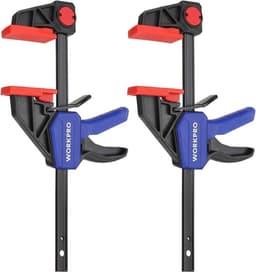
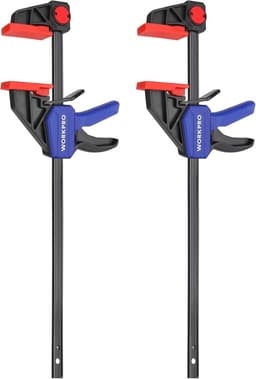
Some one-handed bars become spreaders. The jaw comes off the end of the bar, turns round, and clicks back on so the tool pushes instead of pulls. Wonkee Donkee describes a screw or a button on the fixed jaw. Follow the card you bought. The WORKPRO listings describe a reverse jaw: 285 mm on the 150 mm highlight, 440 mm on the 305 mm pair, and 200 mm and 270 mm on the four-piece set. The DEKO bullets say you reverse the jaw, with spread figures in inches. Press the release, slide the jaw off, turn it, and seat it until it clicks. Keep a pad on the face, and do not push past the stated spread. Do not reverse every clamp because one brand allows it. The IRWIN T54122EL7 bullets describe a trigger and soft pads. They do not describe a spreader. Leave that pair as a clamp. If you still need to buy a model that prints a spreader length, that skip list is on best clamps in this set. The 285 mm figure belongs to the 150 mm WORKPRO highlight. It is not a universal length.

Pads and rust are the failures reviewers name

Loose pads are the repeating complaint on the WORKPRO bars. On the NS juvyig screw clamps the pads or metal discs come off, sometimes on first use, and tape does not hold them. When a pad falls into the glue, stop and put a scrap caul on before you squeeze again. Keep spare pads in a tin if the set came with them. If the maker sells none, scrap wood is the honest substitute. A caul also stops a hard plastic pad printing a shine onto hardwood. Rust is storage, not a squeezing trick. One UK review of the WORKPRO bars says they rust if they live in an unheated shed, especially near the coast. Wipe glue off the bar before it sets, because cured PVA on the rail makes the jaw stick. Pony Jorgensen’s maintenance note, maker guidance for their own clamps and not a test of these ASINs, says wipe the glue and wax the bar. A dry hook in the house beats a damp shed. Do not oil the pads. Stop if the bar is already bent, if the jaw will not hold after you reseat it, or if the work is structural timber. A joiner should take that joint. The Health and Safety Executive’s notes on powered machine clamps are an employer’s PUWER duty. They are not a setting on a shed trigger.

Common questions

How do I clamp a joint without marking the wood?
Dry fit first, then put the soft pad back on or use a scrap caul if the pad is missing or hard. Bring the jaw up so it meets the caul flat. Squeeze only until the joint closes and a little glue shows. A cocked jaw and a bare metal face leave the dent, even when the stated force is a light 63 kg or 68 kg.
How tight is tight enough?
Tight enough is a closed joint, not the maximum kilogram on the packet. Those figures are maker maxima. If the face is bruising or the bar is bending, you are past the stop. Ease off and add a wider caul rather than another squeeze.
How do I turn a WORKPRO or DEKO clamp into a spreader?
Use the release, slide the jaw off the end the listing allows, reverse it, and click it home. WORKPRO spread lengths in this set are 285 mm, 440 mm, or 200 mm and 270 mm, depending on the pair you bought. The DEKO bullets describe the same idea. Keep a pad on the face. Do not treat 285 mm as the spread of every clamp.
Does the IRWIN mini in this set reverse?
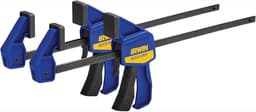
This listing does not say so. The T54122EL7 card describes a trigger, soft pads, a 300 mm opening, 63 kg and a 62 mm throat. It does not describe a reversed jaw. Use it as a clamp. If you need a spreader, use a WORKPRO or DEKO listing that states one.
What do I do when the soft pads fall off?
Stop, find the pad, and do not carry on on bare jaws if the face matters. Scrap wood is the reliable stand-in. Tape or a little PVA is what people try, and the NS juvyig reviews already say it does not always hold. If the pads fell off a new clamp on first use, that is a quality complaint.
How do I stop the bar rusting?
Wipe wet glue off the bar, wax the steel if you want a light film, and hang the clamp somewhere dry. A UK review links rust on WORKPRO bars to an unheated shed, especially near the coast. A case is optional. Dry air is the part that matters. Do not leave the clamp in a damp corner until next weekend.

Related pages

Sources

Public UK sources from the research digest. Shelf prices and star lines are the amazon.co.uk figures filed on 21 October 2026.

  1. Thomas Graham, clamp size and clamping force (retrieved 21 October 2026)
  2. Thomas Graham, G clamps vs F clamps (retrieved 21 October 2026)
  3. HSE, PUWER overview (retrieved 21 October 2026)
  4. HSE L114, safe use of woodworking machinery (retrieved 21 October 2026)
  5. HSE, woodworking standards (retrieved 21 October 2026)
  6. General Product Safety Regulations 2005 (retrieved 21 October 2026)
  7. Consumer Rights Act 2015, section 9 (retrieved 21 October 2026)
  8. IRWIN workholding brochure (retrieved 21 October 2026)
  9. UK Workshop, clamps and where to start (retrieved 21 October 2026)