Independent comparisons. We may earn from shop links. More info

Clamps for wood glue up

Updated: 22 October 2026

You have PVA on an edge or a small frame, and a one-handed clamp that feels strong in the hand. Clamps for wood glue up are enough when the dry fit already closes and you only need to keep it closed. They are the wrong class when the panel is wide, bowed, or open before the glue goes on. Spring clamps and positioning squares do not pull that panel shut. The [clamp comparison](/hub/hand-tools/clamp) holds the light-duty bars in this set, with prices in GBP. Peter F. read the amazon.co.uk listings on 21 October 2026. We did not glue a panel or measure pressure. A qualifying purchase through our links can earn us a commission at no extra cost to you.

You have PVA on an edge or a small frame, and a one-handed clamp that feels strong in the hand. Clamps for wood glue up are enough when the dry fit already closes and you only need to keep it closed.

Our top picks

On this page

Close the joint before you buy force

If the dry fit will not close, no clamp here will invent a joint. If it closes, keep it closed without crushing the face. If the panel is wide or bowed, leave this set for a sash or parallel clamp. Dry fit with no glue. The faces should meet, and you should be able to close the gap with hand pressure or a modest squeeze. PVA does not fill a slot you can see through. The Woodworkers Institute puts it plainly: PVA will not fill a gap you can fit a razor blade into. If the joint is open, correct the cut. A higher kilogram on the next bullet will not plane the edge. Tight means the joint is together, not that the handle has reached the maker’s maximum. Titebond UK says the required pressure is enough to bring joints tightly together, and it prints bands of generally 100–150 psi for softwoods, 125–175 psi for medium woods and 175–250 psi for hardwoods, with an open time of about 4–6 minutes at 70°F (about 21°C). Those psi figures are pressure on the glue line, not the 63 kg or 68 kg on a clamp, and this page will not convert one into the other. UK Workshop says the packet kilogram is not the force to chase, and that squeezing the glue out is a failure. The Titebond page also says that glue is not for structural use. The hand sequence for one bar is on how to use a bar clamp.

A light-duty bar can hold a small glue-up

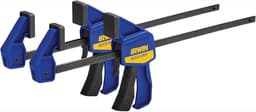
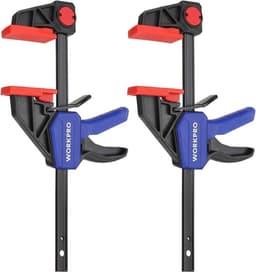
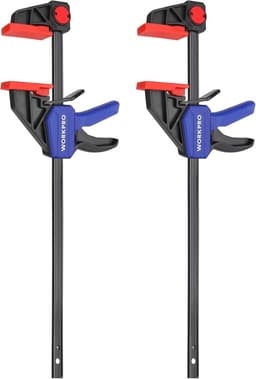
For a small closed joint, the IRWIN Quick-Grip T54122EL7 twin and the WORKPRO pairs are a third hand while the glue grabs. Reviews of this class of clamp describe a small plywood cabinet held while the glue dries. The IRWIN card states 300 mm, 63 kg and a 62 mm throat, at £14.90, and that 63 kg is the light-duty brochure row. The WORKPRO 150 mm pair at £12.99 states a 150 mm jaw, a 60 mm throat and up to 68 kg, with pads that reviews say come loose. The 305 mm pair states the same 60 mm throat, 68 kg and a 440 mm spreader, at £16.99. Put the pads on, or a scrap caul, and stop when a little glue shows and the joint is closed. The throat is the limit. A 60 mm throat presses near the edge. It does not press the middle of a wide board, and the 305 mm opening does not fix that. ITS calls quick clamps the tool that positions a light glue-up, and heavier clamps the tool that pulls a panel. Use the light bar when the joint is already willing. Read the Amazon Basics bullets before you treat that six-piece as the same third hand: the title says spring clamps and the bullets describe triggers, and a UK review says the pads can mark hardwood. The next size check is on the bar clamp buying guide.

Spread the pressure with more clamps and a caul

One clamp in the middle of a long edge bows the panel and starves the ends. Thomas Graham’s sash-clamp note still applies to a small glue-up: one clamp is rarely enough, the clamp should be longer than the job, alternate above and below, use cauls, and check diagonals on a frame. The Woodworkers Institute spaces clamps about every 200–255 mm. Treat that as their technique, not as a regulation. On a 600 mm edge that spacing is three clamps, not one squeeze in the centre. A caul is a straight scrap that spreads one jaw’s force along the edge and protects the face when the plastic pad has fallen off. Alternate clamps above and below so the bars do not dish the board. On a frame, check both diagonals before the glue grabs, and ease the clamp that is pulling the long one. Open time on the Titebond page is only a few minutes in a warm room, so rehearse the order on the dry fit. A UK shed in January is colder than 21°C, and cold PVA is slower, but a joint you disturb is still a failed joint. If you only own one light bar, glue a short edge or a small box, not a tabletop. The 120 mm clamps in the WORKPRO four-piece are the ones a review said moved on a router fence, so do not give them the heavy end of a wide panel.

Some tools in the table do not glue a joint

Spring clamps do not close an edge. The G4GADGET six-pack draws reviews that say it is not robust enough for gluing wood, and it states no force. The EMART eight-pack states 10 lb and a 2 inch opening for backdrops. Either can hold a note on the bench. Neither replaces a bar. Positioning squares do not pull a joint. A review on the Anylot 8-pack, £55.99 with 10 reviews, says the squares hold 90 degrees and do not press the joint. Use them to keep a corner honest, then close the glue line with a bar. The AOQCFS plastic set has no reviews and no force figure. The ZFFAFUR tool holds a filler strip while you scribe. It is not a glue clamp. The NS juvyig screw clamps open only 10–57 mm, and the pads come off. They are not the stiff G clamp you add for bench work. That split is on bar clamp vs G clamp. Leave this set when the panel is the real job. A sash clamp should be longer than the panel, you will want several, and you use cauls. Parallel-jaw clamps are what UK forum users add when flat panels matter, because the jaws stay parallel. Neither is among these ASINs. If the timber is structural, use a joiner.

Common questions

How tight should I clamp a PVA joint?
Tight enough that the joint is closed and a little glue shows. Titebond UK describes pressure to bring the faces together, with psi bands and an open time of about 4–6 minutes at 70°F (about 21°C). Those psi numbers are not the kilogram on a clamp. Stop when the faces meet, and follow the bottle for how long the clamps stay on.
Are the one-handed clamps in this set enough?
They are enough for a small glue-up that already closes: a light frame, a small box, a short edge within a 60 mm throat. The IRWIN mini and the WORKPRO pairs are that third hand. They are not enough for a wide or bowed panel. A 305 mm bar in this set does not deepen the 60 mm throat.
Why did the joint open when I squeezed harder?
Usually the dry fit was already open, the glue was asked to fill a gap, or one clamp bowed the edge and the ends sprang back. More force on a light bar makes that worse. Correct the fit, add clamps along the edge, and use a caul. If the bar is bending, this set has run out of road.
How many clamps do I need, and what is a caul?
One clamp is rarely enough on anything longer than a short block. A Woodworkers Institute spacing is about every 200–255 mm, as a technique rather than a rule. A caul is a straight scrap that spreads the jaw and protects the face. Lay the clamps out before you spread the glue, because open time in a warm room can be only a few minutes.
Can a corner square replace a bar clamp on a frame?
It can keep the corner at 90 degrees. On the Anylot listing, a review says that is all it does: it does not press the joint. You still need a clamp that pulls. The AOQCFS set has no reviews to show it does more. Use the square as a register, not as the clamp.
When do I need a sash or parallel clamp instead?
When the panel is wide, long or bowed, when 60 mm of throat cannot reach the glue line, or when the light bars flex before the joint closes. A sash clamp should be longer than the job, and you will want more than one. Parallel jaws are the later buy for flat panels. They are not in this comparison. A structural joint should go to a joiner.

Related pages

Sources

Public UK sources from the research digest. Shelf prices and star lines are the amazon.co.uk figures filed on 21 October 2026.

  1. Thomas Graham, clamp size and clamping force (retrieved 21 October 2026)
  2. Thomas Graham, G clamps vs F clamps (retrieved 21 October 2026)
  3. HSE, PUWER overview (retrieved 21 October 2026)
  4. HSE L114, safe use of woodworking machinery (retrieved 21 October 2026)
  5. HSE, woodworking standards (retrieved 21 October 2026)
  6. General Product Safety Regulations 2005 (retrieved 21 October 2026)
  7. Consumer Rights Act 2015, section 9 (retrieved 21 October 2026)
  8. IRWIN workholding brochure (retrieved 21 October 2026)
  9. UK Workshop, clamps and where to start (retrieved 21 October 2026)