Independent comparisons. We may earn from shop links. More info

Bar clamp vs G clamp

Updated: 22 October 2026

You are about to buy one clamp, and the titles say F clamp, bar clamp, quick grip and G clamp as if they were the same object. Bar clamp vs G clamp is a mechanism choice. A one-handed bar lets you keep a hand on the work and span a longer opening. A screw G clamp is a stiff frame for a short, local squeeze. In this amazon.co.uk set the only screw clamps open 10–57 mm with 28 mm of depth, so they are that second tool only when the stack is that thin. The [clamp comparison](/hub/hand-tools/clamp) holds the GBP prices. Peter F. read the listings on 21 October 2026. We did not load either mechanism on a bench. A qualifying purchase through our links can earn us a commission at no extra cost to you.

You are about to buy one clamp, and the titles say F clamp, bar clamp, quick grip and G clamp as if they were the same object. Bar clamp vs G clamp is a mechanism choice.

Our top picks

On this page

The names overlap on purpose

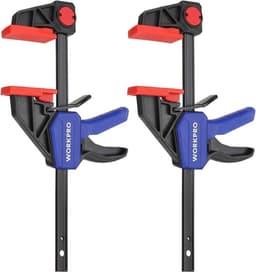
Thomas Graham’s G-versus-F note is the clearest UK split: a G clamp is slow, rigid and suited to small parts, and an F clamp slides and reaches further, often one-handed on the trigger versions. Their starter kit is a few short G clamps plus mid-length F clamps. They use “F clamp” for a screw bar. On these listings, shoppers also use “F clamp” for the WORKPRO trigger. A G clamp, sometimes called a C clamp, is a fixed frame with a screw you wind. The opening cannot grow, because the frame is the opening. An F clamp, in the trade sense, is a bar with a jaw that slides and a screw that finishes the squeeze. A quick-grip is that idea with a trigger instead of a slow screw. Amazon titles collapse the last two. A WORKPRO listing can say F clamp and still be the trigger bar in the photograph. Look at the picture and the bullet that says one-handed. If the card says spring in the title and trigger in the bullets, as the Amazon Basics ABL012 set does, believe the bullets. Jaw and throat, once you have picked a type, are on the bar clamp buying guide.

Choose the bar when speed and a free hand matter

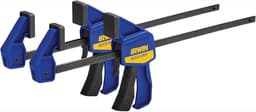
Choose the one-handed bar when you are alone, the joint is light, and you need the other hand to keep a frame square. You set the jaw, squeeze, and watch the glue line. That is the job ITS assigns to quick clamps: position and hold a light glue-up. In this set the WORKPRO pairs state a 60 mm throat and up to 68 kg, with a spreader on the listing. The IRWIN T54122EL7 twin states 300 mm, 63 kg and a 62 mm throat, and it does not describe a spreader. The DEKO set states up to 130 lb and a reverse jaw, on a file of 25 reviews. Those kilograms are maker claims for a light hold, not a measured win over a screw clamp. The limit is stiffness. A trigger bar can flex, the WORKPRO pads come loose in reviews, and a 60 mm throat does not deepen because the bar is 305 mm long. DIYWiki prefers a quick-release when lower force is enough, and still warns that a small pad dents. Heavy edge-to-edge panels are the job ITS moves to a G clamp or a sash clamp. If that is your panel, the exit is on clamps for a wood glue-up. For a first solo DIY kit, buy the bar. Skip it when the work is metal, when the clamp must lock without a plastic ratchet, or when you need a short stiff bite the trigger will not square up to.

Choose a screw clamp when the frame must be stiff

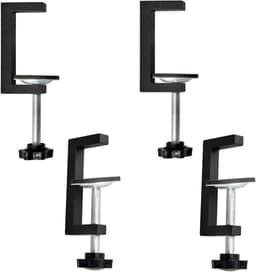
Choose a screw G clamp when the hold is local, the frame should not flex, and you can spare a hand to wind the screw. Metalwork, a fence on the bench, and a thin stack that must not creep are the usual cases. The screw is slow, which helps you feel the pressure and hurts you when six clamps must go on before PVA skins. ITS still starts with opening and throat. Do not put a pipe on the tommy bar. Muddy Faces puts ordinary G clamps around 25–150 mm because the frame is fixed, and sliding bars much longer. Both dent wood on a small pad, so use scrap. The only G-clamp ASIN here is the NS juvyig four-pack, B0D11MSYF9, at £13.99. The bullets state 10–57 mm opening and 28 mm depth. The star line is 4.0 from 157 reviews. The listing claims silicone pads. UK reviews say the pads or metal discs come off, sometimes on first use. No force is stated. That pack can clip a thin piece. It is a weak stand-in for a thick joint or for the cast G clamp a trade counter means by a small G clamp. A cast 50 mm G clamp is a different object from this ASIN even when the opening looks similar. If the stack is under 57 mm and 28 mm of depth is really enough, this four-pack is the screw option in the table, pad fault included.

A sensible kit has both, in the right size

Thomas Graham’s starter split still holds: short, stiff screw clamps for local holds, and mid-length bars for repeated setups. In this set you can buy the bar today. You cannot buy the cast G side from the rows we kept. Buy the one-handed bar first for solo DIY. Add a real G clamp when the job is a stiff local hold the trigger will not reach or will not lock. Do not add the 10–57 mm four-pack and call the kit complete. A single WORKPRO or IRWIN pair will hold more ordinary DIY than the small screw pack will. You will feel the missing G clamp when a metal bracket needs a frame that does not ratchet back. That is the moment to add one, in a size you measured. If the job has turned into a panel, neither the trigger nor this tiny screw pack is the whole answer.

Common questions

Is a one-handed bar an F clamp?
On these amazon.co.uk titles, shoppers use “F clamp” for the trigger bar. In UK trade writing, an F clamp is often a sliding bar with a screw, and the trigger is the one-handed cousin. Look at the photograph. A ratchet and a trigger means the bar in this comparison. A fixed frame and a winding screw means a G clamp.
When is a G clamp the better hold?
Use a G clamp for a short, stiff squeeze you can wind: metalwork, a bench hold, a small part that must not flex. It is slower than a trigger, which helps you feel the pressure and hurts when several joints must close before the glue skins. A small pad still dents, so use scrap. The better hold is the stiffer frame, not a higher star rating.
Are the four-pack G clamps a normal workshop G clamp?
No. The NS juvyig pack opens 10–57 mm and is 28 mm deep, at £13.99, with 4.0 from 157 reviews and pads that come off. Trade guides mean a cast frame, often around 50–150 mm. A similar opening does not make them the same tool. Use the four-pack only on a thin stack.
Can I glue a cabinet with only trigger clamps?
You can hold a small box or a light carcass with the IRWIN mini or a WORKPRO pair if the dry fit already closes and the throat reaches the edge. You should not glue a wide or bowed panel on light triggers alone. ITS still wants a heavier clamp to pull that panel.
Which one dents the wood more?
Whichever meets the face on a small hard pad. A G clamp’s screw can apply a very local load. A trigger with lost pads, the WORKPRO review complaint, does the same with less warning. Scrap cauls matter on both.
What job should leave both of these types?
A wide panel, a bowed edge, and structural timber should leave both the light trigger and the 10–57 mm screw pack. Those jobs want a sash or parallel clamp, or a joiner. A backdrop wants a spring clamp. A cabinet filler strip wants the scribe clamp. Stay with bar versus G only for a normal DIY squeeze.

Related pages

Sources

Public UK sources from the research digest. Shelf prices and star lines are the amazon.co.uk figures filed on 21 October 2026.

  1. Thomas Graham, clamp size and clamping force (retrieved 21 October 2026)
  2. Thomas Graham, G clamps vs F clamps (retrieved 21 October 2026)
  3. HSE, PUWER overview (retrieved 21 October 2026)
  4. HSE L114, safe use of woodworking machinery (retrieved 21 October 2026)
  5. HSE, woodworking standards (retrieved 21 October 2026)
  6. General Product Safety Regulations 2005 (retrieved 21 October 2026)
  7. Consumer Rights Act 2015, section 9 (retrieved 21 October 2026)
  8. IRWIN workholding brochure (retrieved 21 October 2026)
  9. UK Workshop, clamps and where to start (retrieved 21 October 2026)