Independent comparisons. We may earn from shop links. More info

How to use a click torque wrench without chasing a silent click

Updated: 22 October 2026

The bolt in front of you has a number in newton-metres, and you are not sure whether a faint movement counted. How to use a click torque wrench, on these small scales, is a short sequence: set the number, lock it, pull once until the head moves, stop, and put the scale back to the lowest printed mark. A whisper at 5 Nm can be the signal. No movement at any setting is a different problem. Listings and prices stay on the [1/4 inch torque wrench comparison](/hub/hand-tools/1-4-inch-torque-wrench). Peter F. used the amazon.co.uk listing text. We did not calibrate a wrench. A qualifying purchase through our links can earn a commission at no extra cost to you.

The bolt in front of you has a number in newton-metres, and you are not sure whether a faint movement counted.

Our top picks

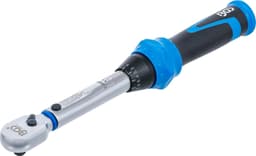
BGS BGS 7181 6–30 Nm

Best overall

BGS BGS 7181 6–30 Nm
8.9/10about £15.98
On this page

Set the scale in Nm

Read the unit before you read the number. The ss shovan line prints “3–25 Nm (8.9–221.3 in-lb)”. About 221 in-lb does match 25 Nm. About 8.9 in-lb is about 1 Nm, not 3 Nm. If you set the inch-pound collar to 8.9 and think you have set 3 Nm, you have set something nearer 1 Nm. When the two scales disagree, use the Nm mark that matches the bolt. Unlock the handle, turn to the figure, and lock it again. Sealey’s micrometer instructions describe that order: unlock, set the main scale and the collar, lock, stop at the click, then return to the lowest setting and not below it. If your bolt says 5 Nm and the wrench opens at 6 Nm, there is nothing to set. The buying guide is the fix, not a harder pull.

Pull until it deflects once

Seat the socket fully. Draper reviews say some 1/4 inch squares let the socket fall off, so a socket on the floor is a fit problem, not a torque result. An extension along the axis does not change the setting. A crow’s-foot stuck out to the side does change the length, and this page does not give you a formula for that. Pull smoothly in the tightening direction. Norbar’s guidance is one click. Park Tool makes the same practical point: the wrench signals, and then you stop. A second pull “to be sure” is how a 5 Nm bolt becomes something higher. If the bolt will not move and the scale is already at its maximum, stop. You do not exceed the maximum to undo a fastener.
BGS BGS 7181 6–30 Nm

Testsieger

BGS BGS 7181 6–30 Nm
8.9/10about £15.98

A faint bend is not a broken wrench

At the bottom of a small scale the click is often quiet. Park Tool says the click may be almost silent and that the head deflection is the signal. The BLUEMARS bullet says that below about 10 Nm you may feel the shaft bend rather than hear a click, and that you should turn slowly. A Draper review pattern matches that experience near 5 Nm. No movement at any setting is the fault. That is not the same as a quiet 5 Nm click. In the AivaToba sample, several reviews say there is no click even at the minimum, and one headset was broken while the owner waited for a sound that did not come. Try the feel once on a low-value bolt before a carbon faceplate. Stem and carbon limits are on the bike page.

Stop, store, and do not undo a seized bolt

After the one signal, stop. Wind the handle back to the lowest mark printed on that tool, not to zero. Park Tool says store at the lowest scale value. Norbar says the minimum mark, never zero. Where this set prints the reset, AivaToba and BLUEMARS say 2 Nm. Do not wind below the scale. Do not use the wrench as a breaker bar. The highest maximum in this comparison is 30 Nm. Wheel nuts are on the 1/4 vs 3/8 page, and they are not a job for a wrench that ends at 30 Nm. If the lock will not hold, the Draper sample includes that complaint.

Common questions

How do I set the number?
Unlock the adjustment, turn the handle until the Nm mark matches the bolt, and lock it. Ignore a foot-pound or inch-pound figure when it does not match the Nm scale. The ss shovan inch-pound low end, about 8.9 in-lb, is about 1 Nm, not the 3 Nm printed beside it. If the bolt’s number is below the lowest mark, you need a different wrench.
What if I barely hear a click at 5 Nm?
Feel the head as you pull slowly. Park Tool treats deflection as the signal when the click is almost silent, and the BLUEMARS listing warns of a bend rather than a click below about 10 Nm. One smooth release is enough. Keep pulling only if nothing moved at all.
When is no click a fault?
It is a fault when the head does not release at the low end or further up the scale, on a fastener you already know. AivaToba reviews describe that pattern, including a headset damaged while someone waited for a click. A faint bend at a low setting, which the listing warned you about, is not the same fault.
Do I store it at zero?
No. Return it to the lowest printed mark. AivaToba and BLUEMARS print 2 Nm. Zero is under that mark on a wrench that starts at 2, 3, 5 or 6 Nm. Park Tool and Norbar both say the minimum, not zero.
Can I loosen bolts with it?
Not as a breaker, and not when the listing says tightening only. The BGS and Draper bullets describe clockwise tightening. Several kits forbid loosening. A bolt that will not undo inside the maximum needs another tool.
Does an extension change the setting?
A short extension in line with the bolt does not change the number you set. The kits that include a 100 mm bar are for reach. A fitting that sticks out to the side changes the length, and this page does not calculate that correction.

Related pages

Sources

Public sources from the research digest, last checked on 19 October 2026. Shelf prices, stars and review counts are the amazon.co.uk figures in the display file, not a live check.

  1. BSI, BS EN ISO 6789-1:2017 (retrieved 19 October 2026)
  2. BSI, BS EN ISO 6789-2:2017 (retrieved 19 October 2026)
  3. Park Tool, torque wrench use and care (retrieved 19 October 2026)
  4. Park Tool, threadless stem (retrieved 19 October 2026)
  5. Norbar, ten things about your torque wrench (retrieved 19 October 2026)
  6. HSE, work equipment inspection (retrieved 19 October 2026)
  7. PUWER 1998 (retrieved 19 October 2026)
  8. Acribi, torque wrench tolerance summary (retrieved 19 October 2026)