Independent comparisons. We may earn from shop links. More info

Bike torque wrench 1/4: use the number on the part

Updated: 22 October 2026

The stem faceplate says 5 Nm, the bar says 4 Nm, and the torque wrench in the drawer starts at 6. A bike torque wrench 1/4 is the usual square for that job because the bolts are small and the figures are low. The useful version is the one you can actually set to the lower of those two numbers. If the part still moves at that number, the next step is not “a bit more”. Peter F. read the amazon.co.uk files of 19 October 2026. A qualifying purchase through our links can earn a commission at no extra cost to you. The rows live on the [1/4 inch torque wrench comparison](/hub/hand-tools/1-4-inch-torque-wrench).

The stem faceplate says 5 Nm, the bar says 4 Nm, and the torque wrench in the drawer starts at 6. A bike torque wrench 1/4 is the usual square for that job because the bolts are small and the figures are low.

Our top picks

Homvvi Homvvi 2–24 Nm kit

Best overall

Homvvi Homvvi 2–24 Nm kit
7.2/10about £28.99
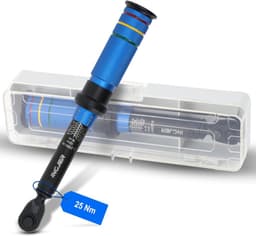
INGJER INGJER 3–25 Nm

Best value

INGJER INGJER 3–25 Nm
8.0/10about £15.99
On this page

Read the number on the part

Many bicycle bolts are marked in Nm on the stem, the faceplate, the seatpost clamp or the lever. Park Tool’s threadless-stem guide calls 4–6 Nm typical for faceplate and pinch bolts, tightened in a cross pattern, with assembly compound where a carbon bar needs grip. Typical is not a law. A stem printed at 5 Nm and a bar printed at 4 Nm means you stop at 4 Nm. The lower number wins. If the two marks disagree, do not average them. Park Tool’s cross pattern exists so one side of the faceplate does not clamp first and twist the bar. A second pull after the click is how a 5 Nm bolt gets more than 5 Nm. The pull and the quiet click are on how to use a click torque wrench.

A 6 Nm wrench cannot set a 4 Nm bolt

Three kept listings open too high for a 4 Nm mark. The BGS 7181 is 6–30 Nm, and it cannot be dialled to 4 or 5. The HYCHIKA title is 5–25 Nm, so 5 Nm is on the scale and 4 Nm is not. The Draper 78639 is also 5–25 Nm. A 4 Nm bar cannot. The INGJER is 3–25 Nm and has no bits. The FOURROBBER is 2–20 Nm. The AivaToba, Homvvi and BLUEMARS titles are 2–24 Nm. The ss shovan bullet starts at 3 Nm. The TAGVIT title says 1–25 Nm and the bullets say 3/8 inch, so do not treat that 1 Nm start as a settled 1/4 inch fact. A wrench that ends at 20 Nm still covers a stem. It does not cover a fastener marked at 22 or 25 Nm. A preset 5 Nm key is enough when every bolt you touch really is 5 Nm. It is the wrong only-tool when the bar says 4 and the seatpost says 6. How to choose a window is on the buying guide.
Homvvi Homvvi 2–24 Nm kit

Testsieger

Homvvi Homvvi 2–24 Nm kit
7.2/10about £28.99

Bits, and the kit that did not fit

The AivaToba bullet lists hex H2, H2.5, H3, H4, H5, H6, H8 and H10, plus Torx T20, T25 and T30, and a 100 mm extension. The HYCHIKA bullet lists the same hex and Torx families. If your bike uses a size they skip, the kit does not save a shop trip. The FOURROBBER bullet claims hex, Torx, slotted, Phillips, Pozidriv and nut drivers, on a 2–20 Nm wrench. One of 14 reviews says the kit was returned because nothing fitted that bike. Homvvi’s bullet lists a 100 mm extension, a 3/8 adapter, hex sockets, hex bits, Torx and Phillips. The ss shovan sample includes a missing 2.5 mm bit, with two 3 mm bits instead. The BGS, INGJER and Draper include no bits. A 3/8 inch adapter does not raise a 24 Nm scale. The AivaToba set-name field says 33 pieces and the bullet says 13.

If a carbon bar slips

Stop at the lower printed limit. If the bar or the seatpost still slips, do not add newton-metres. Extra torque is how a carbon faceplate cracks while the slipping, which was a grip problem, remains. Park Tool’s assembly compound, sold as SAC-2, is for the contact faces of a bar, stem and seatpost. The product page says it is not for threads. Grease on the carbon interface is the wrong substitute. Apply the compound to the mating faces, refit, and tighten again to the same printed number, in the same cross pattern. If the part still moves at that maximum, a mechanic should see it. When the job becomes a wheel nut, leave the 1/4 inch wrench in the drawer. Car wheels are covered on the 1/4 vs 3/8 page.

Common questions

Is 5 Nm always right for a stem?
No. Park Tool calls 4–6 Nm typical for a threadless stem’s faceplate and pinch bolts. Your stem or bar may print a different figure. Use the number on the part. If the bar says less than the stem, use the lower one.
Which wrench starts low enough for 4 Nm?
In this set, title ranges that start at 1, 2 or 3 Nm can be set to 4 Nm. That includes the INGJER at 3 Nm, the FOURROBBER at 2 Nm, and the 2–24 Nm kits, plus the ss shovan at 3 Nm. The BGS starts at 6 Nm. The HYCHIKA and the Draper start at 5 Nm, which misses 4.
What if the bar says less than the stem?
Use the lower number for the bolts that clamp that bar. A stem marked 5 Nm and a bar marked 4 Nm is a 4 Nm pull. Do not split the difference. A tool that opens at 5 or 6 cannot be set to the bar’s figure.
The bar still slips. Do I add torque?
No. Stop at the printed maximum. Slip on carbon is a grip question for the contact faces. Assembly compound belongs on those faces, not on the threads. If the part still moves at the printed limit, a shop should see it.
Is a preset 5 Nm key enough?
It is enough when the bolts you undo are all 5 Nm. It is not enough when the bar says 4 Nm or the next clamp says 6 Nm. A preset key also will not show an 8 Nm accessory.

Related pages

Sources

Public sources from the research digest, last checked on 19 October 2026. Shelf prices, stars and review counts are the amazon.co.uk figures in the display file, not a live check.

  1. BSI, BS EN ISO 6789-1:2017 (retrieved 19 October 2026)
  2. BSI, BS EN ISO 6789-2:2017 (retrieved 19 October 2026)
  3. Park Tool, torque wrench use and care (retrieved 19 October 2026)
  4. Park Tool, threadless stem (retrieved 19 October 2026)
  5. Norbar, ten things about your torque wrench (retrieved 19 October 2026)
  6. HSE, work equipment inspection (retrieved 19 October 2026)
  7. PUWER 1998 (retrieved 19 October 2026)
  8. Acribi, torque wrench tolerance summary (retrieved 19 October 2026)