Independent comparisons. We may earn from shop links. More info

Impact socket or normal socket

Updated: 22 October 2026

You have a 1/2 inch impact wrench and a chrome socket, and the question is whether that socket can go on the anvil. It should not. An impact socket or a normal socket is a choice about shock, not about which ratchet feels nicer. The Products Compared editorial team compared the twelve amazon.co.uk listings in this sample on 20 October 2026 against Chicago Pneumatic, Toolstation, and the British Standards for hand and impact sockets. A qualifying purchase through our links can earn a commission at no extra cost to you. The sets are on the [1/2 inch socket set](/hub/hand-tools/1-2-inch-socket-set) page.

You have a 1/2 inch impact wrench and a chrome socket, and the question is whether that socket can go on the anvil. It should not.

Our top picks

On this page

Two sockets, two jobs

A normal socket is for a ratchet, a breaker bar or a torque wrench, commonly in chrome vanadium. Chicago Pneumatic describes impact sockets as matt, thick-walled, chrome molybdenum, with a pin and ring so the anvil cannot throw the socket off. A regular chrome vanadium socket can rupture on a gun. You can turn a proper impact socket on a hand ratchet. You should not put the chrome hand socket on the gun. The hand steps are on how to use a 1/2 inch socket set.

What the finish does and does not prove

In this amazon.co.uk sample a black finish does not mean an impact socket. Atooge is black oxide and the material line says chrome vanadium. KIRXST is chrome vanadium with a black phosphate finish and an impact claim. Reviewers describe WinHolder’s deep set as ordinary sockets painted black. KATSU’s £9.99 deep set is carbon steel, and reviewers say the walls are too thin. HOYETO’s pin hole has no groove for the usual O-ring. Paint does not change chrome vanadium into chrome molybdenum.

What these listings actually say

None of the twelve listings names chrome molybdenum or cites BS ISO 1711-2:2019. KIRXST, WinHolder, Atooge and Draper Expert name chrome vanadium and still use impact language. HOYETO names alloy steel only, and KATSU’s deep set names carbon steel. WinHolder sockets opened on a wheel nut that was not seized. KATSU’s carbon-steel sockets split on a hand ratchet. Alitamei’s 19 mm cracked on a wheel nut. KIRXST has a 24 mm that split within two weeks. Which tin contains 17 mm or 21 mm is on the 1/2 inch socket set for car repairs page.

If one has already cracked

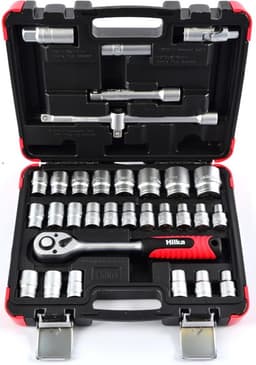
Do not put a cracked socket back on the gun. Photograph it and talk to the seller. A split on first use is an argument that the goods were faulty, not a promise of a refund. Hilka stays off the impact wrench. None of these twelve pages gives you a chrome molybdenum socket cited to BS ISO 1711-2.

Common questions

Can a chrome socket go on an impact wrench?
No. A chrome vanadium hand socket is for a ratchet or a torque wrench. Chicago Pneumatic and Toolstation both say regular chrome sockets can rupture on power tools and that impact work wants a thick chrome molybdenum socket. Hilka and the Draper 12-piece set are hand kits in this sample. Bright chrome is a warning to keep them off the gun, not a style choice.
Does black oxide prove an impact rating?
No. Black oxide, phosphate and paint are finishes. Atooge, KIRXST and WinHolder combine a dark finish with chrome vanadium and impact wording. KATSU’s cheapest deep set is black carbon steel. Reviewers of the WinHolder deep set called them ordinary sockets painted black. Look for the alloy name. The colour only tells you to look.
What is chrome molybdenum?
Chrome molybdenum is the steel trade guides name for impact sockets, often shortened to Cr-Mo. It is a different alloy from the chrome vanadium, or Cr-V, used on many hand sockets. The point of the choice is shock from an impact wrench, not a brighter finish. None of the listings in this sample prints chrome molybdenum, so none of them has met that check.
Why do cheap impact sockets split?
Because the title says impact and the wall is still a thin hand socket, or a carbon-steel tube, under a blow it was not built for. In this sample, WinHolder split on a wheel nut, Alitamei split a 19 mm and a 22 mm, and KATSU’s carbon-steel set split on a hand ratchet as well as on wheels. A low price does not add the alloy the page forgot to name.
Can I use an impact socket on a hand ratchet?
Yes, if it is a true impact socket and it fits the 1/2 inch square. A hand ratchet does not hammer the wall the way a gun does, so the thick socket is usable, if clumsier in a tight arch. The reverse is the dangerous one. Do not put the chrome hand socket on the impact wrench because the impact socket happened to work on the ratchet.
What does the British Standard cover?
BS ISO 1711-2:2019 covers technical requirements for machine-operated impact sockets, including hardness and torsion. BS ISO 1711-1:2019 is the hand-operated counterpart. BS ISO 1174 is about the driving square, not a licence to use any socket on a gun. No listing in this sample cites those impact or hand socket standards. You cannot grade them as compliant from a title.
What if a socket has already cracked?
Take it off the tool and do not use it again. A cracked wall can open on the next blow. Keep the pieces, note the ASIN, and contact the seller about a fault. A break on first use supports that conversation. It does not guarantee a refund, and it does not mean the socket was illegal to sell. Replace it with a socket whose page names the steel, not with the next black tin that only says impact.

Related pages

Sources

Sources for this comparison, last checked on 22 October 2026.

  1. Toolstation socket set buying guide (retrieved 22 October 2026)
  2. RS impact sockets (retrieved 22 October 2026)
  3. Metro Sales, the importance of impact sockets (retrieved 22 October 2026)
  4. BSI BS ISO 1711-2:2019, machine-operated impact sockets (retrieved 22 October 2026)
  5. BSI BS ISO 1711-1:2019, hand-operated wrenches and sockets (retrieved 22 October 2026)
  6. BSI BS ISO 1174-1:2011, driving squares (retrieved 22 October 2026)
  7. HSE work equipment FAQ (retrieved 22 October 2026)
  8. GOV.UK, accepting returns and giving refunds (retrieved 22 October 2026)