Independent comparisons. We may earn from shop links. More info

How to use a 1/2 inch socket set

Updated: 22 October 2026

The ratchet is the right drive, and the nut will not start because the socket is a size too big or the switch is the wrong way. This is how to use a 1/2 inch socket set: seat the opening, set the direction, use an extension only to reach, and stop before you guess a torque figure. The Products Compared editorial team wrote it on 20 October 2026 from amazon.co.uk notes in this sample and from Wonkee Donkee, RS, ManoMano and Continental Tyres. A qualifying purchase through our links can earn a commission at no extra cost to you. Shopping rules sit on the [1/2 inch socket set](/hub/hand-tools/1-2-inch-socket-set) comparison.

The ratchet is the right drive, and the nut will not start because the socket is a size too big or the switch is the wrong way.

Our top picks

On this page

Seat the right socket

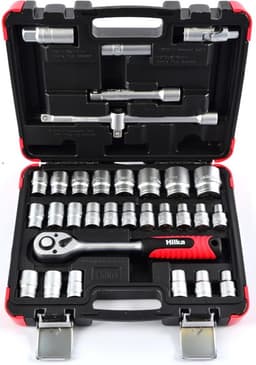
A 1/2 inch socket should sit square on the nut and click onto the ratchet’s square. If a 17 mm rocks, turning it will round the corners. Six-point sockets grip flats. A 12-point socket is easier to start on a hidden nut and more likely to slip if the nut is already damaged. A click also fails when the old ratchet is 3/8 inch. Hilka sockets can be very tight on an extension, so a stiff fit is not automatically the wrong size. That mismatch is covered in the 1/2 inch socket set buying guide.

Set the ratchet and swing

Undo anticlockwise as you look at the nut, and tighten clockwise. If the handle clicks and the nut does not move, flip the lever. Hilka and WORKPRO are 72-tooth, so they take a smaller arc beside a chassis rail. KATSU’s hand set is 24-tooth, and the listing’s 5-degree claim does not match. If the head clicks without turning a seated socket, stop. On that KATSU set, springs have fallen out after a few uses.

Use an extension without adding leverage

Use an extension when the nut sits beyond the ratchet head. Click the extension onto the ratchet first, then the socket onto the extension. On the KATSU 12-piece set, reviewers could not fit the 5 inch bar until they pressed the button. Hilka’s sockets can be very tight, so pull straight with the button pressed. HOYETO’s pin hole has no groove for the usual O-ring. ManoMano treats an extension as reach, not extra torque. A tube on the handle multiplies the load on the pawl.

Stop and use the handbook torque

Wheel nuts are not a final nip on the ratchet. Continental Tyres UK says you tighten them to the vehicle’s figure, in a star or cross sequence, and recheck after about 30 miles. The newton-metre number is in the handbook, so this page will not invent one. Call a garage when a wheel nut will not move and the car still has to be driven. Sizes for those jobs are on the 1/2 inch socket set for car repairs page.

Common questions

Which way is undo?
Look at the nut and turn it anticlockwise to undo, clockwise to tighten, then set the ratchet lever so the handle drives that way. Prove it with a light swing before the fastener is under load. If the handle clicks and nothing turns, the lever is reversed. A stuck nut is not a reason to keep clicking in the wrong direction, because the pawl takes that wear.
Why will the socket not click on?
The usual causes are a drive that is not 1/2 inch, dirt on the square, or a quick-release button that must be pressed before the bar will enter. On the KATSU 12-piece set, reviewers had to press the button before the extension would fit. Check the square size before you force it. A 3/8 inch ratchet needs an adaptor, not a harder push.
How do I get a stuck socket off?
Press the quick-release button and pull the socket straight off the square. Hilka reviewers find sockets very tight on extensions, so expect a firm pull, not a twist that scars the detent. If a pin-and-ring anvil is holding it, remove the pin. Do not hammer the socket sideways. If the button is broken, the ratchet head is the failed part.
Can I put a pipe on the ratchet?
No. A pipe on the handle, or an extension used as a longer lever, multiplies the load on a mechanism meant to run nuts, not to break them free. ManoMano treats the extension as reach only. If the nut will not move, use penetrating oil and a breaker bar, or stop. A 72-tooth ratchet is the wrong place to hang your weight.
When do I use the extension?
Use it when the ratchet head cannot reach the nut: a long stud, a deep brake bolt, or any fastener set back from the surface. Fit the extension to the ratchet, then the socket to the extension, and press the release button to take it off. A deep socket sometimes removes the need for a long bar. The extension does not make the set stronger.
Do I torque wheel nuts with the ratchet?
Use the ratchet to remove them and to run them on. Tighten to the handbook figure with a torque wrench, in a star or cross pattern. Continental advises a recheck after about 30 miles on a refitted wheel. Do not copy a number from another car, and do not finish the job with an impact gun. The figure belongs to that vehicle.
When should a garage take over?
Hand the car over when a wheel nut will not move and you still need to drive, or when the nut is rounding and the ratchet is skipping. The same applies to spring and hydraulic work you are not already practised at. A socket set removes fasteners you can reach and see. It does not replace a ramp, a torque record, or a joint you cannot safely support.

Related pages

Sources

Sources for this comparison, last checked on 22 October 2026.

  1. Toolstation socket set buying guide (retrieved 22 October 2026)
  2. RS impact sockets (retrieved 22 October 2026)
  3. Metro Sales, the importance of impact sockets (retrieved 22 October 2026)
  4. BSI BS ISO 1711-2:2019, machine-operated impact sockets (retrieved 22 October 2026)
  5. BSI BS ISO 1711-1:2019, hand-operated wrenches and sockets (retrieved 22 October 2026)
  6. BSI BS ISO 1174-1:2011, driving squares (retrieved 22 October 2026)
  7. HSE work equipment FAQ (retrieved 22 October 2026)
  8. GOV.UK, accepting returns and giving refunds (retrieved 22 October 2026)