Independent comparisons. We may earn from shop links. More info

Plug-in vs battery wireless doorbell: which power setup

Updated: 16 October 2026

The plug-in vs battery wireless doorbell choice covers indoor power, outdoor-button power and spare sockets. Most products in our [wireless doorbell comparison](/hub/grills-and-barbecues/wireless-doorbell-stainless-steel) use a plug-in chime with a small cell in the button. One uses battery chimes, while three combine plug-in receivers with a kinetic button. If you have a free UK socket, a plug-in chime is usually simpler. Choose battery chimes when placement outweighs maintenance, or a kinetic button to remove the outdoor cell. The Products Compared editorial team used the amazon.co.uk listings. This is not a lab test. A qualifying purchase can earn a commission at no extra cost to you.

The plug-in vs battery wireless doorbell choice covers indoor power, outdoor-button power and spare sockets.

Our top picks

On this page

Three ways these wireless kits are powered

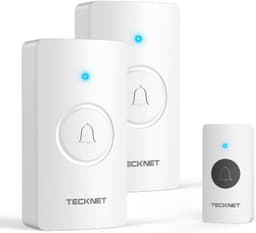
The common pattern is a mains receiver and a cell in the outdoor button. The wesstun, SURFOU and AVANTEK kits, plus the TECKNET twins, follow it. The chime uses a UK socket and a cell such as CR2032 or 12V23A. The outdoor cell still needs replacing eventually. The TECKNET HWD01990 is the only kit here with battery-powered indoor chimes. Two sounders can sit without a wall outlet. The button still has a CR2032 claim. One line says three AA cells, another says batteries are not required, and a UK review describes three AA cells in each sounder. The third pattern is a self-powered button with plug-in chimes. The TECKNET HDB01806 has one chime, the HWD01816 has two, and the AURTEC kit has two. No battery describes the push, not the whole system. If you have no socket, look at the HWD01990. The wireless doorbell buying guide covers the wider trade-offs.

When a plug-in chime is the better buy

Choose a plug-in receiver when a BS 1363 socket is free and you do not want the chime to depend on AA cells. It can stay on, and many models add an LED flash or a silent mode. Two plug-in receivers help across two floors if you can spare two outlets. The black TECKNET 470867 is the top pick for that job: stated IP65, 60 melodies and five volume levels. For one room, the black wesstun WS-001AB is the best value at an extracted £9.99, with IP67 on the transmitter, mute and an LED flash. Its 300 m figure is an open-area claim. The SURFOU pages are similarly inexpensive and print no IP code. The kinetic TECKNET models add pass-through outlets. A 2,000 W figure appears in a review of the twin, not in every extracted bullet. The best wireless doorbell picks compare the named models by job.

When battery-powered chimes make sense

Battery chimes win when the receiver must move, or when no outlet sits in the right place. One HWD01990 sounder can stay near the living area and the other upstairs, or you can carry a unit to a garden office. Both receivers may need AA cells, and the button has its own CR2032 claim. Low cells can cut the volume, so note the fitting date and keep spares. The listing conflicts, so buy enough cells for three per sounder and confirm that against the instructions. At an extracted £15.29 it includes two sounders and uses no sockets. Choose it for that difference. The transmitter is stated as IP65, and the chimes stay indoors.

When the button should be self-powered

A kinetic button helps when changing a small outdoor cell would be awkward, for example on a gate post. The TECKNET HDB01806 costs an extracted £20.99, with one pass-through chime. The HWD01816 costs £29.99 and keeps both outlets usable. Both state IP65 for the transmitter. Those listings specify volume only up to 85 dB, below the 110–120 dB claims on several cell-button kits. The AURTEC kinetic twin lists IP44, no decibel figure and a 150 m open-area claim, so it suits a sheltered entrance. With a free socket and two rooms to cover, choose a plug-in twin. With no useful socket, choose the battery-chime kit and plan for AA cells. With a socket but no wish to replace a button cell, choose the HDB01806 for one room, or the HWD01816 for two if 85 dB is acceptable.

Common questions

If a title says no battery, what still needs power?
On the kinetic kits in this set, no battery refers to the outdoor button. The indoor receiver still plugs into a UK socket. Only the HWD01990 uses battery-powered chimes, and its button separately has a CR2032 claim. A kinetic headline does not remove the need for a BS 1363 socket.
When is an AA chime the right choice?
Choose an AA-powered chime when there is no suitable socket, or when you need to move the sounder between rooms. Accept that you must monitor and replace receiver cells. The HWD01990 listing is contradictory, so check its manual and have enough AA cells available for a three-per-sounder arrangement if the instructions confirm it.
Do kinetic buttons reach less far?
Not necessarily. Tests of some other kinetic products have found shorter practical range, but that does not establish the performance of these models. Use each listing’s range only as an open-area claim, and test the actual route through your closed door and walls. The TECKNET kinetic pages state up to 400 m in open air.
Does a pass-through socket support a heater?
Only if the supplied manual permits that load. Do not assume every pass-through chime has the same rating. Verify the exact receiver’s limit before connecting a kettle, heater or other high-power appliance, and stop using it if the plug or socket becomes hot. The extracted bullets do not print a wattage for every ASIN.
Can I carry a plug-in chime into the garden?
Only by moving it to a suitable indoor or properly protected UK socket. The plug-in body is not given an outdoor IP code here. A battery chime is easier to move, but it should also remain within the conditions stated by its manual. An extension through a doorway is not a permanent installation.
Which setup suits one socket and no button-cell changes?
The TECKNET HDB01806 fits that brief: one plug-in chime with a pass-through socket and a self-powered button. It states IP65 for the transmitter and 25–85 dB for the chime. Choose the twin HWD01816 if you need two receivers and can accept the same stated volume ceiling. Both still need a BS 1363 socket.

Related pages

Sources

Listing prices, stars and review counts are from the amazon.co.uk pages used for this comparison on 16 October 2026. The public sources below cover plugs, radio equipment, IP codes and consumer rights. This is not a lab test.

  1. Ofcom: radio spectrum and the law (retrieved 16 October 2026)
  2. GOV.UK: Radio Equipment Regulations 2017, Great Britain (retrieved 16 October 2026)
  3. Electrical Equipment (Safety) Regulations 2016, regulation 35 (retrieved 16 October 2026)
  4. GOV.UK: Electrical Equipment (Safety) Regulations 2016, Great Britain (retrieved 16 October 2026)
  5. RNID: doorbells (retrieved 16 October 2026)
  6. Consumer Rights Act 2015 (retrieved 16 October 2026)
  7. ManoMano UK: doorbell and intercom buying guide (retrieved 16 October 2026)
  8. IEC 60529 IP rating chart (buyer summary) (retrieved 16 October 2026)