Independent comparisons. We may earn from shop links. More info

Wireless doorbell buying guide for UK homes

Updated: 16 October 2026

You may start with a simple aim, hearing a visitor from the kitchen, and end up comparing plug-in chimes, battery sounders, kinetic buttons and a stainless-steel plate that is not wireless at all. This wireless doorbell buying guide separates those products before you spend. Start with the power arrangement, the number of receivers and the exposure of the outdoor button, then treat range and melody counts as secondary. Our [wireless doorbell comparison](/hub/grills-and-barbecues/wireless-doorbell-stainless-steel) ranks the 11 amazon.co.uk listings. The Products Compared editorial team used those pages. This is not a lab test. A qualifying purchase can earn a commission at no extra cost to you.

You may start with a simple aim, hearing a visitor from the kitchen, and end up comparing plug-in chimes, battery sounders, kinetic buttons and a stainless-steel plate that is not wireless at all.

Our top picks

On this page

What this search actually returns

The stainless steel wording is misleading for the products retained in this comparison. These are cordless door-chime kits made from ABS, or from a material the listing does not state. The outdoor button sends a radio signal to an indoor receiver. They are not brushed-steel switches on existing bell wire. If the visible metal finish is the priority, you need a low-voltage wired push, plus a compatible chime and transformer. That is a different installation. A product can look like a simple button and still need an existing wired circuit. The stainless plate found during research is specified for low-voltage wiring and does not supply a radio receiver. The kits here include a transmitter and at least one sounder. Do not buy the metal plate expecting it to ring a plug-in chime.

Choose plug-in, battery or a self-powered button

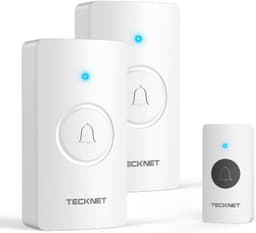
Most kits use a receiver on a UK socket and a small cell in the button. The chime does not go flat, and several add a flash or silent mode. Check for a BS 1363 plug and 230 V. Do not plan a travel adaptor as a permanent fix. One receiver can suit a flat. Two plug-in receivers suit separate floors. The TECKNET HWD01990 is the other way round: two battery chimes, no socket required. The listing conflicts on AA cells. One line says three are needed, another says batteries are not required, and a UK review describes three AA cells in each sounder. Buy cells and follow the instructions in the box. No battery usually means the outdoor button only. The TECKNET HDB01806 and HWD01816, and the AURTEC kit, make the signal from the press, but the chimes still plug in. The plug-in versus battery guide compares the three patterns.

Judge range, receivers and outdoor protection

Figures such as 300 m or 400 m describe open space. Brick, foil-backed insulation, metal doors and appliances shorten the signal, so the largest number is not automatically the best buy. Check that the box has a receiver for each place you spend time, then test through the closed front door before you fix the button. Look for a flash if hearing the chime is difficult, or if you use mute. The SURFOU MN9-4565 states an LED-only mode. One clear short tone matters more than a long tune list. For the outdoor push, read the printed IP code rather than waterproof. This set runs from IP44 on the AURTEC transmitter through IP55 and IP65 to IP67 on the black wesstun listing. The white wesstun and both SURFOU pages do not print a code. The outdoor weather guide explains the tests.

Price bands and the final shortlist

The extracted prices divide into useful groups. Entry kits cost £8.48 to £10.19 and generally include one receiver. The middle group, from £14.99 to £20.99, adds choices such as two battery chimes, a large review pool, or a self-powered button with a pass-through socket. The upper group, from £25.99 to £29.99, centres on two-receiver kinetic kits. Prices were captured on 16 October 2026 and can change. For a quick decision, choose one plug-in receiver for a flat, two receivers for separated rooms, battery chimes where sockets are unavailable, or a kinetic button when replacing its cell would be awkward. Then require a transmitter IP code that matches the doorway. The best wireless doorbell picks in this set name the strongest options for those jobs.

Common questions

Is a wireless doorbell the same as a stainless-steel button?
No. A wireless kit has a radio transmitter and an indoor receiver. A stainless-steel push may be only a low-voltage wired switch that needs compatible bell wiring, a transformer and a chime. None of the 11 retained kits is documented as a stainless-steel radio button. Where a kept listing states a material, it is ABS.
How many chimes do I need for two floors?
Two receivers are the safer starting point when closed doors or distance make one central chime hard to hear. Put one near the main living area and one upstairs, then test both before fixing the button. A single loud chime may work, but its maximum figure does not guarantee even coverage through the house.
Does a 400 m claim mean 400 m through my house?
No. It is an open-area figure without the walls and metalwork found indoors. Treat 150 m, 300 m and 400 m claims as comparison lines, not a promised household distance. Test the receiver in its intended room with the exterior door closed before drilling or relying on adhesive.
What should I do if no IP number is printed?
Assume only that the seller uses the words shown on the page. Do not infer IP65 from waterproof. Place the button under cover, or choose a listing that prints a suitable code for the transmitter. A temperature range does not replace an ingress-protection test. The code covers only the part named.
Will a non-UK plug work in a UK socket?
The plug-in receiver should be designed for a UK BS 1363 socket and a 230 V supply. Do not make a European or US receiver a permanent installation through a travel adaptor. Regulation 35 of the Electrical Equipment (Safety) Regulations 2016 requires electrical equipment to fit a BS 1363 socket. Confirm the plug in the current images before ordering.
Are black and white review totals separate evidence?
Not in the paired listings identified here. The wesstun colours repeat one review pool, and the TECKNET plug-in twins repeat review texts. Treat each pair as one body of customer evidence rather than adding the counts. A large count still does not turn an open-area range into a result measured for this page.

Related pages

Sources

Listing prices, stars and review counts are from the amazon.co.uk pages used for this comparison on 16 October 2026. The public sources below cover plugs, radio equipment, IP codes and consumer rights. This is not a lab test.

  1. Ofcom: radio spectrum and the law (retrieved 16 October 2026)
  2. GOV.UK: Radio Equipment Regulations 2017, Great Britain (retrieved 16 October 2026)
  3. Electrical Equipment (Safety) Regulations 2016, regulation 35 (retrieved 16 October 2026)
  4. GOV.UK: Electrical Equipment (Safety) Regulations 2016, Great Britain (retrieved 16 October 2026)
  5. RNID: doorbells (retrieved 16 October 2026)
  6. Consumer Rights Act 2015 (retrieved 16 October 2026)
  7. ManoMano UK: doorbell and intercom buying guide (retrieved 16 October 2026)
  8. IEC 60529 IP rating chart (buyer summary) (retrieved 16 October 2026)