Cast iron griddle induction hob
You cook on a glass induction hob, the listing says all hobs, and the zone beeps and stays cold. A cast iron griddle can work on induction because the metal is magnetic. It fails when a lip or the ridges hold that metal too far off the glass. This page is that contact problem: detection, scratches, and a slow preheat. Weber fit and the full size guide sit elsewhere. Ranked plates are on the [cast iron griddle plate comparison](/hub/grill-accessories/griddle-plate-cast-iron). We used Which? and the amazon.co.uk reviews in this set. We did not lab-test hobs. Updated 20 October 2026.
You cook on a glass induction hob, the listing says all hobs, and the zone beeps and stays cold. A cast iron griddle can work on induction because the metal is magnetic.
You cook on a glass induction hob, the listing says all hobs, and the zone beeps and stays cold. A cast iron griddle can work on induction because the metal is magnetic. It fails when a lip or the ridges hold that metal too far off the glass. This page is that contact problem: detection, scratches, and a slow preheat. Weber fit and the full size guide sit elsewhere. Ranked plates are on the cast iron griddle plate comparison. We used Which? and the amazon.co.uk reviews in this set. We did not lab-test hobs. Updated 20 October 2026.
Our top picks
| Badge | Product | Induction claim | Faces | Weight | Note | Price | Offer |
|---|---|---|---|---|---|---|---|
| Best overall |  nuovva nuovva reversible cast iron griddle, 50 x 25 cm | Question only | Flat and ridged | 5.36 kg | 8.8 | about £39.99 | View offer |
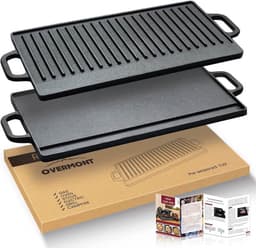
| Best value |  OVERMONT OVERMONT reversible cast iron griddle, 51.2 cm | Claimed; reviews conflict | Ribbed and smooth | 3.6 kg | 8.4 | about £29.17 | View offer |
| Alternative |  NutriChef NutriChef reversible cast iron plate, 45.7 cm | Title says yes; reviews say no | Flat and ridged | 4.4 kg | 8.0 | about £41.69 | View offer |


On this page
Why the metal is not the whole test
Lips and ridges
Glass and heat
What this set claims
Common questions
Is cast iron magnetic enough for induction?
Why does the hob beep and do nothing?
Will it scratch the glass?
Does a 50 cm plate heat evenly on one zone?
How do I preheat without cracking the plate?
Related pages
Sources
Public UK sources used for this comparison. Listing prices, stars, and review counts are from amazon.co.uk on 19 October 2026.
- Regulation (EC) No 1935/2004, food-contact materials (retrieved 19.10.2026)
- SI 2012/2619, materials and articles in contact with food (England) (retrieved 19.10.2026)
- General Product Safety Regulations 2005 (retrieved 19.10.2026)
- GOV.UK — General Product Safety Regulations 2005, Great Britain (retrieved 19.10.2026)
- OPSS product recall — Emba cast iron cookware 2502-0151 (retrieved 19.10.2026)
- Consumer Rights Act 2015, section 22 (retrieved 19.10.2026)
- Which? — how to buy cast iron pans (retrieved 19.10.2026)
- BBC Good Food — how to season cast iron (retrieved 19.10.2026)
- Netherton Foundry — cast black spun iron care (retrieved 19.10.2026)
- Weber UK — griddle 6790 (retrieved 19.10.2026)