Independent comparisons. We may earn from shop links. More info

Coconut charcoal vs lumpwood

Updated: 23 October 2026

You are choosing fuel for a kettle or a kamado, and the bag, the box and the hookah cubes are all being called coconut charcoal. Lumpwood, coconut briquettes and 25 mm cubes are three fuels. Coconut charcoal vs lumpwood is that three-way split: lumpwood when you want a fast hot sear, coconut briquettes when you want a steadier longer bed, and the cubes left out of the choice. The [coconut charcoal comparison](/hub/grill-accessories/coconut-charcoal) scores the cube, flat and disc packs on amazon.co.uk, and this page does not re-rank those ASINs. Links to Amazon may be affiliate links.

You are choosing fuel for a kettle or a kamado, and the bag, the box and the hookah cubes are all being called coconut charcoal. Lumpwood, coconut briquettes and 25 mm cubes are three fuels.

Our top picks

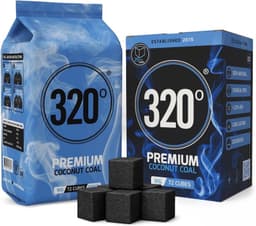
320° 320° (1 kg, 25 mm)

Best overall

320° 320° (1 kg, 25 mm)
9.2/10about £8.99
320° 320° (4 kg, 26 mm)

Best value

320° 320° (4 kg, 26 mm)
8.1/10about £30
KULL KULL (1 kg, 25 mm)

Alternative

KULL KULL (1 kg, 25 mm)
8.0/10about £7.99
On this page

Three fuels, not two

Lumpwood is irregular hardwood. It catches relatively quickly, and the heat moves when you rake it. Coconut briquettes are shell pressed into a repeatable shape, often with starch. Weber’s UK page names tapioca starch, about 20 minutes to light and up to 3 hours, on a 4 kg bag at £10.62, about £2.66 a kilogram. Big K quotes up to about 2 hours and calls that approximate. Cubes are the third column: about 22–27 mm, or a 25 × 25 × 15 mm flat, for a hookah coil and often labelled BBQ, at about £7–£10 a kilogram. Up to 100 minutes is one cube, not a kettle of briquettes. The listing checks are on the coconut charcoal buying guide.

Heat, time and ash

BBC Good Food says lumpwood lights quickly and often burns faster, while briquettes usually last longer. A 2025 paper citing BS EN 1860-2:2023 found lump samples generally hotter and briquettes generally longer and cooler. Those bags were Italian, not these ASINs. The caps it uses are 8% ash for charcoal and 18% for briquettes. ProQ’s claim of about 3–5% ash and a hotter burn sits against that cooler result. Neither is a result for these packs.
320° 320° (1 kg, 25 mm)

Testsieger

320° 320° (1 kg, 25 mm)
9.2/10about £8.99

Kettle and kamado

On an open kettle, lumpwood is the fuel when you want the coals to respond: rake a gap and the heat drops, bank the pieces and it returns, at the cost of a faster burn. Coconut briquettes suit a long grill or a covered roast when you would rather not refuel, at a price per kilogram well below hookah cubes. Ash is the kamado question. A small firebox can choke on dust, which is why ProQ sells coconut shell charcoal on a low-ash claim. The paper’s longer, cooler briquettes suit a steady pit temperature and not a fierce sear. A lower-ash briquette is a reasonable next sack. It is not a reason to fill the firebox with 25 mm cubes.

What this does not decide

Leave the eleven cube listings out of the bed-fuel choice. At about £7–£10 a kilogram they are a poor two-hour cook when Weber’s briquettes were about £2.66 a kilogram. For a fast hot sear, buy lumpwood. For a steadier longer bed, buy coconut briquettes and treat the hour claims as maker ceilings. Hookah cubes belong only on a small grill and a short cook. The coil and chimney clocks are on how to light coconut charcoal.

Common questions

Which burns hotter, lumpwood or coconut briquettes?
The 2025 paper that cites EN 1860-2 found lump samples generally hotter and briquettes generally longer and cooler. That was Italian commercial bags, not a UK shop test. ProQ’s coconut page claims a hotter burn than ordinary timber charcoal. Quote the paper for the measured pattern, and quote ProQ as the maker’s claim. Do not collapse them into one slogan.
Which lasts longer on a covered grill?
Briquettes usually last longer than lumpwood, which is both the BBC Good Food account and the paper’s longer, cooler briquette result. Weber prints up to 3 hours for its coconut briquettes, and Big K prints up to about 2 hours and calls the figure approximate. Your lid, the wind and how full the chimney was will move the real time. The figures are ceilings, not a booking.
Do coconut briquettes choke a kamado with ash?
They can, if the ash is high for that firebox. The standard cap cited for briquettes is 18% ash, which is a ceiling, not a typical bag. ProQ claims about 3–5% for its coconut shell charcoal. A cube bullet of under 2.5% is a different product and an unverified line. If your kamado clogs, a lower-ash briquette is the experiment, not a box of hookah cubes.
Can you taste coconut?
Nothing in these sources measures a coconut flavour on food. Weber’s briquettes name tapioca starch as the binder, which is a texture ingredient, not a flavour claim. ProQ talks about low odour. A starch smell in the first minute of lighting is what one cube listing calls normal, and that is during the start, before food. Do not expect the shell to season the meat, and do not expect it to be proved tasteless by a lab that was not run here.
Where do 25 mm cubes fit in this choice?
They do not. They are hookah pieces that some titles also point at a small grill. A 60–100 minute line is per cube on the listing, not a kettle session. They cost about £7–£10 a kilogram in this set, against about £2.66 for the Weber briquette bag. Use them only as the short-cook case on the barbecue page.
Is restaurant-grade the same as coconut?
No. Restaurant-grade on the Defra list, in the Big K example, is an authorised fuel for smoke-control rules on a chimney. Coconut describes the shell. A coconut briquette is not automatically that list entry, and a cube box that says BBQ is not restaurant charcoal. Check the list for the fuel you will burn indoors. A garden barbecue is a separate allowance.

Related pages

Sources

Public UK sources used for this comparison. Listing prices, stars and review counts are the amazon.co.uk figures for these ASINs. Retrieved 20 October 2026.

  1. GOV.UK: smoke control area rules (retrieved 20 October 2026)
  2. GOV.UK: selling manufactured solid fuels for domestic use in England (retrieved 20 October 2026)
  3. The Air Quality (Domestic Solid Fuels Standards) (England) Regulations 2020, Part 4 (retrieved 20 October 2026)
  4. NHS: carbon monoxide poisoning (retrieved 20 October 2026)
  5. London Fire Brigade: indoor barbecue carbon monoxide warning (retrieved 20 October 2026)
  6. Scottish Fire and Rescue Service: guide to safer barbecues (retrieved 20 October 2026)
  7. BSI: BS EN 1860-2:2023 barbecue charcoal and briquettes (retrieved 20 October 2026)
  8. Weber UK: coconut briquettes (retrieved 20 October 2026)