Independent comparisons. We may earn from shop links. More info

How to light coconut charcoal

Updated: 23 October 2026

You have a box of coconut charcoal, a match or a bottle of lighter fluid, and the coals are not catching. Natural coconut cubes are made to be heated through on a coil burner until every face is grey, not to flare from a dousing. How to light coconut charcoal depends on which pack you opened: a cube or flat that says it is not instant light, or a briquette that belongs in a chimney for about 20–30 minutes. The [coconut charcoal comparison](/hub/grill-accessories/coconut-charcoal) is the pack table if you are still choosing. This page does not rank ASINs. Links to Amazon may be affiliate links.

You have a box of coconut charcoal, a match or a bottle of lighter fluid, and the coals are not catching.

Our top picks

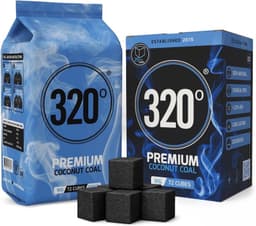
320° 320° (1 kg, 25 mm)

Best overall

320° 320° (1 kg, 25 mm)
9.2/10about £8.99
320° 320° (4 kg, 26 mm)

Best value

320° 320° (4 kg, 26 mm)
8.1/10about £30
KULL KULL (1 kg, 25 mm)

Alternative

KULL KULL (1 kg, 25 mm)
8.0/10about £7.99
On this page

Natural cubes are not quick-light

Quick-light charcoal is impregnated so a flame can start it. Natural cubes are not that product, even when a title says BBQ. KULL’s material field says not quick light. M. ROSENFELD’s bullets say not instant light. A match or lighter fluid is the wrong tool for either phrase. How to read those words is the coconut charcoal buying guide. The 320° discs say quick lighting and natural, and the file does not say which. Light them as natural coals, outdoors, and stop if you cannot get a grey coat without fluid.

Coil burner for cubes

M. ROSENFELD’s flats, 25 × 25 × 15 mm, are the only pack here with a full lighting line. They are not instant light. They go on a coil burner for 8–10 minutes until each side is ashed. A faint starch smell in the first minute is called normal. The burner is not in the box. Dry the cubes and turn them so the pale coat is not only on the bottom. Food, or a hookah bowl, waits until that coat is there. If a side is still black, leave the piece on the coil.
320° 320° (1 kg, 25 mm)

Testsieger

320° 320° (1 kg, 25 mm)
9.2/10about £8.99

Chimney for briquettes

Coconut briquettes are the pillow or hex for a kettle, not the 25 mm cube. Weber and Big K both point you at a chimney or wood-wool firelighters for about 20–30 minutes, until the pieces are grey. Weber says outdoors and no spirit. Big K calls the times approximate. Fill the chimney, light the firelighters underneath, and tip it out only when the top is grey. Scottish Fire and Rescue says use recognised firelighters on cold coals, and do not use petrol. If the top is still black at 30 minutes, wait. Do not pour fluid onto a warm column.

What goes wrong

Lighter fluid on a natural cube flares and leaves a patch that is still not through-hot. If the listing says not quick light, fluid does not convert it. A pack that will not stay lit after a proper coil heat, as some Zen reviews describe, is a return, not a second soaking. A cube that is grey on one face and black in the centre goes back on the coil. A cube that falls apart there will not improve in the bowl.

Common questions

Can you light natural coconut cubes with a match?
Not if the pack says not instant light or not quick light. M. ROSENFELD specifies a coil burner for 8–10 minutes until the pieces are ashed. KULL’s material line says not quick light, and a UK review complains that the coal has to be heated on a stove. A match is how quick-light charcoal is sold. These cubes are the other product.
How long on a coil burner?
The time written in this set is 8–10 minutes for the M. ROSENFELD flats, until each side is ashed. A brand method for a different cube quotes about 4–5 minutes plus a flip, and that figure was not measured on these ASINs. UK reviews elsewhere in the file mention about five minutes, or about 10–15 minutes, before a steady burn. Stay with the clock until the faces are grey.
Is a glass ceramic hob safe for cubes?
This page will not clear a glass hob. Shisha retailers disagree with each other, and the NHS forbids barbecues and camping stoves indoors and in tents because of carbon monoxide. Heat natural cubes outdoors on a coil burner. Do not move the job onto a balcony to get around that.
How do you light coconut briquettes in a chimney?
Use a chimney or wood-wool firelighters, outdoors, for about 20–30 minutes, until the briquettes are grey. Weber and Big K both describe a version of that, and both reject spirit. Tip the chimney out only after the top has ashed over. That half-hour is for briquettes, not for a single 25 mm cube.
What does ashed-over look like?
A grey coat on the faces you will use, with no large black patches. The M. ROSENFELD bullets use that as the end of the 8–10 minutes. Weber and Big K use the same visual cue before food goes on a briquette bed. An orange edge on a black cube is still lighting, not cooking heat.
Why do people say the coals will not light?
They are often trying a match or fluid on natural cubes, or they stop at the first orange spot. Damp storage does the same thing. Some review bodies, including Zen notes, describe packs that will not stay lit even after a long start. That is a bad box, not a reason to add petrol.
Where must you not light them?
Not indoors, not in a tent, not on a balcony, not on decking, and not with petrol. The NHS covers the indoor and tent ban. London Fire Brigade adds balconies, decking, petrol, and the hours a smouldering barbecue can keep making carbon monoxide. Suspected poisoning is NHS 111, or 999 if someone is struggling to breathe.

Related pages

Sources

Public UK sources used for this comparison. Listing prices, stars and review counts are the amazon.co.uk figures for these ASINs. Retrieved 20 October 2026.

  1. GOV.UK: smoke control area rules (retrieved 20 October 2026)
  2. GOV.UK: selling manufactured solid fuels for domestic use in England (retrieved 20 October 2026)
  3. The Air Quality (Domestic Solid Fuels Standards) (England) Regulations 2020, Part 4 (retrieved 20 October 2026)
  4. NHS: carbon monoxide poisoning (retrieved 20 October 2026)
  5. London Fire Brigade: indoor barbecue carbon monoxide warning (retrieved 20 October 2026)
  6. Scottish Fire and Rescue Service: guide to safer barbecues (retrieved 20 October 2026)
  7. BSI: BS EN 1860-2:2023 barbecue charcoal and briquettes (retrieved 20 October 2026)
  8. Weber UK: coconut briquettes (retrieved 20 October 2026)