Independent comparisons. We may earn from shop links. More info

How to light charcoal UK

Updated: 22 October 2026

You have the bag open, the grill outside, and a choice between stacking a chimney and tearing the corner of an instant-light sack. How to light charcoal UK, on this page, is the method for the fuels in the [charcoal comparison](/hub/grill-accessories/charcoal): safe steps and ready cues, not a ranking. Times such as 15 minutes, or ready within 30 minutes, are claims on the bag. You still judge heat at the grate. If you have not chosen lumpwood or instant-light yet, read the [charcoal buying guide](/hub/grill-accessories/charcoal/sub/charcoal-buying-guide) first. Peter F. used NHS, GOV.UK and London Fire Brigade for the limits. This is not a lab burn.

You have the bag open, the grill outside, and a choice between stacking a chimney and tearing the corner of an instant-light sack.

Our top picks

On this page

Before you light

Set the barbecue on level ground outdoors, away from sheds, fences, and dry grass. NHS guidance is explicit: do not use charcoal indoors or inside a tent. Carbon monoxide can build without obvious smoke. London Fire Brigade’s barbecue leaflet adds balconies, decking, and petrol, paraffin, or lighter fluid to the do-not list. GOV.UK fire safety outdoors covers enclosed spaces too: not under an awning you would sleep in, and not inside a caravan with the door shut. Use firelighters or a chimney starter on cold fuel. In a smoke control area, a garden barbecue is often still allowed outside, but a chimney on a building follows authorised-fuel rules. The bag does not replace that check. Lay about 5 cm of fuel across the base for a kettle-style fire, or follow the depth your grill maker specifies. More depth is not automatically better. A small camping grill chokes if you pour a 12 kg sack in whole.

Lumpwood with a chimney or firelighters

Fill the chimney with lumpwood. Big K CH10 or the Homefire 12 kg sack are the usual sack fuels in this set. Place firelighters or newspaper under the chimney and light those, not the food. Reviewers often describe about twenty minutes to a glowing column, but damp fuel or a windy day adds time. When the top coals are ash-grey, and you can hold a hand above them only briefly, tip them into the kettle and set direct or indirect zones. Some cooks pile lumpwood in a pyramid with firelighter cubes inside. That works when the fuel is dry. Homefire reviews include cases where cubes failed on damp lumps. Fix the fuel or switch to a chimney. Do not add petrol. White ash over the surface, and steady heat at cooking height, matter more than a single minute figure. CH10’s bag says ready within 30 minutes and up to 90 minutes of cooking. Treat that as a claim, not your timer. Fines light quickly and burn out. Fist-sized lumps need longer to core. Sort dusty material from the bottom of the bag if the grate is narrow. A pizza oven or a small kamado punishes dust first. Homefire’s saved additive line is messy, so follow the print on the sack in your hand.

Instant-light bags

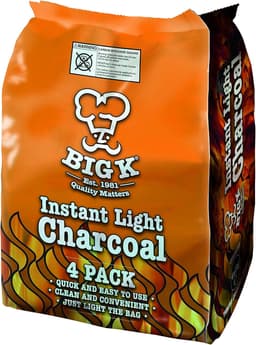
Treated 1 kg bags, including Big K IL04, are meant to light from a torn corner with a match or lighter, without pouring fluid. Follow the print on the bag you hold: light the corner, stand back from the first flare, and keep the bag on ground that will not catch until the fire is in the grill. The dedicated notes for these three listings are on instant light charcoal. IL04C’s listing mentions about 15 minutes. MOSKILA mentions about 20 minutes. Use both as hints. The failure UK reviews repeat is food that tastes of the starter when it went on while the bag still smelled sharp. Wait until that smell fades and the coals look ash-grey, even if that runs past the boldest time on the bag. Do not open these bags indoors, and do not store them in a hot car boot longer than you must. A multipack whose weight fields conflict does not change the lighting steps. It changes how much fuel you thought you had bought. Some MOSKILA reviews mention off-label uses. That is reviewer context, not a lighting instruction for a kettle.

Finishing and ash

When you finish, close the vents on a lidded kettle to starve the air, or spread the coals to cool on bare soil away from grass. GOV.UK guidance says not to tip hot ash into a wheelie bin. Fully cold ash can go to soil or to whatever your council allows. Partly burned lumpwood can sometimes relight next time if you keep it dry. Treated instant-light leftovers are less predictable. If flames reach a fence, or someone feels unwell after smoke in an enclosed space, stop cooking. NHS 111, or 999 for breathing difficulty, is the next step, not another firelighter. If you want a starter that is not lighter fluid, a wood wool firelighter is a separate comparison. This page stays with charcoal you already have.

When the coals are actually ready

If the fuel is sack lumpwood, light a chimney or dry firelighters outdoors and wait for ash-grey coals at the grate. If the fuel is a treated 1 kg bag, light the corner and wait until the starter smell has gone before food goes on. If the only way to keep the fire going is petrol, paraffin, or lighter fluid, stop. Those are the London Fire Brigade limits, and a dying fire is not a reason to ignore them.

Common questions

Chimney or firelighters for lumpwood?
A chimney gives the more consistent light on a sack of lumpwood such as CH10. Firelighters work on a dry pyramid and struggle on the damp loads some Homefire reviews describe. If the cubes fail, change the fuel or use the chimney. Do not pour petrol on either setup.
How do I light an instant-light bag?
Outdoors, open the marked corner, light the treated edge, and stand back from the first flare. Let the bag burn down, or tip the coals into the grill once they are stable. Never do this indoors, in a tent, or on a balcony. The smell test comes before the food, not after.
When are coals ready to cook on?
Look for ash-grey surfaces and stable heat at grate height. On instant-light, the starter smell also has to be gone. A printed 15 or 30 minutes is a claim on the bag. Damp fuel and wind both add time, so the grate is the clock.
Can I use lighter fluid on charcoal?
London Fire Brigade says no petrol, paraffin, or lighter fluid on barbecue coals. Use firelighters or a chimney for lumpwood, and the marked corner for a treated instant-light bag. A fire that is dying is still not a reason to add either fluid.
How do I put the fire out safely?
Shut the air on a lidded grill, or spread the coals so they cool on bare soil, away from grass, fences, and sheds. Do not leave a balcony grill unattended, and do not tip hot ash into a plastic bin. Stay with the fire until it is no longer burning.
What do I do with charcoal ash?
Cool it completely on soil first. Hot ash does not go in a wheelie bin. Fully cold ash can go to bare soil or to the disposal your council allows. Check local rules if you compost. The same cooling rule applies to lumpwood and to instant-light.
Can I relight partly burned charcoal?
Dry untreated lumpwood sometimes relights on the next cook if you kept it dry. Treated instant-light leftovers are less reliable. Damp pieces, from either type, are a hard light. Spread them to cool rather than forcing them with fluid.
Why does my food taste of chemicals?
Usually the food went on too soon, while an instant-light bag still smelled of the starter. Wait until that smell has gone and the coals are ash-grey. Next time, a no-additives sack such as CH10, lit with a chimney, avoids that treated lighting phase.

Related pages

Sources

Public UK sources used for this comparison. Listing prices, stars and review counts are the amazon.co.uk figures for these ASINs. Retrieved 21 October 2026.

  1. GOV.UK: smoke control area rules (retrieved 21 October 2026)
  2. GOV.UK: smoke control enforcement in England (retrieved 21 October 2026)
  3. Defra: authorised fuels in England (retrieved 21 October 2026)
  4. NHS: carbon monoxide poisoning (retrieved 21 October 2026)
  5. London Fire Brigade: barbecue safety leaflet, April 2024 (retrieved 21 October 2026)
  6. GOV.UK: fire safety outdoors (retrieved 21 October 2026)
  7. Weber: lumpwood and briquettes (retrieved 21 October 2026)
  8. Globaltic: what restaurant grade charcoal means (retrieved 21 October 2026)