Independent comparisons. We may earn from shop links. More info

Charcoal buying guide UK

Updated: 22 October 2026

You are about to buy a sack that says restaurant grade, or a small bag that lights at the corner, and the title weight looks cheap until you work out the price per kilogram. This charcoal buying guide UK orders the checks on the six bags in the [charcoal comparison](/hub/grill-accessories/charcoal): lumpwood sacks and instant-light bags, with no briquette in that table. You should finish knowing which form fits the cook, what the label is claiming, and when the fire has to stay outdoors. Named roles are on [best charcoal for BBQ UK](/hub/grill-accessories/charcoal/sub/charcoal-best). Lighting steps stay on [how to light charcoal](/hub/grill-accessories/charcoal/sub/charcoal-how-to-light). Peter F. used the amazon.co.uk listings. This is not a lab burn.

You are about to buy a sack that says restaurant grade, or a small bag that lights at the corner, and the title weight looks cheap until you work out the price per kilogram.

Our top picks

On this page

Lumpwood, briquettes and instant-light

Lumpwood is carbonised wood in irregular pieces. It tends to flare hot and finish sooner than a dense briquette bed, which is why kettle cooks often choose lump for a direct sear and look elsewhere for a long, even indirect burn. Briquettes are pressed fuel with binders. They live in other hub categories, including barbecue briquettes, not in this charcoal folder. Instant-light here means a treated bag, usually 1 kg, that you light from a corner without stacking a full chimney first. It is still lump-style charcoal in most of these listings, not a briquette, and it is not additive-free. Match the form to the job before you compare stars. A 10–12 kg lumpwood sack suits repeated garden cooks. A treated instant-light bag suits a camping grill or a single short session.

Six checks before you pay

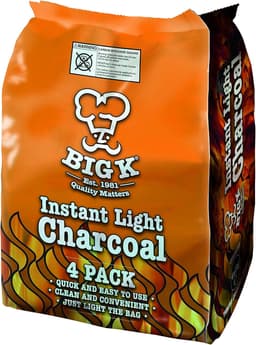
Form comes before stars. A 4 × 1 kg instant-light multipack is not interchangeable with a 10 kg sack. Piece size is the next split. Large lumps hold heat and airflow. Dust falls through the grate and can clog a chimney. Titles that sound large still collect fines complaints in UK reviews, so picture the open bag before you pay. Treated or not is a separate line. Big K IL04 states treated instant-light bags. Big K CH10 states no additives. If you want untreated fuel, the additive line is the filter, not the star average. Use a price per kilogram only when the title pack weight agrees with the item weight field. When they conflict, that figure is unknown, not a hidden discount. IL04C (B071GD1VRF) and MOSKILA (B00EUGEOGQ) are the clear examples: multipack wording and weight fields that do not line up on the saved page. Stated times are bag claims. Ready within 30 minutes, or about 15 minutes, is not a timer for your grate. Judge heat at the cooking surface. On instant-light, a starter smell means you waited too little.

Place, quantity and catalogue noise

The ordinary case is an outdoor kettle in the garden. NHS guidance keeps barbecue charcoal out of a tent, a garage, and a room. GOV.UK smoke control rules separate that garden fire from a chimney on a building, where you need an authorised fuel or an approved appliance. A balcony or decking setup runs into London Fire Brigade warnings. The bag does not fix the place. Kilogram figures from UK sellers are a rule of thumb, not a result from these bags. About 1–1.5 kg of lumpwood covers a direct cook on a 47–57 cm kettle, and a longer indirect cook uses more. Do not tip a 12 kg sack into a small kettle. Chilla-Grilla reviews often mention large lumps, but a Namibia line on the listing is not the same as a Defra entry for a different Big K restaurant grade charcoal from Argentina. Do not merge those into one chimney story. Ready to Burn marketing on wood does not automatically cover every barbecue charcoal sack on amazon.co.uk. On a messy multipack, judge the fuel lines and the weight fields, not a stray bullet.

If the checks disagree

If the title weight and the item weight agree, and the additive line matches the cook you want, you can compare a price per kilogram. If the weight lines conflict, stop that sum until the order page agrees. If the only place you can cook is a balcony, a tent, or a room, change the place before you change the bag. A no-additives sack with both fields at 10 kg is a different buy from a treated 1 kg bag, even when both sit in the same table.

Common questions

Lumpwood or briquettes for a kettle?
Lumpwood suits a hot, shorter direct cook, with irregular heat as pieces collapse. Briquettes suit a longer, steadier bed. Buy those from a briquette comparison, because none of the six charcoal bags here is a briquette sack. Instant-light bags in this folder are treated lump-style pieces, not pressed pillows.
What does restaurant grade mean in the UK?
It is a seller phrase, not a UK legal grade. Globaltic says a seller can print it without a certificate. It sometimes lines up with larger pieces, but reviews on restaurant grade titles in this set still report dust and small lumps. Look at the pieces when the sack arrives.
How do I compare price per kilogram when the weight field disagrees with the title?
Stop. Do not hold a price per kilogram in your head until the title weight, the unit count, and the item weight field agree on the order page you are paying on. A conflict is not a second, cheaper reading of the same bag. IL04C and MOSKILA are the listings in this set where that stop applies.
Are instant-light bags additive-free?
No. The instant-light listings in this folder are marked as treated. CH10 is the row that states no additives. Wait until any starter smell has gone before food goes on a treated bag. A blank additive field on another listing is not a no-additives claim.
How much charcoal do I need for one cook?
Seller guides often quote about 1–1.5 kg of lumpwood for a typical kettle direct session. Indirect or longer cooks use more. A small camping grill is closer to a single 1 kg instant-light bag than to a 10 kg or 12 kg sack. Treat those figures as planning guides, not a timed result from these bags.
Can I use any bag on a balcony or in a smoke control area?
Balcony barbecues are discouraged by fire services and may breach a lease. In a smoke control area, a garden barbecue is often allowed outdoors, but a chimney on a building needs an authorised fuel or an approved appliance. Check GOV.UK and the local rules. The choice of sack does not move the kettle indoors.
Does Ready to Burn apply to barbecue charcoal?
Do not assume it does. Ready to Burn marketing on wood and some manufactured solid fuels is aimed at other product types. These sacks still need outdoor use, a sensible distance from sheds and dry grass, and ash that is cold before it leaves the bare soil. The logo on a different fuel is not a pass for this bag.

Related pages

Sources

Public UK sources used for this comparison. Listing prices, stars and review counts are the amazon.co.uk figures for these ASINs. Retrieved 21 October 2026.

  1. GOV.UK: smoke control area rules (retrieved 21 October 2026)
  2. GOV.UK: smoke control enforcement in England (retrieved 21 October 2026)
  3. Defra: authorised fuels in England (retrieved 21 October 2026)
  4. NHS: carbon monoxide poisoning (retrieved 21 October 2026)
  5. London Fire Brigade: barbecue safety leaflet, April 2024 (retrieved 21 October 2026)
  6. GOV.UK: fire safety outdoors (retrieved 21 October 2026)
  7. Weber: lumpwood and briquettes (retrieved 21 October 2026)
  8. Globaltic: what restaurant grade charcoal means (retrieved 21 October 2026)