Left-handed wallpaper scissors: true reversed blades

Left-handed wallpaper scissors need reversed blades, not a swapped handle. See how to check orientation, length and whether ambidextrous shears will do.
On this page

You are at the ceiling with a pasted drop folded back over a crease, but the upper blade covers the line you need to follow. Squeezing harder makes the paper bunch, and turning the scissors sideways strains your wrist. Left-handed wallpaper scissors with genuinely reversed blades address that problem. An ambidextrous handle on its own does not.
In short
True left-handed wallpaper scissors place the top blade on the left when you look down the tool, so you can see the cutting line and your natural grip presses the edges together. Ambidextrous decorating shears may still suit occasional work, but judge them by blade orientation, visibility and cutting action, not by the handle label.
Reversed blades are not swapped handles
Scissors do not become left-handed because both handles share a shape. A true left-handed pair reverses the blades as well. Held in your left hand with the tips pointing away, the top blade is on the left, so you see the intended cut beside the upper blade instead of looking across it.
Your fingers and thumb apply sideways pressure as well as closing pressure. Correct geometry brings the cutting edges together. A conventional right-handed pair in your left hand can push the edges apart, so damp wallpaper folds into the gap or tears at the tip even when the edges feel sharp.
Ambidextrous usually describes a handle meant to work in either hand. It answers a different question from blade reversal. If you need to see the crease, ask whether the blades themselves are reversed. Our wallpapering scissors comparison covers six amazon.co.uk listings, and none states true reversed blades.
Cutting wet wallpaper left-handed
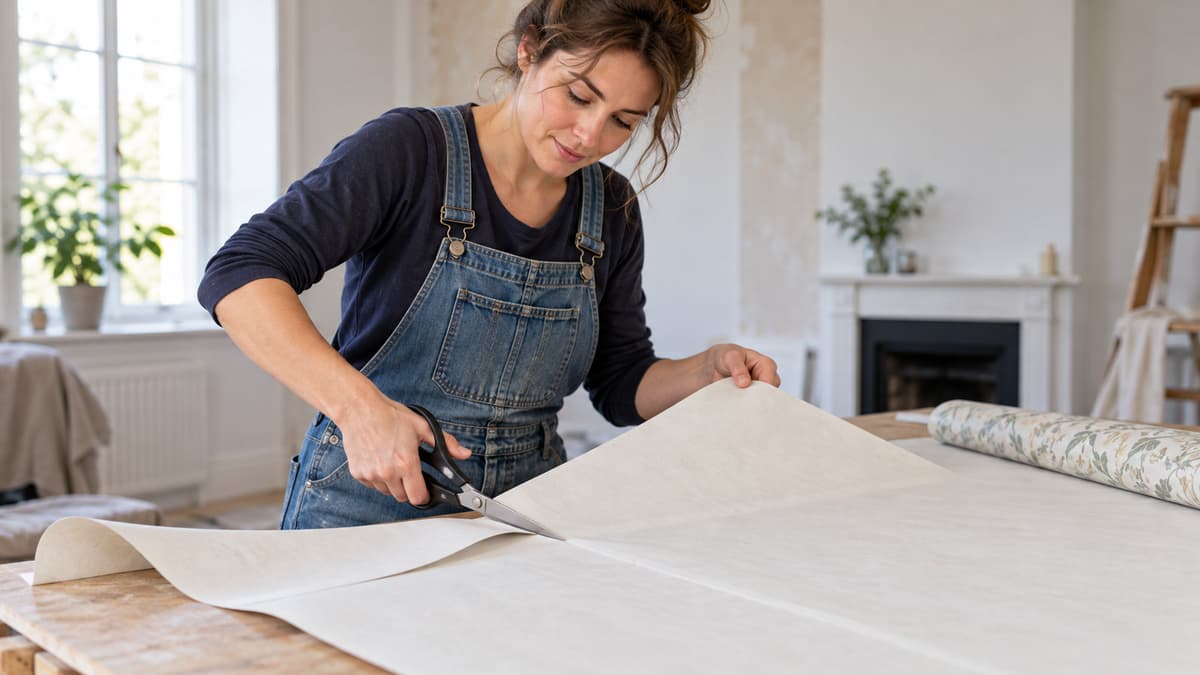
Wallpaper shows handedness more clearly than a quick cut through dry paper. You crease the pasted drop at the ceiling or skirting, peel it back slightly, and cut along that damp fold. The line can be faint, and paste makes poor blade contact obvious. You need to see just ahead of the tip while the sheet stays supported.
Right-handed blades in your left hand can put the upper blade between your eye and the crease. Cocking your wrist, pulling the paper sideways, or using short snips can move the cut off the fold. Reversed blades do not guarantee a straight finish. They remove that visibility problem and let you keep a more natural wrist.
Support the peeled-back paper, start cleanly, and close most of the blade without snapping the tips together. If the paper is very soft, wipe off paste rather than forcing the next cut. The fold-and-cut method is in how to trim with wallpaper scissors. A dry bench cut can sometimes suit a sharp knife and a guide. That is a task choice, not a cure for the wrong blades.
Three options for left-handed scissors
A dedicated reversed-blade pair
This is the clearest choice if you regularly lose sight of the line. The specialist Everest left-handed wallpaper scissors in the UK research are 25.4 cm, or 10 inches, with reversed blades. They were listed at £20.99 in October 2026, outside the six amazon.co.uk listings. Treat that as a dated specialist-retailer price, not today's amazon.co.uk cost.
The gain is proper left-handed blade orientation. The limit is length. Ten inches suits trimming, borders and repairs. Full drops and lining paper often want about 11 to 12 inches. Confirm both reversal and length before you order. A title that only says left-handed scissors is not automatically a paperhanging tool.
Ambidextrous decorating shears
Hamilton and Axus are listed as suitable for left- and right-handed use. The top pick is the Hamilton Perfection, listed on amazon.co.uk, at about £8.65 and 140 g, with an angled handle. Reviewers describe cuts on dry and pasted wallpaper through to the point. On 15 October 2026 the listing showed 4.6 from 159 reviews, though many of the texts are brief.
The only size line is 20 cm by 4 cm, and blade length is not stated, so reach is not confirmed. A qualifying purchase can earn us a commission at no extra cost to you. Either-hand wording does not prove reversed blades, and the upper blade may still sit on the right. Length, edge, pivot and grip are in the wallpaper scissors buying guide.
Right-handed defaults and general scissors
Harris and Draper are listed for the right hand. A low price does not remove the sight-line problem. The Harris 12 inch single is the best value, at about £4.00 and about 160 g, only if you already cut comfortably with conventional scissors in your left hand.
General-purpose left-handed scissors fix blade orientation and add another limit. A 21 cm craft pair needs more closures across a full width, which can leave a stepped edge. Kitchen, dressmaking and office scissors are not substitutes for paperhanging shears on a room-sized job.
Length, tip and weight
Handedness is the first filter, not the only one. For long drops and lining paper, about 275 to 300 mm overall means fewer closures and a more flowing cut. A 254 mm specialist left-handed pair trades some reach for easier control and the correct blades. Choose by whether the recurring problem is full-sheet speed or visibility at the trim.
Do not treat the title length as the cutting edge. Titles often include the handles. Long blades also need to meet near the tip. Extra length does nothing if the edges splay on wet paper.
Weight shows above shoulder height. The long Axus listing is around 320 g, and reviewer comments mention ache on overhead cuts. Harris and Hamilton are about 160 g and 140 g. Weight does not override blade orientation. Full-length jobs are compared in wallpaper scissors for long drops.
Ambidextrous means the listing claims either hand can use the handles. It does not mean the top blade sits on the left. If you cannot see the crease, the label has not solved the problem.
Check before you buy
Start with the photograph, not the headline. In your left hand, tips forwards, the top blade should sit on the left. If you only see closed scissors from the side, ask the retailer to confirm the arrangement in writing.
Confirm they are wallpaper or paperhanging shears, not ordinary left-handed craft scissors. Read the overall length, blade length if given, material, pivot and weight. Long blades usually earn their place on a full room. For borders, repairs or a small feature wall, control can matter more than reach.
On arrival, draw a pencil line on scrap and cut slowly in your normal left-handed posture. You should see the line just ahead of the upper blade. Then cut a lightly dampened offcut. The blades should meet from the pivot towards the tip without folding the sheet or twisting your wrist.
A poor result can come from a loose pivot, a damaged edge or the paper, as well as handedness. This is a usability check, not a laboratory test. Keep the packaging until the orientation matches the listing. If an ambidextrous model is enough, compare choices in the top wallpapering scissors overview.
Care and cutting habits
Paste dries around the pivot, adds drag, and can stop the blades meeting evenly. Wipe the scissors while you work, wash them in warm soapy water, and dry them completely. Do not leave them closed while wet, and do not drop them into a toolbox with paste still between the blades.
If a gap remains when the clean pair closes, forcing the next cut can crease the sheet and worsen your wrist. A damaged or permanently loose pair is better replaced, or sharpened properly, than squeezed harder.
Keep your wrist close to neutral, and move the platform instead of reaching sideways from a ladder. Reversed blades improve the view. They do not make an awkward overhead cut safe. If you cannot keep stable footing and control of the open tool, stop.
This page is from the Products Compared editorial team. The six amazon.co.uk listings were checked on 15 October 2026. We did not test these scissors in a lab, and none of the six is described as a true reversed-blade pair.
Common questions
Do I need true left-handed wallpaper scissors?
What is the difference between reversed blades and a swapped handle?
How can I tell whether scissors are genuinely left-handed?
Are ambidextrous wallpaper scissors suitable for left-handers?
Is a 10-inch pair long enough for wallpaper?
Can I use ordinary left-handed scissors for wallpaper?
Why does wet wallpaper fold instead of cutting cleanly?

Products Compared publishes British-English buying guides based on amazon.co.uk listings and public UK sources. We do not run a lab and we do not invent test scores.
Related articles

How to clean wallpaper scissors after paste
Remove paste from the blades and pivot, then dry your wallpaper scissors properly to help prevent sticking and rust.

What wallpaper scissors cost in the UK
See what different wallpaper-scissor price bands buy and when paying more may make sense.
How to cut lining paper straight
Use a measured fold, a clear cutting line and steady shears to prepare straighter lengths of lining paper.