Independent comparisons. We may earn from shop links. More info

Ratchet anvil loppers

Updated: 22 October 2026

You have closed the handles once, the stem is still there, and the jaws have sprung wide open. It feels like a fault. On ratchet anvil loppers that spring is how the tool resets. The blade has bitten, the pawl has held, and the next squeeze takes a shorter bite. You open the handles without leaving the stem, you hear the click, and you close again until the wood is through. This page is for that pump. The [anvil loppers comparison](/hub/garden-tree-and-hedge-shears/anvil-loppers) is the full table. Compound and gear, which finish in one stroke, stay on the [buying guide](/hub/garden-tree-and-hedge-shears/anvil-loppers/sub/anvil-loppers-buying-guide). If the jaws fly open on a thin offcut, you have not broken the lopper. You have asked a step-cut to do a one-stroke job. Peter F. read the listings. A qualifying purchase can earn a commission at no extra cost to you.

You have closed the handles once, the stem is still there, and the jaws have sprung wide open. It feels like a fault. On ratchet anvil loppers that spring is how the tool resets.

Our top picks

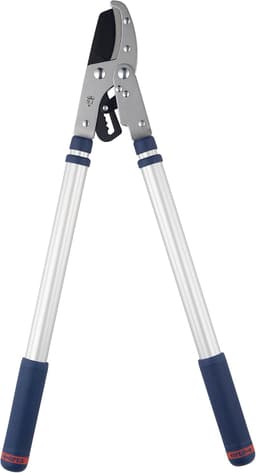
AGRICUT AGRICUT E-L-Serise

Alternative

AGRICUT AGRICUT E-L-Serise
5.9/10about £19.99
On this page

It stops, then you open it

Burgon & Ball describe the action in plain sequence. The ratchet stops part-way. You open the handles without the blade leaving the stem. It clicks. You close again, and you repeat until the cut finishes. They tie that action to anvil work where plant health is not the point, and they say it can boost power by as much as 100%. That percentage is their wording, not a measurement of the listings below. Gardeners' World’s review of a Spear & Jackson ratchet anvil says you squeeze and release until the branch is through. In their test a five-stage head cleared most branches in three passes. Their length note of 72–104 cm belongs to that article. It is not the amazon bullet for the 8100RS, which prints 800 mm, 72 cm and 28 inches in one sentence. The spring-open is the reset. The pawl holds the blade while the handles travel back for another bite. Buyers who meet this for the first time often file it as a defect, especially on the first thin stem. On a thick, dry stem the same spring is the reason the cut completes at all. Keep the stem deep in the jaw, near the fulcrum, for every pump. How to seat the wood and when to stop if the tool creaks is on the how to use anvil loppers page. If the handles are fully extended and the tubes bow before the last pump, the ratchet is not the part that failed.

Less force, more pumps

The trade is effort against time. Each squeeze can be lighter than one attempt to finish a thick stem, which is why a ratchet helps when your grip will not close a compound head in a single stroke. On the Spear & Jackson 8290RS, UK reviews say the jaws spring fully open and then take about four or five pumps to close. Buyers call that excellent on thick laurel and buddleia. They call it a waste of time on thin offcuts, where you still wait through the same wide reset for a stem a short gear drive would have taken once. One of those reviews says not to try to close the tool with both arms in a tight space. The handles need room to open fully so the pawl can reset. Twisting a stalled cut is how telescopic tubes bend. If the handles are already fully out and the cut stalls, shorten them or use a saw. Weak grip is a fair reason to choose the pump, with that time cost stated first. A basket of finger-thick prunings is the wrong afternoon for it. A single hard stem you cannot finish is the afternoon it was built for. The anvil face still means dead or dry wood. A lighter squeeze does not make the block kind to a green rose. The best anvil loppers page names who the deep-sample rows suit.

Three titles that say ratchet

Three listings in this set actually say ratchet. The Spear & Jackson 8100RS is about £22.86, with a stated cut of 42 mm on both the bullet and the cutting-width field, 4.6 from 6,529 reviews, and a twist lock. It is the largest sample, and it is the top pick in the comparison for that reason. The length bullet conflicts with itself. There is no spare blade. It is still a step-cut, so thin wood will feel slow, and overhead work is a skip if the 1.58 kg and the bent-handle reviews matter. The Spear & Jackson 8290RS is about £27.90, with 4.6 from 5,307 reviews. The cutting-width field says 2 inches. The bullets do not print a millimetre capacity. The bullet gives 400–800 mm with a twist and lock. Leave third-party and Australian lengths off this row. At 1.89 kg it is heavier than the 8100RS. The AGRICUT E-L-Serise is about £19.99. The title and the first bullet say a ratchet that cuts in stages, and they say 1.4 inches. The sample is 4.1 from 17 reviews. One of those texts says there is no ratchet. The title does not say the handles extend, though several of the 14 review texts describe telescopic handles. Field weight is 840 g and the bullet says 1.3 lbs. Treat the ratchet as a claim you can check when the parcel arrives. A 59HRC line on that page is seller wording. It does not outweigh 17 reviews.

Compound is a different squeeze

A compound head, and a gear drive, are built to finish in one stroke. They do not click, and they should not spring open as a reset. The Kimura Pro 302 is the light telescopic compound here, at 1.26 kg, 35 mm and about £44.99, with 4.6 from 179 reviews. One reviewer says they chose the compound version rather than the ratchet Kimura. The extra length, in those reviews, is for reach. It is not a set of hidden ratchet stages. The Grüntek Grizzly 470 is the short gear drive, 470 mm and 687 g, with dry wood stated to 29 mm, at about £24.98 and 4.6 from 5,042 reviews. It is the best value pick in the comparison for a one-stroke anvil you can already reach. It will not pump, and it will not extend. The Wolf-Garten RS900T does not belong in the ratchet choice. It is about £63.84, with 4.6 from 4,328 reviews and a 50 mm claim. The bullets do not say ratchet. Some UK reviews use the word. The listing does not, so do not buy the RS900T because a review remembered a click. It is also not the Gardeners' World telescopic bypass at £124.99 RRP. Handles fully out, a thick stem, a creak or a bow: shorten the tubes or pick up a saw. A ratchet gives you another squeeze. It does not give you a stronger tube. In England, look for an active nest before you clear a hedge, and ask about a Tree Preservation Order before you lop a tree that might be protected.

Common questions

How does a ratchet lopper cut?
It cuts in steps. You squeeze until the ratchet holds, open the handles without taking the blade off the stem, wait for the click, and close again. Burgon & Ball describe that open-click-close sequence, and they attach it to anvil work on wood you are not trying to heal. Gardeners' World watched a five-stage Spear & Jackson head finish most of their test branches in about three passes. You keep going until the stem is through. The first stop is the mechanism working. A single close that finishes a thin stem is what a compound or gear head is for, and those tools are a different buy.
Why do the jaws spring wide open?
The spring resets the handles so the pawl can take the next bite, while the blade stays in the cut. On the 8290RS, UK reviews say the jaws spring fully open and then need about four or five pumps to close. That looks like a fault the first time, especially on a thin offcut that did not need a hold. On a thick, dry stem it is the reason you can finish without one enormous squeeze. If the blade leaves the stem when you open the handles, you have not kept the jaw seated. If it stays and clicks, the tool is doing what a ratchet does.
Are ratchet loppers better if my grip is weak?
They can be, because each squeeze is a fraction of the cut and can be lighter than one attempt to finish a thick stem. The cost is time, and room for the handles to open. UK reviews praise that on thick laurel and buddleia, and they complain on a pile of thin prunings. One reviewer says not to work it with both arms in a tight space, because the handles need to travel. A weak grip on a single hard, dead stem is the case that fits. A weak grip and a bucket of finger-thick twigs is the case for a short one-stroke anvil instead.
Why are they slow on thin branches?
The reset is sized for a stem that will not finish in one close. On a thin offcut you still open the handles through the full spring, often four or five times on the 8290RS pattern, for a cut that a 470 mm gear drive would have ended immediately. The tool is not blunt. It is stepwise. If most of your afternoon is thin, dry waste you can reach easily, a compound or gear anvil will feel quicker. Keep the ratchet for the stem that stalls a one-stroke head. Mixing both jobs in one hour is why the pump starts to feel like a defect.
Which listings in this set actually say ratchet?
The Spear & Jackson 8100RS, the Spear & Jackson 8290RS, and the AGRICUT title. The 8100RS is about £22.86, 42 mm, 4.6 from 6,529 reviews. The 8290RS is about £27.90, a 2 inch cutting-width field, 400–800 mm in the bullet, 4.6 from 5,307 reviews. The AGRICUT is about £19.99, 1.4 inches, 4.1 from 17 reviews, and one of those reviews says there is no ratchet. Prefer the two Spear & Jackson rows when you want the mechanism and a deep sample. Check the AGRICUT against its own title if you buy it, because the file already disagrees with itself.
Is the Wolf-Garten RS900T a ratchet?
The bullets do not say so. They list a 50 mm cut, a 900 mm length in one line, 1-K plastic handles, a non-stick blade and a 10-year guarantee, at about £63.84 with 4.6 from 4,328 reviews. Some UK reviews use the word ratchet. That is not the same as the listing claiming one. Do not add a pawl to this row, and do not confuse it with a Wolf telescopic bypass reviewed elsewhere at £124.99 RRP. If a click is what you need, use a page that prints the word. If you buy the RS900T, buy it as the anvil the bullets describe.
Is the Kimura Pro 302 a ratchet?
No. The Pro 302 is a compound extendable anvil. The bullets say compound action, with a stated cut of 35 mm and handles from 650 mm to 950 mm, at 1.26 kg and about £44.99. One review says the buyer chose that compound version rather than the ratchet version. The extra length is described as reach, not as staged cuts. If the jaws on a Pro 302 spring open the way a 8290RS does, that is a different complaint. It is not evidence this model is a ratchet. The ratchet Kimura is a different product and it is not this row.
What should I do if the handles are fully out and the cut stalls?
Shorten the handles, reseat the stem at the back of the jaw, and try another pump. If the tubes bow or the tool creaks, stop and use a saw. Do not twist a stalled ratchet to force the last stage. Reviews of the long anvils in this set, including both Spear & Jackson rows, describe handles that bend at full extension on a thick stem. A ratchet gives you more squeezes. It does not stiffen an extended tube. The same stop applies if you cannot keep both feet on the ground. At that point the next person is an arborist, not another click.

Related pages

Sources

Public UK sources used for this comparison. Listing prices, stars, and review counts are from amazon.co.uk on 20 October 2026.

  1. Burgon & Ball — anvil, bypass or scissor (retrieved 20.10.2026)
  2. RHS — pruning trees and shrubs (retrieved 20.10.2026)
  3. RHS — renovating overgrown climbers (retrieved 20.10.2026)
  4. Arboricultural Association — guide to pruning (retrieved 20.10.2026)
  5. GOV.UK — tree preservation orders (retrieved 20.10.2026)
  6. Consumer Rights Act 2015 — goods contract rights (retrieved 20.10.2026)
  7. Spear & Jackson — Razorsharp 8100RS (retrieved 20.10.2026)
  8. HSE — manual handling in agriculture (retrieved 20.10.2026)