Independent comparisons. We may earn from shop links. More info

Plastic vs metal snow shovel

Updated: 21.10.2026

You are choosing a blade before the next fall: a plastic face for the patio and the car, or a metal blade because last year’s snow turned to a crust. Plastic vs metal snow shovel is that trade-off, not a re-ranking of seven listings. Fresh snow and a surface you do not want marked point to plastic. Ice you must cut, on a surface that can take a scratch, points to metal or to a stated wear strip. The [plastic snow shovel comparison](/hub/garden-tools/plastic-snow-shovel) keeps the plastic-leaning rows.

You are choosing a blade before the next fall: a plastic face for the patio and the car, or a metal blade because last year’s snow turned to a crust.

Our top picks

On this page

The trade-off

A plastic blade is lighter, and snow is less inclined to stick to it than to an ordinary shovel. Gloucestershire County Council and Essex Highways both name a lightweight plastic shovel for that reason. ManoMano’s removal guide makes the matching point from the retail side: metal cuts ice and can damage surfaces, while plastic is lighter and scratches less, and plastic can break. Parkers says the same thing for cars. Aluminium and steel listings were taken out so this category could stay on plastic faces. They are not brought back here as hidden winners. You can still decide the material. You cannot treat a deleted metal ASIN as if it had won a comparison it was not in.

Fresh snow

For fresh snow, start with plastic. The councils are describing the first clear of a path, not a week-old ridge. A wide plastic face pushes powder that would cling to a steel shovel and then drop off in lumps on the return stroke. The EarlyGrow at £14.95 states that face: a plastic blade, a wooden handle, a 42.5 cm head, and 125 cm. The EarlyGrow at £16.95 states plastic in the table and lists 140 cm. A plastic scoop bought for three snow mornings a year still shifts leaves, and the blade that does not rust in a damp shed is the one you will find in November. If the snow has already been walked into a crust, this advantage shrinks. Do not pour water on either material to hurry that crust. Water freezes, whatever the blade is made of.

Ice and wear strips

A metal edge, or a metal blade, is what you use when you must break a crust and the surface underneath can take a mark. The edge bites. It also leaves lines on block paving and on paint. One UK review of the £16.95 EarlyGrow said the plastic blade did not scratch monoblock. That is one review, not a test. A scraper in a car kit is not a metal shovel blade. The LESOLEIL includes an ice scraper and a brush beside the shovel. The scraper is for glass. It does not settle the material conflict on that listing: the table says a polypropylene blade and the bullet says aluminium blades. When the crust wins, stop. Salt the exposed surface at about a tablespoon per square metre, as the Met Office snow code puts it, rather than hacking at the ice with the wrong edge.

Cars, patios, and hybrids

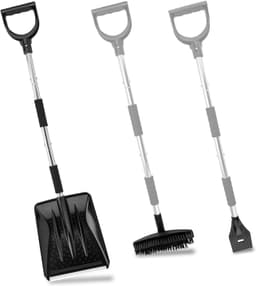
On a car, Parkers’ advice is the practical one: plastic is less likely to scratch paint than metal, and it is the weaker tool on packed snow around the wheels. Keep the blade flat. A metal edge that frees a tyre can also mark the sill if you stab rather than push. The BUERPINKING bullet states a polymer blade on an aluminium alloy head, at 80 cm and 112 cm, with no review line in the saved listing. The LESOLEIL states both materials in conflict, so you do not know which blade will arrive. The UMUACCAN does not state a blade at all. Reviews mention a metal edge, at £25.99, with a short handle that reviewers used to dig a car out.

Common questions

Is plastic or metal better for snow?
Plastic is the better start for fresh snow, because it is lighter and snow sticks to it less than to an ordinary blade. Metal, or a stated metal edge, is the better start for a crust you have to cut, if the surface can be marked. Neither wins every path.
Will plastic scratch block paving?
It is less likely to than a steel edge, and it is not a guarantee. One EarlyGrow review said the plastic blade did not scratch monoblock. That is a single report. Grit trapped under any blade can still mark a block.
Will metal scratch a car?
It may. Parkers says metal is stronger and can scratch paint, and that plastic is less likely to. A metal edge used to chip ice off a sill is the usual way the scratch happens.
Do I need a metal edge for ice?
You need one if a plain plastic face is skating over a crust and you are willing to mark the surface. You do not need one for fresh snow on a path. A kit scraper is for windows. It does not count as the wear strip on the blade.
What is a shovel that is plastic and metal at once?
In this set, the BUERPINKING says a polymer blade and an alloy head in the same bullet. The LESOLEIL says polypropylene in the table and aluminium blades in the bullet, which is a conflict rather than a designed hybrid. The UMUACCAN never names the blade, and reviews mention a metal edge.
Why was an aluminium shovel left out of this comparison?
This category kept listings with a plastic, polypropylene, polymer, or polyurethane face stated, or a car tool still in the plastic set. Aluminium and steel shovels were removed. They are not re-listed here, and they were not scored against these seven. If you want metal, that is a different table.

Related pages

Sources

Public UK sources used for this comparison. Listing prices, stars, and review counts are the figures printed in the amazon.co.uk saved listings.

  1. GOV.UK — Clear snow from a road, path or cycleway (retrieved October 2026)
  2. Met Office — Clearing paths and driveways (retrieved October 2026)
  3. HSE — Good handling technique (retrieved October 2026)
  4. Manual Handling Operations Regulations 1992 (retrieved October 2026)
  5. Consumer Rights Act 2015, section 22 (retrieved October 2026)
  6. Highway Code — Driving in adverse weather (rules 226 to 237) (retrieved October 2026)
  7. Gloucestershire County Council — Tools to clear snow or ice (retrieved October 2026)
  8. ManoMano — Snow removal tools buying guide (retrieved October 2026)