Independent comparisons. We may earn from shop links. More info

Petrol auger for fence posts

Updated: 21.10.2026

The posts are in the drive, a 1.8 metre panel fence is the job, and the kit you are looking at stops at a 200 mm bit. A petrol auger for fence posts has to settle depth and width before you buy, because UK rules of thumb and a normal bit set do not always agree. The listings are on the [petrol earth auger comparison](/hub/garden-tools/petrol-earth-auger). The Products Compared editorial team set those amazon.co.uk files against public UK fencing guides on 20 October 2026. The figures below are rules of thumb, not building regulations. A purchase through our links may earn a commission at no extra cost to you.

The posts are in the drive, a 1.8 metre panel fence is the job, and the kit you are looking at stops at a 200 mm bit.

Our top picks

On this page

Depth first

A common domestic starting point is about 600 mm of hole, or at least one third of the post in the ground, and deeper on clay or an exposed site. Fencing and Landscape Supplies states that pattern. DIY Doctor's chart, using above-ground height divided by three, gives a 75 mm post with 1.8 metres above ground a hole about 600 mm deep. That is a publisher's rule of thumb, not a calculation for a retaining wall or a tall gate. The Draper 30278 bullets claim up to 800 mm. The Donened kit at £109.99 names an extension and does not state its length, so you cannot add centimetres you have not measured. If the site needs more than the rule of thumb, the bit length is the limit and the rest is a spade.

Width, and why trades argue

Width is where the kit and the chart part company. DIY Doctor's chart gives the 75 mm post a hole about 230 mm wide, and the 100 mm post a hole about 300 mm wide, from an about three times the post rule of thumb. A 200 mm bit cannot bore 230 mm or 300 mm. On a MyJobQuote thread, several fitters want a 200 mm auger so there is room for post mix. Others say 150 mm is enough and that a tighter hole keeps the post from wandering while the mix sets. Ron Smith's guide puts roughly 100–150 mm with lighter work, roughly 200–250 mm with domestic posts, and 300 mm and above with heavier supports. For a normal panel on a 75 mm post, 200 mm is the bit that buys mix room inside this set's common kits.

What these listings can bore

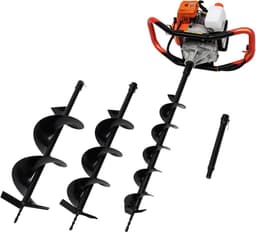
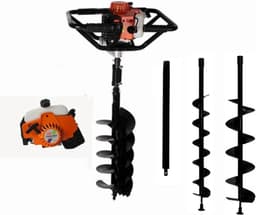
Two files name 100 mm, 150 mm and 200 mm without a second diameter list. The Draper 30278 bullets do, with the 800 mm claim, at £214.79. The Donened kit at £109.99 names the same three diameters, plus an extension of unstated length. The 150 mm bit is the tighter option the MyJobQuote replies argue for. The 200 mm bit is the one that gives the post room. The kyco listing at £360 is the only kept file whose title names a 300 mm bit, beside 100 mm and 200 mm. It does not state a depth, so 300 mm is a diameter and not a stand-in for the 600 mm rule. There is no star line, and the included line does not repeat the bits. The £145.99 Generic page says 80 cm in the title and 4, 6 and 8 inch on the colour line, and it also says 63 cc against 52 cc, so those inch sizes are not confirmed. The £60.50 powerhead and the £75.83 page do not list diameters at all. How to tell a kit from a powerhead is on the petrol earth auger buying guide.

When the bit is the wrong tool

Widen by hand when the chart asks for more than the bit and you have accepted a 200 mm bore as the round part of the hole. Drill to the depth you chose, then shave the sides with a spade until the post stands plumb in a continuous collar of mix. Heavier supports, including a hanging post that carries a gate, are where the 300 mm band starts. Rubble, roots and a hole that will not stay open are stop conditions. The sequence and the jam are on how to use a petrol earth auger. Match the bit to the post you can plumb and backfill, and treat three times the width as a rule of thumb a 200 mm kit may not reach.

Common questions

Do I need 150 mm or 200 mm for a 3-inch post?
A 3-inch post is about 75 mm. Fitters on MyJobQuote split: some want 200 mm so the post can be plumbed in mix, and some want 150 mm because the post is easier to hold still. Neither reaches the 230 mm on DIY Doctor's chart. That chart is a rule of thumb.
Is 100 mm any use for fencing?
It bores a hole barely larger than a slim post, with almost no room for mix or for correcting a lean. In the Draper and Donened kits it is the small bit beside 150 mm and 200 mm. For a panel fence, step up.
How deep is 800 mm in practice?
It is the Draper 30278's claimed maximum, and it covers a 600 mm domestic hole with the powerhead still above the spoil. It does not mean every panel post should go to 800 mm. The Donened kit does not state a depth at all.
Will a 200 mm bit match a three times the post hole?
For a 75 mm post, three times the width is about 230 mm, so a 200 mm bit is close and still short. For a 100 mm post, three times is about 300 mm, and a 200 mm bit is a third narrower. Pushing harder does not turn a 200 mm flight into a 300 mm hole.
Which listing in this set names 300 mm?
The kyco page at £360. The title names 100 mm, 200 mm and 300 mm bits. It does not name a depth, it has no reviews, and the included line says "engine drill" without repeating those bits. The 300 mm figure is a diameter.

Related pages

Sources

Public UK sources used for this comparison. Listing prices, stars, and review counts are the six kept amazon.co.uk files. Scores were updated on 20 October 2026.

  1. HSE — Control of Vibration at Work Regulations (retrieved 20.10.2026)
  2. HSE — INDG480, vibration in horticulture (retrieved 20.10.2026)
  3. Control of Noise at Work Regulations 2005 (retrieved 20.10.2026)
  4. GOV.UK — E10 petrol explained (retrieved 20.10.2026)
  5. HSE — Underground cables (retrieved 20.10.2026)
  6. LSBUD — UK utility-map search (retrieved 20.10.2026)
  7. Draper Tools — petrol earth auger 30278 (retrieved 20.10.2026)
  8. Ron Smith — choosing an earth auger (retrieved 20.10.2026)