Independent comparisons. We may earn from shop links. More info

How to use a handheld seed spreader

Updated: 21.10.2026

You have a bag of grass seed or lawn feed, a jug or a crank in your hand, and a lawn that will show every stripe for a fortnight. The job is to hit the rate on the bag without dumping a pile at the turn or walking back over a bald patch. A handheld seed spreader only meters what you put in it. It does not know your lawn. This page is the walk, not a ranking of amazon.co.uk rows. The models and prices are on the [Hand spreader](/hub/garden-tools/hand-spreader) comparison. A qualifying purchase can earn a commission at no extra cost to you.

You have a bag of grass seed or lawn feed, a jug or a crank in your hand, and a lawn that will show every stripe for a fortnight.

Our top picks

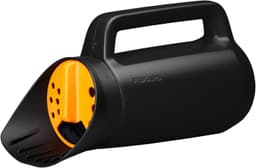
Fiskars Fiskars Solid spreader

Best overall

Fiskars Fiskars Solid spreader
8.8/10about £12.20
UTMHGU UTMHGU 2.5 litre shaker

Alternative

UTMHGU UTMHGU 2.5 litre shaker
7.3/10about £15.99
On this page

Start from the bag, not the dial

Read the packet before you touch a setting. RHS guidance for patch repairs is often about 15–25 g per square metre, and a full sow from seed is whatever the bag prints for your mix. The packet overrides the generic band. That range is not a setting on the Gardena M, and it is not a hole number on a 2.5 litre jug. ICL publishes example settings for named HandyPro fertilisers. Copying setting 3 or setting 5 from that page onto a shop crank will not reproduce their rate. Weigh what you need for a known patch, then split it. For seed, the RHS method is to sow half in one direction and the other half at right angles, then rake lightly so the seed is in contact with soil and not sitting as a green dust on the surface. For feed, you are checking coverage, not raking granules into the crown. A practical test, which ICL describes for a handheld, is to lay a sheet over about a square metre of hard ground, walk it as you mean to walk the lawn, and weigh what landed. If the sheet is heavy, close the gate or slow the pour. If it is almost empty, open one step and repeat. Do that before you commit the whole bag. There is no Gardena step in this comparison that equals 25 g per square metre. The listing gives four quantity steps and a thumb shut-off, not a gram table. The jugs give hole sizes or a dial. Your sheet test is the calibration. Mark the step that matched the bag, and use that mark only for this product.

Walk so the fan overlaps

Pick a still day and a lawn that is not soaking. Wind takes fine seed off the line you think you are walking. Wet grass makes granules stick in the gate, which is the same complaint UK reviews make about fertiliser left in a Gardena and about weed-and-feed in a Fiskars shaker. Keep a steady pace. Changing speed changes the rate even when the dial does not move. Start walking before you open the gate, and close it before you stop, so the pile that would have fallen at your feet never starts. On a crank, the disc throws a fan that is heavier in the middle. Ron Smith's grounds note treats an overlap of about a quarter of the width as a rule of thumb for wheeled rotary work, and it is a fair picture for the Gardena's 1–4 m claim as well. It is not a British Standard. Shut the thumb control when you turn at the flower bed. Two directions still help: half the granules one way, half at right angles, so a missed stripe gets a second chance. A jug does not throw that fan. You pour where you tip it, in a narrower band, so the overlap is simply the next pass of the jug rather than a quarter of 4 m. Walk the same two directions. If the seed is still landing in lumps, the hole is too large or you are tipping too hard, and the shaker spreader or crank spreader page is the place to decide whether a disc would have been the tool. Keep weed-and-feed and any pesticide granules off the border and away from drains.
Fiskars Fiskars Solid spreader

Testsieger

Fiskars Fiskars Solid spreader
8.8/10about £12.20

When the granules will not flow

Nothing coming out is usually moisture, hole size, or a gate that is not actually open. Bone-dry product is the first check. A UK review of the Fiskars says weed-and-feed must be dry or the shaker clogs. Gardena reviews mention fertiliser sticking. Tip the hopper back into the bag if you can, break the bridge with a dry stick, and do not add water. A smaller hole is right for fine seed and wrong for coarse prills. STOWBERRY reviews include one note that the smaller holes do not really work, beside other notes that feed and seed move once the dial is set. Open one step and test on the sheet again. Fill is the other jam. A lid that will not lock because the tub is heaped will fall off on the first shake. One Yiddeoont UK review says the lid failed and spilled grass seed. Leave headroom, press the lid until it clicks, and shake once over the patio. If a new crank will not turn at all, stop. Greenera's UK reviews include jammed spinners, and a seized new tool is not something you calibrate. The Consumer Rights Act 2015 gives 30 days to reject faulty goods.

After you finish

Empty the hopper back into a dry tub or the original bag if the label allows storage. Do not leave seed or feed in the tool in a shed that gets damp overnight. Rinse the jug or the crank with clean water until the gate runs clear, then let it dry open before you put it away. A hopper that still holds fertiliser will cake, and a hopper that still holds salt will be a poor place for seed next month. The LYAZKMY bullets do not list gloves even though one UK review found a pair in the box, so do not assume they are included. If the next job is winter grit, use the hand spreader rock salt page for grams per square metre. Do not invent a salt setting from the seed test you just did. The sheet method is the same idea. The rate on the salt bag, or the supplier guidance, is a different number. When the label is a professional pesticide you are not trained to apply, that is the point to stop and get someone who does that work.

Common questions

What setting should I use for grass seed?
Use the rate on your seed packet, not a borrowed dial number. RHS patch work is often about 15–25 g per square metre, and the packet still wins if it prints something else. Weigh a square metre onto a sheet, then move the Gardena's four steps or the jug's holes until the sheet matches. ICL's HandyPro settings belong to named fertilisers. They are not a universal step for this crank or for a shaker.
How do I stop pale and dark stripes?
Stripes are uneven rate, usually a fan that is heavier in the middle, a pace that changes, or a gate left open on the turn. Overlap roughly a quarter of a rotary width as a rule of thumb, shut off when you turn, and put the second half of the seed at right angles to the first. On a jug, overlap the pours in the same two directions. Test the rate on a sheet before you cross the lawn, so the first stripe is not the experiment.
What if nothing comes out of the holes?
Check that the product is dry, that the gate is actually open, and that the hole is large enough for that granule. Damp weed-and-feed clogs a Fiskars in UK reviews, and fertiliser can stick in a crank. Do not add water. If the lid was overfilled it may have unlocked. If a brand-new crank is seized, stop and speak to the seller rather than forcing the handle.
Can I spread in the wind or on wet grass?
Wind blows fine seed off the line, and wet grass makes granules stick in the holes and on the disc. Wait for a dry, still spell. If the bag has already taken on moisture, it will bridge in the hopper even on a dry lawn. A light dew is enough to turn a free-flowing feed into the clog UK reviewers describe. Cover the bag while you test the sheet.
How full should the jug be?
Full enough to finish a small patch, and empty enough that the lid still locks. Heaping the tub is how lids come off and spill seed, which is a UK review theme on these jugs. Gardena's seed bullet says about 1.0 kg, and one UK review managed about 400 g, so treat the bullet as a claim and the review as a warning to test. Litres are not kilograms. A 2.5 litre tub of dense feed is a heavy carry at arm's length.
Do I rinse between seed and fertiliser?
Yes. Empty the hopper, rinse until the gate runs clear, and dry it before the next product. Fertiliser left in the tool cakes. Salt left in the tool is worse, and it does not belong in a seed sow later. Gloves for the rinse are sensible. Salt rates and the winter walk are a different number from today's seed setting.

Related pages

Sources

Public UK sources used for this comparison. Listing prices, stars, and review counts are the amazon.co.uk figures saved with these products. The page was updated in October 2026.

  1. Gardena UK — Hand-held Spreader M (retrieved October 2026)
  2. Garden Ninja — Best lawn spreaders UK buying guide (retrieved October 2026)
  3. ICL UK — Calibrating your HandyPro handheld spreader (retrieved October 2026)
  4. RHS — Lawns from seed (retrieved October 2026)
  5. RHS — Repairing lawns (retrieved October 2026)
  6. GOV.UK — Using nitrogen fertilisers in nitrate vulnerable zones (retrieved October 2026)
  7. legislation.gov.uk — Consumer Rights Act 2015, section 23 (retrieved October 2026)
  8. IBT Merchants — Using rock salt in winter (retrieved October 2026)