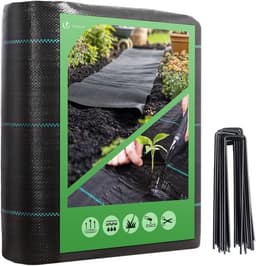
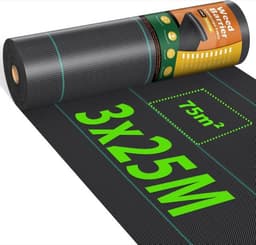
Independent comparisons. We may earn from shop links. More info

Woven weed membrane vs plastic sheeting

Updated: 22 October 2026

Woven weed membrane vs plastic sheeting is the split between a tape weave that is sold to let water through, a non-woven felt sold for lighter beds, and a solid polythene sheet that holds rain on its face. For a planted border or a gravel path, choose a permeable woven or non-woven fabric. Solid polythene behaves as a different product, and a garden roll is not a drainage geotextile just because a bullet says geotextile. The twelve amazon.co.uk listings are on our [ground cover](/hub/garden-supplies/ground-cover) comparison. A qualifying purchase can earn us a commission at no extra cost to you.

Woven weed membrane vs plastic sheeting is the split between a tape weave that is sold to let water through, a non-woven felt sold for lighter beds, and a solid polythene sheet that holds rain on its face.

Our top picks

On this page

What each sheet is for

Woven membrane is polypropylene tape, crossed and locked so the sheet stays a fabric. Ground Cover Solutions publishes Groundtex as a woven polypropylene at 100 g/m², with the EN ISO tests printed on that data sheet. Which? uses Mypex and Groundtex as its woven examples. Those names are not a test result for these twelve listings. Non-woven membrane is a felt or spunbond mat, fibres tangled rather than woven as tapes. On the same supplier’s sheets, Weedtex is a spunbond non-woven at 50 g/m², aimed at lighter beds rather than at stabilising a drive. Solid black polythene is a continuous film. It blocks light, and it also blocks water.

Water and light

The Royal Horticultural Society’s mulch guidance is the clean line for a planted bed. A permeable sheet lets rain through to the soil. A waterproof sheet can send that rain off as runoff, so the bed stays dry underneath while the path beside it takes the water. After a wet hour, lift a corner. Dark soil under a woven sheet, and a dry crust under polythene, tells you which product you actually laid. An impermeable mulch around establishing trees is a narrower job. It is a poor reason to line a whole border or a gravel path with damp-proof membrane. The order of work is on how to lay weed membrane.

A named standard versus a garden bullet

BS EN 13252 is the British Standard for geotextiles and geotextile-related products used in drainage systems. It covers the characteristics needed for filtration, separation and drainage together. Separation is not specified on its own, so a fabric that merely sits between soil and bark has not met 13252 by being in the garden. No garden ASIN in this set cites it. A bullet that says geotextile is a word on a listing. It does not attach the standard, the test method, or a declared water flow. These twelve files are sold as weed membrane or landscape fabric. Ask the file for grams per square metre. That next step is the ground cover buying guide.

What this comparison actually sells

All twelve listings in the set are sold as membrane or fabric. None of the files is labelled non-woven. jxgzyy says degradable and polypropylene in the same breath, which is a pair of claims you should read together before you treat the roll as a permanent weave or as something that quietly disappears. Vivo says it outperforms woven covers, while the title says woven. That is a conflict, not a reason to call the roll non-woven felt. For a planted bed or a gravel path, choose a permeable sheet, covered so the sun stays off it. Choose solid polythene only when you truly want a waterproof cap, and accept the runoff the RHS describes. When the polypropylene comes up, official guidance says plastic need not be collected with garden waste in England.

Common questions

Will woven fabric puddle?
A woven weed membrane is sold to let water through. It can still puddle if the lap is laid like a gutter, if the ground is compacted to a pan, or if a particular roll does not pass water the way the title suggests. One buyer note in this set, on an iropro roll used under stone, said water did not pass.
When is black polythene the wrong sheet?
Use it only when you want a waterproof layer and you have somewhere for the runoff to go. On a planted bed or under gravel it is the wrong sheet, because the Royal Horticultural Society links a waterproof mulch to water running off rather than soaking in. The tree-planting note about impermeable mulch around establishing trees is a separate, narrower job.
What is non-woven membrane for?
Non-woven felt or spunbond is the lighter mat, illustrated by Weedtex at 50 g/m² on trade sheets, for beds that need light blocked more than they need a tough path surface. It can pass water, and it can still tear under sharp stone. Drainage wraps that cite BS EN 13252 are specified for that system, and these garden rolls do not cite it.
Is cardboard the same job?
Cardboard blocks light for a season and then breaks down, which is why Which? lists paper and card beside purchased membranes. It is not the same object as a polypropylene roll, and it is not one of the twelve listings here. Use it on a bed you will cultivate again soon.
Does “geotextile” on a bullet mean BS EN 13252?
No. The word on an amazon.co.uk bullet does not declare the standard. BS EN 13252 applies to geotextiles in drainage systems, where filtration, separation and drainage are required together, and separation alone is not the specification. None of these twelve files cites that standard.
Can you put the sheet in the garden waste?
In England, simpler-recycling guidance says plastic need not be collected with garden waste. A membrane offcut therefore stays out of the green bin on that rule, and you follow your council’s plastic collection instead. The polypropylene roll is still plastic when it comes up, whether the listing also said degradable.

Related pages

Sources

Public UK sources for this comparison. Prices, stars and review counts are the amazon.co.uk listings in this set, captured on 19 October 2026. Page updated 22 October 2026.

  1. RHS: mulches (retrieved 22 October 2026)
  2. RHS: gravel gardens (retrieved 22 October 2026)
  3. GOV.UK: permeable surfacing of front gardens (retrieved 22 October 2026)
  4. GOV.UK: permitted development rights for householders (retrieved 22 October 2026)
  5. Which?: weed suppressing membranes (retrieved 22 October 2026)
  6. Hy-Tex Covertex data sheet (retrieved 22 October 2026)
  7. GOV.UK: simpler recycling in England (retrieved 22 October 2026)
  8. Consumer Rights Act 2015 (retrieved 22 October 2026)