Independent comparisons. We may earn from shop links. More info

Garden shed planning permission

Updated: 22 October 2026

The slabs are on the drive, the fence is a metre away, and a forum post has said you never need planning permission for a garden shed. That sentence is too wide for the United Kingdom. England, Scotland and Wales do not share the same boundary rule, Northern Ireland is a further authority, and a raised base counts in the height. This page is the check before you pour. Product choice stays on the [garden shed comparison](/hub/garden-supplies/garden-shed). These notes are not a decision by your council.

The slabs are on the drive, the fence is a metre away, and a forum post has said you never need planning permission for a garden shed. That sentence is too wide for the United Kingdom.

Our top picks

On this page

England, and only England

In England, the Planning Portal summarises householder permitted development from Class E of the Town and Country Planning (General Permitted Development) (England) Order 2015. Read the Portal, because the order has more conditions than a paragraph can hold. The building is not forward of the principal elevation and covers no more than half the curtilage. Eaves are no higher than 2.5 metres. A dual-pitched roof is no higher than 4 metres, any other roof no higher than 3 metres, and within 2 metres of a boundary the overall height is no higher than 2.5 metres. St Albans council tells you to measure height including the base. Flats and listed curtilage sit outside that note. A 25 cm sleeper frame under a LARBANKE 8x6 listed at 2.3 metres makes about 2.55 metres, over the boundary cap. The PMEIXU tent is 2.2 metres. Do not paste the English numbers onto a Scottish plot.

Scotland and Wales are different sentences

Scotland is not the Planning Portal page. Class 3A in Scottish Government Circular 1/2024 uses 1 metre, not 2 metres, as the distance at which the 2.5 metre height cap applies. A shed 1.5 metres off a fence can sit inside Scotland's tighter band. The rest of Class 3A is that circular, not a copy of Class E. Wales, on GOV.WALES, keeps a 2.5 metre limit within 2 metres of a boundary and adds 1.5 metres maximum height within 2 metres of the house. A LARBANKE 8x6 at 2.3 metres, plus any base, fails that 1.5 metre rule against a Welsh rear wall. Northern Ireland is neither page. Ask that authority. Article 4 directions can remove the allowance in any UK nation.
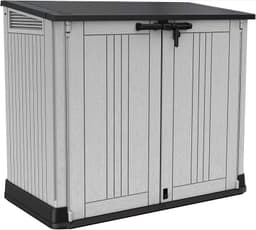
Keter Keter Store It Out Nova

Testsieger

Keter Keter Store It Out Nova
9.2/10about £137.99

The base is part of the decision

The base is both a planning height and a door problem. Soil is not a base. Keter doors and Olsen & Smith doors miss when the ground is out. GardenSite says not to use tarmac for anchors, and to keep a membrane in the slab. COZYBRITE buyers found struts, not a deck. The four bike tents have no floor either. A 2.3 metre LARBANKE on a 15 cm slab is 2.45 metres, which scrapes under a 2.5 metre cap. Measure from the lowest adjacent ground to the highest point of the roof, including the build-up. Leave room to stand panels and to reach outside hinge screws on a COZYBRITE. The sequence is on how to assemble a garden shed. Damp and rust sit on metal vs plastic garden shed.

Building regulations, power and insurance

Planning permission and building regulations are different regimes. Class 6 of Schedule 2 to the Building Regulations 2010 exempts certain small detached buildings around 15 and 30 square metres, and not sleeping accommodation. The LARBANKE 4x6 is about 2.26 square metres. Offizon prints 16 square metres for a tent of about 2.0 x 0.8 m. Do not use that cell. If you take power from the house, Part P and regulation 9 are in play. The Association of British Insurers treats a padlock as a condition the policy must state, and the British Insurance Brokers' Association describes garden-contents limits as often a few hundred pounds. What to measure is on the garden shed buying guide.

Common questions

Do I need planning permission for a garden shed?
Often you do not, if the shed is incidental storage and it meets the permitted-development limits for your nation. Scotland and Wales use different sentences. Listed buildings, flats, Article 4 land and any business or sleeping use need a check with the council.
How close to the fence can it go?
In England, within 2 metres of the boundary the overall height must stay at or below 2.5 metres, base included. Scotland's Class 3A uses 1 metre, not 2 metres, for that cap. Wales also limits height to 1.5 metres within 2 metres of the house.
Does the base count towards the height?
Yes. St Albans council tells householders to include the base or ground build-up. A LARBANKE 8x6 listed at 2.3 metres plus a 25 cm frame is about 2.55 metres, over the 2.5 metre boundary cap.
What changes in Scotland or Wales?
Scotland uses 1 metre, not 2 metres, for the 2.5 metre height cap. Wales adds a 1.5 metre limit within 2 metres of the house. Northern Ireland is neither page.
Do building regulations apply under 15 square metres?
A detached building not over 15 square metres of floor area can fall within the Class 6 exemption if there is no sleeping accommodation and the other conditions are met. That is building control, not the planning rule about half the garden. Offizon's 16 square metre line conflicts with the tent's size, so do not use it.
Will insurance cover the tools?
Only up to the garden or outbuilding limit on your policy. BIBA describes those caps as often a few hundred pounds, commonly with a lock condition of the sort ABI security notes expect. A mower and two bikes can sit above the cap.
Can I sleep in it or run a business from it?
No. These allowances are for incidental storage, not a bedroom and not a workplace. Sleeping accommodation is also outside the Class 6 exemption.

Related pages

Sources

Public UK sources for this comparison. Prices, stars and review counts are the amazon.co.uk listings in this set, dated 19 October 2026. Page updated 22 October 2026.

  1. Planning Portal: outbuildings (retrieved 22 October 2026)
  2. GPDO 2015, Class E (retrieved 22 October 2026)
  3. GOV.UK: permitted development technical guidance (retrieved 22 October 2026)
  4. Building Regulations 2010, Schedule 2, Class 6 (retrieved 22 October 2026)
  5. Building Regulations 2010, regulation 9 (retrieved 22 October 2026)
  6. Scottish Government: Circular 1/2024, Class 3A (retrieved 22 October 2026)
  7. ABI: buildings insurance (retrieved 22 October 2026)
  8. BIBA: garden insurance (retrieved 22 October 2026)