Independent comparisons. We may earn from shop links. More info

Wildlife pond frozen: when you do not need a heater

Updated: 22 October 2026

You look out after a clear night and a wildlife pond frozen solid feels like an emergency, so a pond heater goes into the basket before breakfast. For a planted pond with few or no fish, that purchase is often the wrong response. Ice is a normal January surface. The animals need depth, plants and light. Peter F. used RHS, Amphibian and Reptile Conservation (ARC), Froglife and RSPCA guidance, and did not survey your pond. The heaters on the [pond heater comparison](/hub/garden-ponds/pond-heater) assume a heater is already in play. Here the usual ending is that you leave it in the shop.

You look out after a clear night and a wildlife pond frozen solid feels like an emergency, so a pond heater goes into the basket before breakfast.

Our top picks

On this page

Ice is not automatically an emergency

A frozen wildlife pond is not, by itself, a dead pond. ARC asks for at least 60 cm, so a normal British winter leaves water under the ice. Plants under that ice matter more to oxygen than a hole punched for the look of it. Froglife says many amphibians brumate on land. A heater does nothing for a frog in the compost. The RHS splits the advice. Koi and goldfish need a heater, an air pump or a float so the surface does not seal. A wildlife pond with few or no fish usually does not, unless waste is rotting underneath. ARC says winterkill from trapped gases is real and uncommon. The RSPCA still wants you to check. Looking from the bank is not the same as buying 500 W.

What a hole does, and what it does not

A hole lets gases out and a little air in. It does not raise oxygen by much. Plants do that work under the ice, which is the ARC and Froglife point. Smooth newts gulp air, so a small opening can help them. It is still an opening, not a heater left on all month. Snow blocks light. The RHS says brush it off from the bank so plants can photosynthesise. Do not walk on the ice. Clear ice can stay. ARC, the RHS, Froglife and the RSPCA say do not break the ice and do not use salt. A ball set before the freeze, then lifted out, is ARC’s gentler hole. A ball thrown onto ice that has sealed sits on top. Salt, antifreeze and boiling water stay off the list.

When you still open the surface

Open the surface if waste is rotting under the ice, if you also keep goldfish or koi, or if smooth newts use the pond. Ice that has already formed gets a saucepan of hot water rested on it, the RSPCA method. Do not pour the water in. The pan is a job from the bank. Rotting waste is fixed by next autumn’s clear-out. If goldfish share the pond, choose a vent, a set-point tube or nothing on the pond heater buying guide. OATA’s 45–60 cm, more for koi, is the fish figure. ARC’s 60 cm is the wildlife figure. A heater will not invent depth you never dug.

Leave the heater in the shop unless the pond is a fish pond

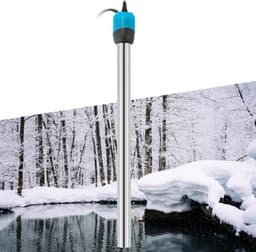
A mains pond heater is the wrong default for frogs. The listings are de-icers and set-point tubes. Several arrive without a stated voltage, and the only one with a stack of UK reviews is a 50 W vent aimed at ponds up to 5,000 litres. None of that raises oxygen the way submerged plants do, and none of it helps a frog in the compost heap. Buy one when the pond is also a fish pond, or when rotting waste or air-breathing newts justify a hole you will check. If you do put a unit in, use an RCD-protected outdoor socket, do not smash the ice, and look at the patch. That sequence is on the how to use page. If the plants are visible through clear ice tonight, a broom for the snow and a decision to leave the ice alone are the whole job.

Common questions

Should I buy a pond heater for frogs?
Usually, no. The RHS says a wildlife pond with few or no fish does not need a hole unless waste is rotting under the ice. Froglife notes that many amphibians spend the winter on land. A heater keeps a patch open. It does not warm a frog under a log, and it does not replace plants under the ice. Buy one if you also keep goldfish or koi.
Will frogs die under the ice?
They can, and most of them do not. ARC says winterkill from gases under ice is real and uncommon as a share of local frogs. The RSPCA still says those gases can harm frogs and fish, and tells you to check. Frogs on land are outside this problem. Frogs in the water need the 60 cm ARC asks for.
Do newts need a hole?
Smooth newts can, because they gulp air. ARC and Froglife both make that exception beside the point that a hole does little for oxygen in the water. A small opening can be a ball you set before the freeze and lift out, or a hole melted with a pan. It does not have to be a 500 W de-icer running for a month. Amphibians brumating on land do not need that opening.
Can I smash a corner of the ice?
No. Smashing sends a shock through the water. ARC, the RHS, Froglife and the RSPCA reject it, including a small hole at the edge. Rest a saucepan of hot water on the ice, and do not tip that water in. Salt and antifreeze are out. Clear ice can be read from the bank.
Is a tennis ball or a floating ball enough?
A ball already floating, then lifted out of the ice, is the hole ARC describes. A tennis ball thrown onto a sealed pond sits on top. The ball is not a heater, and a wildlife pond may not need the hole. It does not replace 60 cm of depth or plants.
What if I also have goldfish?
Then this page steps aside. Goldfish need an open surface, which is the RSPCA and RHS line for fish. A hole matters for them even when frogs are present too. Choose the heater, or an air pump, on the buying guide, and do not smash the ice to get there faster. A heater does not make midwinter feeding safe.

Related pages

Sources

Public UK and maker sources from the research digest, used for this page in October 2026. Prices, stars and review counts are from the four amazon.co.uk listings captured on 20 October 2026. A missing voltage is not treated as 230 V. The Ofgem unit rate is the price cap for England, Scotland and Wales, not a household tariff and not Northern Ireland.

  1. RSPCA, pet fish in winter (retrieved 20 October 2026)
  2. RHS, ponds in January (retrieved 20 October 2026)
  3. OATA, how to look after pond fish (retrieved 20 October 2026)
  4. Ofgem, energy price cap 1 October to 31 December 2026 (retrieved 20 October 2026)
  5. Blagdon, Affinity Ice Vent (retrieved 20 October 2026)
  6. Professional Electrician, electrical installations in the garden (retrieved 20 October 2026)
  7. IEC 60335-2-55:2021 (retrieved 20 October 2026)
  8. ARC, pond FAQs (retrieved 20 October 2026)