Independent comparisons. We may earn from shop links. More info

How to install a pond filter

Updated: 22 October 2026

The box is in the driveway, the hose is still coiled, and you want the pond running before the weekend. How to install a pond filter, for a unit you have already chosen, is mostly where the outlet sits and where a new electrical supply stops being a job you finish yourself. This page follows that order: height for the layout you bought, then the hose, then the socket, then the first switch-on. The listings are the [pond filter comparison](/hub/garden-ponds/pond-filter). Peter F. used retailer install notes, Approved Document P, and the 19 October 2026 amazon.co.uk snapshot. This is not a wiring diagram and not a lab install. A qualifying purchase through our links can earn a commission at no extra cost to you.

The box is in the driveway, the hose is still coiled, and you want the pond running before the weekend.

Our top picks

Fish Mate Fish Mate 2500 GUV

Best overall

Fish Mate Fish Mate 2500 GUV
9.0/10about £69.91
Fish Mate Fish Mate 10000 PUV

Rank 2

Fish Mate Fish Mate 10000 PUV
8.8/10about £146.75
On this page

Sit the box for the layout you bought

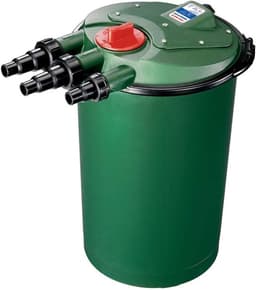
Start with the return, not with the nearest flat stone. A gravity box, such as the Fish Mate 2500 GUV in this set, has to discharge above the pond surface. Water Garden and the RHS describe the same limit: if the outlet is below the surface, the box floods, and that kind of outflow will not push a fountain uphill. Put the spill so it falls back into the pond, and leave yourself room to lift the lid without kneeling in the water. A pressurised canister is the opposite height problem. Water Garden wants the inlet and the outlet above the water so a stopped pump does not empty the canister back into the pond. The Fish Mate instructions for the pressurised models say not to immerse the unit. Swell UK, a retailer guide rather than a standard, says you can bury a pressurised filter with the lid above ground. The Fish Mate manual’s line about burying with the clamp above ground belongs to that manual. It is not a licence to sink every brand until the lid disappears. The 10000 and the 15000 still need the pump the Amazon bullets do not include. Which shape you needed is the pressurised or in-pond page. An in-pond unit sits on a flat part of the floor. Swell’s note, again a retailer step, is not to pull it out by the cable. The Blagdon bullet says to remove debris before you install. The Biling and the FEOXSHAL are pump-and-box kits that live in the water. They are not external canisters you bury by the shed. The FEOXSHAL voltage field says 110 V AC. That unit stays out of the pond until you know you are not about to put it on a UK 230 V socket.

Hose direction and the first leak

Hozelock’s UK help page, for the pump-fed systems it describes, puts the pump at a deep point and away from the return, and it tells you to use the largest hose you can. Water then falls back by gravity on that style of system. If the return lands next to the pump, you stir the same corner and leave the far shelf stale. A short offcut that kinks behind the liner costs more flow than the title litres per hour suggest, because the stated flow is a low-lift figure before bends. The Fish Mate 10000 reviews in this file describe hose tails that rely on friction and leak, and a backwash that does not always close. Dry-fit the tails, then run the pump with the return aimed where you can see it, and watch the joint for a minute before you bury anything. One 15000 review says the fitting will not take 38 mm pipe. The spec table does not give a diameter, so you match the tail you can see in the carton rather than forcing a hose you already own. Clips, where the manual asks for them, belong on before the trench is filled. Biling and FEOXSHAL reviews mention short leads. If the cable ends a metre from the socket, the answer is not an indoor reel across the lawn. NICEIC warns against living on an extension lead outdoors. Plan the hose run and the cable run on the same afternoon, while the ground is still open.
Fish Mate Fish Mate 2500 GUV

Testsieger

Fish Mate Fish Mate 2500 GUV
9.0/10about £69.91

Where the DIY electrics stop

An existing outdoor socket with a 30 mA RCD is the supply these mains filters are written around. Electrical Safety First asks you to test that RCD at least every three months. Fish Mate’s instructions for the 10000 and 15000 ask for a 30 mA RCD, a 3 A fuse, and outdoor flex. They also say the filter is not a swimming-pool filter and that you should not immerse it. Plugging into that existing socket is a different job from creating the socket. Approved Document P (2013) brings pond pumps in the garden inside Part P. On that document, notifiable work includes a new circuit, a new consumer unit, or work in a bath, shower, pool, or sauna location. A garden pond is not that special location. An existing 30 mA outdoor socket is not, on that text, a new circuit. Some council pages and older comments still talk as if any pond supply were broadly notifiable, or as if DIY garden electrics had been banned outright. Those texts disagree with the 2013 approved document. This page follows the approved document and still sends you to an electrician when the work is a new circuit, a buried cable back to the consumer unit, or any supply you do not already trust. If an RCD trips at once, or you smell burning, see a crack, or read a shock allegation in circumstances that match your own unit, stop and do not keep resetting it. The Blagdon spec says 12 V and 10 W. You fit the supply the listing describes. You do not add a 13 A plug because a review title complained that none was fitted. The Biling included line says a UK plug and a UK review says otherwise. Look at the pins in your hand before the pump goes under the water. Regulation 35 of the Electrical Equipment (Safety) Regulations 2016 is the rule for a domestic lead on a BS 1363 socket. A 110 V FEOXSHAL does not become a UK pond pump because the rest of the kit looks familiar.

Switch on, then stop

Isolate the supply before you open a housing. Fish Mate’s instructions tell you not to look at the UV lamp to see if it is on. A glowing glass is not a maintenance check, and the 2500 GUV chamber is described as quartzless, which does not make staring at it safer. The first hour is leaks, flow, and whether the return lands back in the pond, not a tour of the bulb. Plan the sludge path before the first backflush. Swell suggests a flowerbed or a drain. GOV.UK says you must not put polluting waste into a watercourse. A flowerbed that does not run into a ditch or a stream is the usual garden path. Hosing the first dirty water into a ditch that reaches a stream is not. The same stop applies if your pond itself sits on a watercourse. After the first week you are looking for a joint that weeps, a gravity box that has crept below the surface, and an RCD that still tests. If the water stays green, the lamp and the difference between pea soup and blanketweed belong on the green water page. If the return cannot reach the waterfall you wanted, you bought the wrong layout, and re-plumbing a gravity box as if it were pressurised will not invent the missing lift.

Common questions

Where should I put the pond filter?
Match the layout. A gravity box discharges above the pond surface. A pressurised canister stays out of the water, with inlet and outlet above the surface so a stopped pump does not dump it, and any burial keeps the lid and clamp where that model’s manual allows. An in-pond unit sits on a flat part of the floor. Put the pump away from the return so you are not cleaning the same corner twice.
Can the outlet sit below the pond surface?
On a gravity box, no. Below the surface the box floods, and that outflow will not run a fountain uphill. A pressurised canister is allowed to push upwards because it is sealed, and Water Garden still wants its own inlet and outlet above the water so the canister is not siphoned out when the pump stops. The two layouts do not share one height rule.
Can I bury a pressurised pond filter?
Retailer guides, including Swell, say a pressurised filter can be buried with the lid above ground. Fish Mate’s own manual talks about the clamp remaining above ground. That line is for those instructions, not for every brand in this set, and it is not permission to immerse the canister. The Fish Mate sheet says not to immerse the unit. Leave access for the backwash and for any leak at the hose tails.
Do I need an electrician to install a pond filter?
You need one for a new circuit, a new consumer unit, or a buried supply you do not already have. Approved Document P includes garden pond pumps in Part P, and it does not treat the pond itself as a bath, pool, or sauna zone. Plugging into an existing outdoor 30 mA socket is the ordinary case. If you are unsure the RCD is sound, or the cable has to be dug in from the house, that is the stop.
Is an extension lead across the lawn acceptable?
NICEIC warns against running the garden on an extension lead. Biling and FEOXSHAL reviews already complain about short cables, which is how the reel appears. Use an existing outdoor socket on a 30 mA RCD, tested at least every three months, or have a proper supply fitted. An indoor reel in the wet is the failure this page is trying to keep you from.
Should I look at the UV lamp to see if it is on?
No. Fish Mate’s instructions tell you not to look at the lamp. Isolate the supply before you open the housing. A clarifier that has died is a bulb or a missing part, which the green water page covers, including the Blagdon bullet that says to replace the UVC lamp each spring. Checking it by eye is not the test.

Related pages

Sources

Public UK sources for this comparison. Listings and prices were taken from amazon.co.uk on 19 October 2026.

  1. RHS: Choosing a pond filter (retrieved 19 October 2026)
  2. Water Garden: pond filter selection guide (retrieved 19 October 2026)
  3. Water Garden: pond filters, including the OASE volume rule of thumb (retrieved 19 October 2026)
  4. Electrical Safety First: garden electrics (retrieved 19 October 2026)
  5. Electrical Equipment (Safety) Regulations 2016, regulation 35 (retrieved 19 October 2026)
  6. Consumer Rights Act 2015, section 22 (retrieved 19 October 2026)
  7. Approved Document P, 2013 (retrieved 19 October 2026)
  8. Fish Mate filter instructions (retrieved 19 October 2026)