Independent comparisons. We may earn from shop links. More info

Solar wall light motion sensor or dusk-to-dawn

Updated: 22 October 2026

You are standing in a side passage that goes dark at half past four, and the listing cannot decide whether the solar wall light motion sensor is a burst or an all-evening glow. In the twelve amazon.co.uk listings captured in October 2026 for our [solar wall light outdoor comparison](/hub/garden-decor/solar-wall-light-outdoor), the behaviours are dusk-to-dawn, a PIR burst, dim-then-bright, or unclear. Peter F. did not measure detection range. A qualifying purchase can earn a commission at no extra cost to you.

You are standing in a side passage that goes dark at half past four, and the listing cannot decide whether the solar wall light motion sensor is a burst or an all-evening glow.

Our top picks

TECKNET TECKNET colour four-pack

Best overall

TECKNET TECKNET colour four-pack
8.3/10about £26.99
vighep Vighep motion six-pack

Best value

vighep Vighep motion six-pack
8.5/10about £19.98
On this page

Three behaviours, not two

Dusk-to-dawn tries to stay on while the garden is dark and spends the cell all evening. A PIR burst comes on for a short time, then goes off, which is what a side passage usually needs. Dim-then-bright is the third mode. The vighep six-pack’s bullets name a low standby that jumps to full, a 30 percent all-night mode, and motion only for about 20 seconds. On a solar head the trade-off is the cell. A burst uses less of a small charge than an all-night glow, and it still needs a charge to begin with. A PIR pack is the wrong object if you wanted a warm wash you look at from the street.

When the switch and the bullets disagree

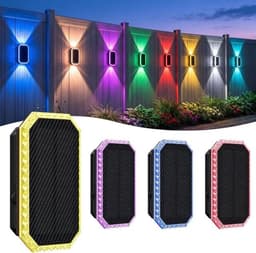
TECKNET’s four-pack is £26.99 with 4.6 from 297 ratings. The switch field says motion sensor. The bullets describe an up-and-down wash, nine RGB modes, and dusk-to-dawn, with no detection distance. IP67 is a claim, not a test in this file. Most sampled review texts are in German. Trust the bullets, and do not buy this pack as a PIR light because one field used the words motion sensor. You then get a tinted glow that stays on until the cell is empty. Blakapoo’s pair, £10.99 with 4.2 from 109 ratings, is clearer: a constant medium level, light when motion is detected, and a dim mode the extract only partly states.
TECKNET TECKNET colour four-pack

Testsieger

TECKNET TECKNET colour four-pack
8.3/10about £26.99

How far it claims to see, and who gets the beam

The only detection distance in this set is Yaolon’s claim of about 3 metres and 120 degrees, at 3.8 from 31 ratings. It is a claim, not a range we walked. Do not import 5–8 metre figures from other brands. Vighep states no distance, and one review calls the sensor under-sensitive. A cool beam can still hit a bedroom for those twenty seconds. GOV.UK does not give a lux number for that complaint. Vighep’s six-pack is 6000 K.

Winter is the battery, not the sensor

A PIR can still notice you when the cell is empty. The symptom is a single weak flash. Which? says these lights need direct sun for part of the day. Their test is not these ASINs. A burst spares a small charge compared with dusk-to-dawn. It does not create charge the panel never collected. Grey days and the only USB-C backup in this set are on the solar wall lights in winter page. Fitting the panel is on how to install solar wall lights. The wider checklist is in the buying guide.

Common questions

What is the difference between a PIR solar wall light and a dusk-to-dawn one?
A PIR light comes on for a short burst when it sees movement, then goes off. A dusk-to-dawn light tries to stay on for the whole dark period and spends the cell while it does. On a solar fitting that is a charge difference, not an electricity-bill difference. A burst is the better match for a side passage. An all-evening glow is the better match for a porch you want to see, if the panel actually charged.
What does dim-then-bright actually do?
It holds a low output and rises when the sensor trips, so the path is not fully dark and the cell is not at full output all night. The vighep six-pack’s bullets name that standby alongside a 30 percent all-night mode and motion only for about 20 seconds, at 6000 K. It is still a motion head, not a decorative wash, and the listing does not state how far the sensor claims to see.
How far does the sensor in this set claim to reach?
Only Yaolon states a distance: about 3 metres and 120 degrees, and that is a claim on a lantern with 3.8 from 31 ratings. Seklin’s bullets say 16 feet and 120 degrees, which is also a claim, on a page whose lumen figure is not credible. Vighep and Blakapoo do not print a distance. Ranges of 5–8 metres on other brands’ pages are not this set.
Will a motion light stay off a neighbour’s window better than an all-night glow?
A short burst is on for less of the night, so it is less likely to sit in a window for hours. It can still be a nuisance for those seconds if the head is aimed at glass, especially at 6000 K. GOV.UK does not publish a lux limit for that complaint. Aim the beam down the path, keep cool white off a bedroom, and do not treat a sensor as a licence to flood the boundary.
Why does my solar motion light work in June and barely flash in December?
The sensor can still be fine when the cell is empty. June gives the panel a long, high sun. December gives it a short day, a low sun, and shade from the house that was not there in summer. A single weak flash means you were detected and there was almost nothing to give. Moving the light deeper into a shaded alley will not repair that. Charge and aspect are the winter page.

Related pages

Sources

Public UK sources used for outdoor IP guidance, light nuisance, and electrical waste. amazon.co.uk prices, stars and review counts were taken from the listings in October 2026. Seller lumen and runtime lines were not measured. No listing here was lab-tested.

  1. GOV.UK, artificial light nuisances (retrieved 22 October 2026)
  2. Clean Neighbourhoods and Environment Act 2005, section 102 (retrieved 22 October 2026)
  3. Electrical Safety First, outdoor lighting (retrieved 22 October 2026)
  4. NICEIC, gardens and electrics (retrieved 22 October 2026)
  5. GOV.UK, recycling batteries and electrical waste (retrieved 22 October 2026)
  6. GOV.UK, EEE covered by the WEEE Regulations (retrieved 22 October 2026)
  7. New Forest National Park, good lighting advice (retrieved 22 October 2026)
  8. Which?, best solar garden lights (retrieved 22 October 2026)
  9. Consumer Rights Act 2015, section 9 (retrieved 22 October 2026)
  10. Consumer Rights Act 2015, section 22 (retrieved 22 October 2026)