Outdoor house numbers UK: make them readable from the road
Outdoor house numbers UK drivers can read need height, contrast, and a clear line from the road. 62.5 mm is recommended practice, not an England-wide minimum.
On this page
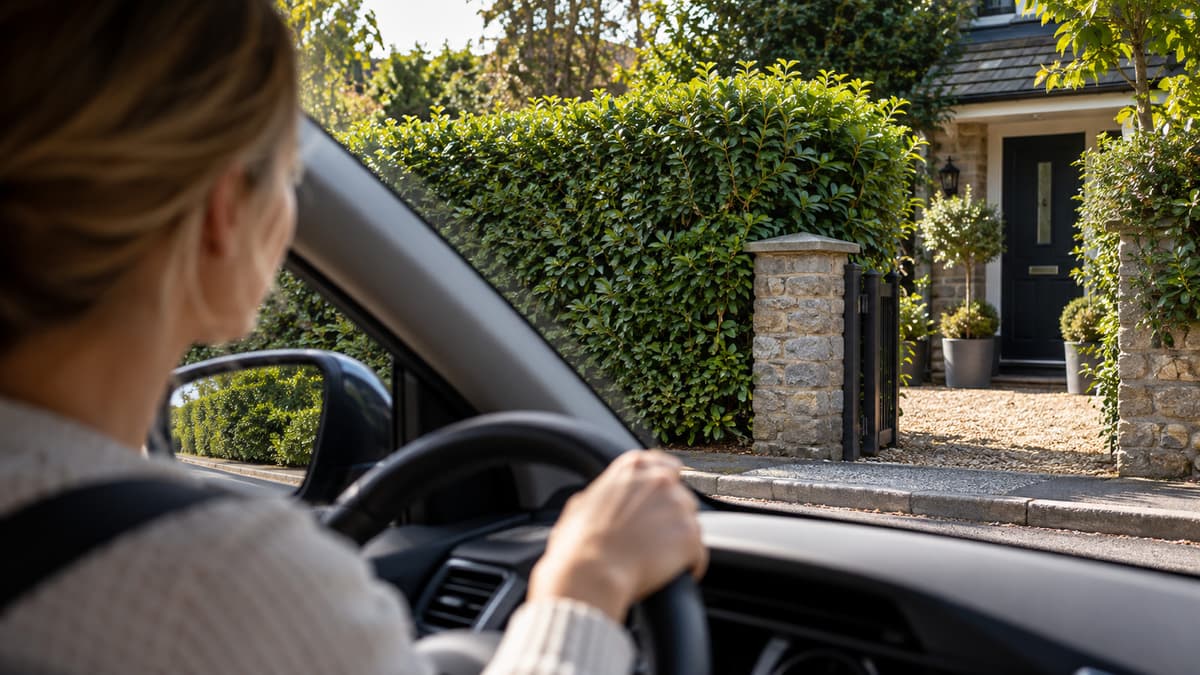
The driver slows, looks at the hedge, and misses the house. The digits are on the front door, in a typeface you chose, and they cannot be read from the public road. For outdoor house numbers UK, what a driver needs is height, contrast, and a clear line from the kerb.
Keep the rules apart. In Scotland a council can require a number readily legible from the nearest public place that gives access. Circular Roads 3/93 recommends numerals of at least 62.5 mm, with contrast, facing the road. A sign maker's distance rule, and a shop line such as 75 mm or 30 metres, are not that section, and 62.5 mm is not a legal minimum this page will state for England.
Peter F. read section 97 of the Civic Government (Scotland) Act 1982 on legislation.gov.uk, the GeoPlace copy of Circular Roads 3/93 Appendix C, Hurstbourne Forge's guide, the Housenumbers Limited FAQ, and the amazon.co.uk listings in our house number comparison. We did not measure your drive or test legibility in a lab. A qualifying purchase can earn us a commission at no extra cost to you.
In short
There is no single UK statute that sets one height for a house number. In Scotland a council can require a number readily legible from the access, and that power prints no millimetre. The Department for Transport recommends at least 62.5 mm, with contrast, facing the road, so a hedge that hides the door means moving the number or opening a sightline.
What the law says about outdoor house numbers UK
Section 97 of the Civic Government (Scotland) Act 1982 lets a Scottish council require a number readily legible from the nearest public place that gives access. It prints no millimetre. England and Wales do not inherit that section.
Circular Roads 3/93, in the Appendix C text GeoPlace publishes, recommends at least 62.5 mm, contrast, and a position facing the road. It also says there is no general legal requirement to display a conspicuous number except where a local Act gives that power. Hansard on 28 November 2000 recorded no British Standard for house numbering, so a shorter digit is not an automatic offence in every English borough.
Housenumbers Limited call 150 mm their best seller and say many local bylaws want a number readable from the road. That is a maker's account, not a height to copy onto a Scottish notice. Some shops print 75 mm and 30 metres as one national rule. Those two figures are a distance sum at about 30 metres. Display the number you were given. A shop citation of the Towns Improvement Clauses Act 1847 is unchecked on this page, because we have not quoted it from legislation.gov.uk. If a council has written, the letter names the power. Northern Ireland has no separate height statute here.
Size and contrast a driver can use
62.5 mm is the figure to beat. It is the Department for Transport recommendation, and it is still only a recommendation. Hurstbourne Forge's rule of thumb is about 25 mm of height for every 10 metres. At 10 metres, 25 mm sits under 62.5 mm, so the circular is the stricter figure beside the pavement. At 40 metres the maker's rule is about 100 mm, and at 60 metres about 150 mm, the height Housenumbers Limited say they sell most. Use the larger figure.
Measure to the face you will use. Dark digits on dark brick, or pale grey on anthracite, vanish in shade when the height is already right. Light characters on a dark ground, or dark characters on a pale wall, hold up on a dull afternoon. A board of 200 mm by 130 mm can still carry a 30 mm numeral once a street name takes the space, so judge the preview rather than the board. That order of checks is in the house number buying guide.
Where the number should sit
A gate, a gatepost, a door, or a wall, facing the road: that is the circular's list, and it is the face the Scottish access test cares about. A door on the pavement with a clear view is a sound place. A door down a side path is a weak place for the only number. The number at the gate is the one that has to pass the road test. A house name does not stand in for the official number the driver was given.
Richmond upon Thames asks for numerals of at least 63 mm, mounted from 750 mm to 2.4 metres above ground. That band belongs to one borough. Elsewhere, keep the digits above a parked bumper and out of fascia shadow. Which boards state their screws, and how to drill them, is on how to fit a house number. Leave a listed pier, and any wall you do not own, undrilled. A road name that shrinks the numeral has already lost the test.
Hedges, listed walls, and a lit digit
Leaves across the door or the gatepost are what the driver reads. Section 97 is not met by a digit behind a shrub, however large the digit is. Cut a window at numeral height, wide enough for the nearside lane, and keep it open through the summer. Or move the number to the road side of the hedge. If birds are in the hedge, move the number and leave the growth.
King's Lynn and West Norfolk restate the 62.5 mm line and still treat listed-building consent as a separate check. The size note does not authorise screws in a listed pier or a new lit panel. Ask before you drill. A legibility note is not listed-building consent.
In England, Class 2A of the Town and Country Planning (Control of Advertisements) (England) Regulations 2007 covers an identification sign up to 0.3 square metres only when it is not illuminated. The Planning Portal says a small unlit house number is unlikely to need advertisement consent, and an illuminated sign may need consent at any size. A porch lamp leaves the sign unlit. A solar head or an LED strip on the plaque does not, even when the board is under 0.3 square metres. That English class is not section 97. This page does not apply it in Scotland, Wales, or Northern Ireland. The lit plaques in the comparison, and the seller's note that solar performance is not guaranteed from October to February, are on the solar house number light page.
What a shop plaque will not fix
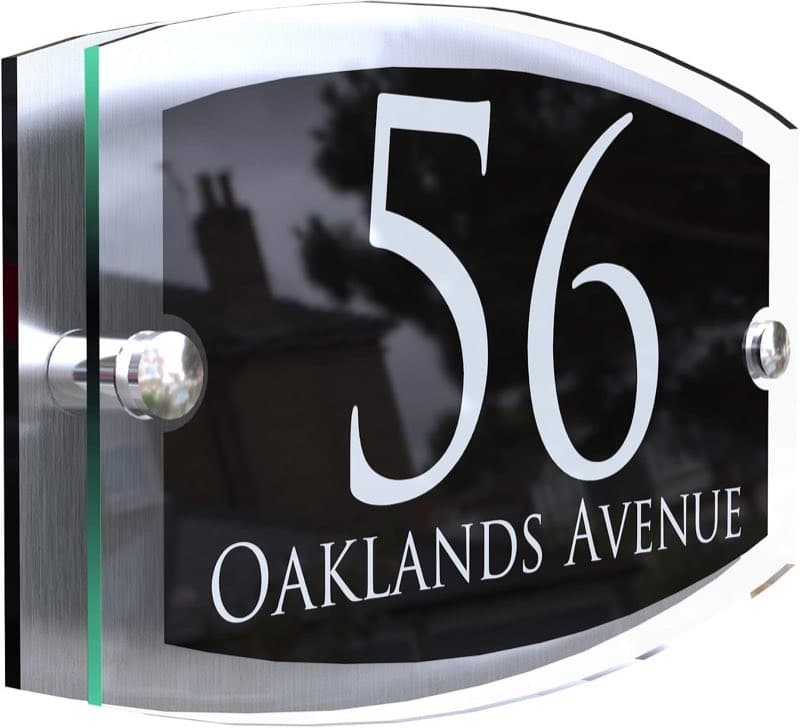
The top pick is a door plaque, not a distance test. K Smart Sign's glass-effect board, ASIN B06ZZGMWJM, was £7.99, 200 mm by 130 mm by 15 mm, and 240 g, with 4.8 from 8,594 reviews. It is the only star line above 4.7 in the set. UK reviews praise white lettering. The 4.8 line is not a reading from 30 metres. The same sample includes blue-grey print, a missing screw, and rust after a couple of months. The listing does not state the numeral height.
Use it when the door faces the road and the preview clears 62.5 mm at your measured distance. Leave it when the door is hidden, when the white must match the photograph, or when early rust would matter on a wet wall. Vicloon adhesive digits are one character, about 76 mm on the size bullet, at £3.49. A dimensions line also prints 7 cm by 5 cm, so treat 76 mm as the bullet. They carry no street name. Slate, mirror-cut faces, and the solar pair are on the best house number plaque page. £7.99 is the shelf price we recorded, not a promise that the same board suits a 40-metre set-back.
Common questions
If a council notice arrives, follow the notice. The answers below stand on their own: the Scottish access test, the 62.5 mm recommendation, set-back height, contrast, hedges, illumination in England, and listed-building consent.
Common questions
Is there one UK law on house number height?
What applies in Scotland?
How big should the number be if the house is set back?
Do dark digits on dark brick work?
Can plants cover the house number?
Are lit house numbers allowed?
Do I need consent on a listed house?

Peter F. is the editor for DIY & tools at productscompared.co.uk. Comparisons in this category are checked against amazon.co.uk listings, review evidence and public UK sources.
Related articles
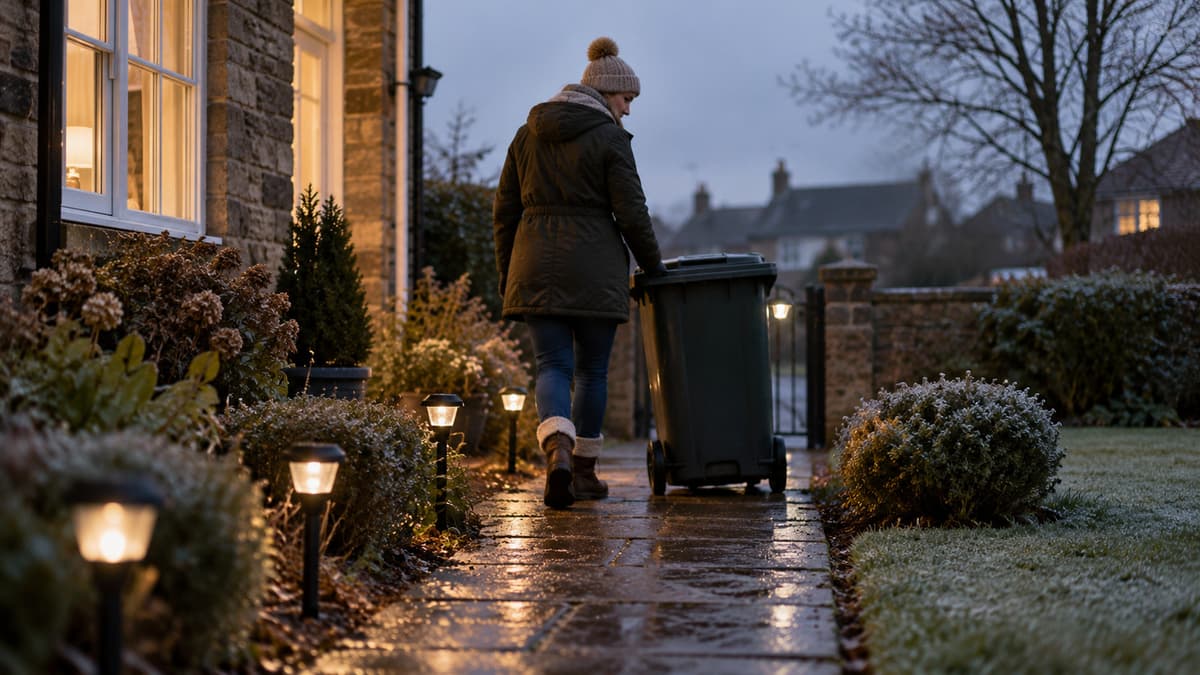
Do solar garden lights work in a UK winter?
Short, dull days cut the runtime of solar path lights, and a panel under trees or snow does not charge.

Fixing a garden gargoyle to brick
A screw in weak mortar, or a heavy casting on one fixing, is how a small garden gargoyle fails on a wall.

Artificial boxwood balls outside in Britain
Indoor-grade foliage fades outside, and a pot under an artificial boxwood ball still has to drain.