Mushroomed splitting wedge: when to file the lip
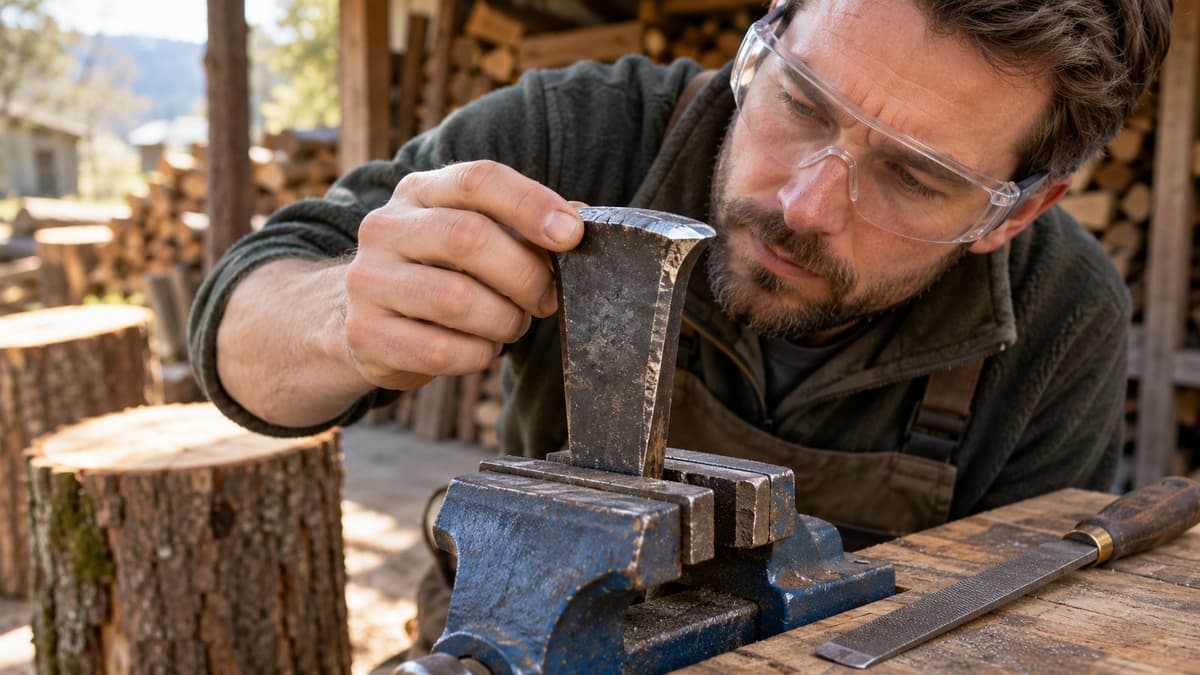
A mushroomed splitting wedge can throw steel chips. See when to file the lip, when a soft Bahco face is expected, and when a crack means you stop using it.
On this page

You pull last winter's wedge out of the shed, set it on a round of beech, and the head no longer matches the tool you bought. The rim has spread into a thin lip, wider than the shank, with a bright burr where the hammer has been landing. That shape has a plain name: a mushroomed splitting wedge. The lip is steel the blows have peened outward, and it can leave the face as a chip.
In short
A mushroomed splitting wedge has a rolled lip on the striking face, and that lip can throw chips. File or grind a thin lip while the steel underneath is sound, keep the metal cool, and wear impact eye protection. Retire the wedge if you find a crack, a broken tip, or a shard that has already left the face.
What a mushroomed splitting wedge is doing
The striking face starts as a flat or slightly crowned pad for a club hammer, a sledge or a maul poll. Each blow moves a little steel, and over a winter of rounds the rim creeps outward, the way a rivet head spreads when you peen it.
Conservation Handbooks, writing about wedges and cold chisels, describes a mushroomed head that can slip under the hammer and throw splinters. The overhang fails first, because it is thin and it stands proud of the body that should take the blow.
You can see the change without a gauge. The head looks wider than the shank just under it, with a bright ring where the hammer has been rubbing. A fingernail catch all the way round is an early lip, and a curled shelf you could hook a file under is further along.
Either shape is a reason to stop striking. The how to use a splitting wedge page makes the same call: a lipped face comes off the wood until you have dealt with the rim. Tooled-Up's notes ask you to inspect mushrooming, cracks and chips, and to take a damaged wedge out of use. A hairline from the rim, a dark line across the face, or a piece already missing is past a file.
Shelf prices in this amazon.co.uk set run from £6.12 to £24.91, and retiring a cracked head stays the same decision at both prices.
How to file a mushroomed splitting wedge
A file is the cooler tool for a thin lip, and it is hard to blue the steel with one. An angle grinder is faster, and it is easier to overheat a face the size of a large coin. Conservation Handbooks tells you to grind the shoulders without cooking the temper.
If you grind a mushroomed wedge at home, you only remove metal, and the maker's heat treatment stays as it was. Clamp the wedge and put impact eye protection on before the first stroke.
- File the striking face until the rim no longer overhangs and the pad is flat or slightly crowned.
- Use short passes, then pause. If the steel is too hot to touch, or it turns blue or straw-coloured, stop and let it cool in the air.
- Leave the torch, and any water or oil quench, out of the job. Heating the head and quenching it can send splitting wedge chips off the face.
- Stop if the file or the wheel lifts flakes, or a crack opens as the lip comes away. A clean curl is a wedge burr. A crystalline piece is part of the wedge.
Keep the cutting edge out of this repair. Several buyers of the Amtech A3400, at £9.75 in this amazon.co.uk file, ground a new edge because the wedge arrived blunt and would not enter the wood. That sharpening is separate from the striking face. If flakes are already coming off the face, a replacement sits in the splitting wedge comparison.
A soft Bahco head and a cracked one
Bahco's traditional steel splitting wedges page says the steel is not hardened, to reduce chipping. That sentence is the maker's. The amazon.co.uk bullets for the WS15 and the WS20 leave it out, so the listing on its own never shows the trade-off: a face that yields under the hammer, chosen so it is less likely to throw a chip.
A soft face and a cracked face are different conditions, and the maker's sentence is not a warranty for the head in your hand.
The two pages share one review text and the same 4.5 from 508 ratings. The WS15 is £19.39, with bullets at 1,500 g and 230 mm. The WS20 is £24.91, with bullets at 2,000 g and 250 mm, while its item-weight field says 934 g. Those comments belong to both ASINs together. Counting 508 twice would invent a second sample.
In the shared text the steel is called soft, the edge chipped on beech and needed regrinding after a few weeks, and one hitting face was not burred after about 150 logs with a 4 lb hammer. Our notes on that material also record mushrooming. Neither the few weeks nor the 150 logs is a service life you can copy onto the wedge in your vice.
Some reviewers accept a slow mushroom, because the hammer is upsetting steel and the head is staying in one piece. Hardening the face with a torch and a quench reverses Bahco's choice.
What this set's reviews said about the face
The Rotatech 1.7 kg twisted wedge, at £14.99, has the plainest mushrooming sentence, and it rests on one amazon.co.uk review, its 5.0 from 1. The review says the striking face mushrooms and needs occasional filing. It also says 27 cm suits medium-to-large logs rather than kindling. Heat treatment is absent from the listing. One review is a reason to look at your own face, and a thin basis for expecting every Rotatech to mushroom.
The Amtech A3400, at £9.75 and 4.4 from 187 reviews, holds two outcomes. One review says the steel showed little mushrooming under a sledgehammer. A different review describes a fingernail-sized shard breaking off under a sledgehammer and lodging in a shin. The listing never names a hammer. A quiet face in one shed says nothing about the shard in another, and a shard that has left the steel is a finished wedge.
The Roughneck 65-504 wood grenade is the top pick here, at £13.99 with 4.3 from 1,490 reviews and an item weight of 1.46 kg. The notes we used record a broken tip after about a year of steady use. The broken tip stays broken after you file the lip. Who should skip which wedge is on the best splitting wedge page, and profile, mass and steel are ordered on the splitting wedge buying guide.
The Products Compared editorial team read these amazon.co.uk listings and the makers' pages, with no laboratory strike behind the notes. Prices are the figures in those files, not a live basket on 15 October 2026. A qualifying purchase can earn a commission at no extra cost to you.
When a mushroomed splitting wedge is finished
Tooled-Up's notes put a cracked or chipped wedge out of use, with goggles for the inspection. Grinding a crack so the face looks tidy leaves the fracture under the hammer, and the next blow is what opens it.
A dressed lip can come back. On steel the maker has left unhardened, that return is part of owning the tool. Check the face whenever you bring the wedge out, and file a fresh thin lip before it becomes a shelf. If the file lifts flakes on a light pass, the cycle is over. A second wedge for a knotty round leaves a shedding head unrepaired.
Impact eye protection stays on while you dress the head and while you strike. The Health and Safety Executive treats projectiles as an eye hazard, and a chip is a projectile in the vice and on the block. Ordinary spectacles are a weak stand-in, and steel-toe boots belong with the goggles on the block. The Rotatech review names both, and the Amtech shard reached a shin. A wedge and a hammer are for a bucked round on the ground.
A standing tree, or a limb hung up in the crown, is work for someone who does that job. On a sound face, strike square, and stop when the blows stop opening the wood. Deal with the lip on the bench first.
Common questions
Is a mushroom on a splitting wedge normal?
Should I grind a mushroomed wedge or file it?
Can I burn the lip off a splitting wedge?
When should I throw a splitting wedge away?
Does a soft Bahco head mean the wedge is faulty?
Do I need goggles to dress a wedge head?

Products Compared publishes British-English buying guides based on amazon.co.uk listings and public UK sources. We do not run a lab and we do not invent test scores.
Related articles

Eye protection when you strike a wedge
Why impact eye protection belongs on for every blow, and for filing a lip that can throw a chip.

When a splitting wedge sticks
How to free a wedge buried in a round, without levering on the hammer handle.

Club hammer or sledge for a wedge
What these listings name as the striker, and why the hammer poll should meet the face.