Eye protection splitting logs: impact PPE that fits

Wear impact eye protection when splitting logs. See what can leave a struck steel wedge, which UK rules apply at home, and what to put on before you swing.
On this page

The round is upright on end grain, the wedge is tapped in, and the hammer is already in your hands. The next blow is steel on steel, and anything that leaves the head has a short trip to your face or to someone standing too close. Eye protection splitting logs is the control for that moment: impact eyewear that fits, worn before the heavy strikes, with everyone else kept out of the swing path.
Reading glasses on the bench do not do that job.
The Products Compared editorial team read the nine amazon.co.uk listings in our splitting wedge comparison on 15 October 2026, plus HSE guidance on PPE and the public UK rules below. We did not strike these wedges in a lab. Shelf prices are the figures in those listing files, not a live basket on that date. A qualifying purchase on amazon.co.uk can earn us a commission, at no extra cost to you.
In short
Wear impact eye protection before you strike a splitting wedge. Wood chips and steel fragments are both projectile hazards, and the Health and Safety Executive expects the protection to match the task and to fit you. The Provision and Use of Work Equipment Regulations 1998 cover work equipment used at work, and domestic DIY in a private household sits outside that duty.
What can leave the wedge
A splitting wedge is struck steel. You drive it into the end grain of a bucked log, and the working blow is a hammer face meeting that head. A chip of wood can flick off the round, a burr can shear from a spread rim, and a piece of the wedge itself can break away. Reviews in this set record steel as well as wood, so the eyewear goes on before the heavy strikes.
Look at the rim first. Repeated blows spread the striking face into a lip of thin steel, and the next strike can take that lip off. On the Rotatech 1.7 kg twist, at £14.99 in the listing file, the only UK review says the face mushrooms and needs occasional filing. If the lip is already curled, stop for the day.
Hardness does not close the hazard. Bahco states that its traditional wedges are not hardened, to reduce chipping. Roughneck states that it hardens and tempers the twister. A softer face tends to mushroom, and a harder face can chip. We did not measure the steel, and one Amtech review describes a fingernail-sized shard, already enough metal to matter at an eye.
What HSE says about projectile PPE
The Health and Safety Executive's page on the right type of PPE treats projectiles as an eye hazard. It names safety spectacles, goggles and face shields, and the protection has to match the task and fit you. For splitting logs that means chips of wood and of metal, eyewear that stays on through the swing, and a clear view of a striking face a few centimetres across. If you cannot see the head, the blow lands on the rim.
Prescription glasses are built for vision. Safety spectacles count when they are impact protection and they fit your face. Reading glasses, and sunglasses from the car, are a different product. The Eyecare Trust points DIY buyers who face chips of wood or metal at the identifier BS EN 166. This page names that identifier only and does not reproduce the standard.
Goggles sit against the eyes. A face shield covers more of the face and is a separate type. Fogged lenses, or a shield you did not choose as the impact protection, fail the fit test. HSG172 covers workplaces where chips are ejected, and powered splitters with two-hand controls. Use the projectile point in a garden, and leave those machine controls in that workplace document.
Which rules apply at home, and which apply at work
Under the General Product Safety Regulations 2005, as GOV.UK explains them for Great Britain, a consumer product must be safe in normal or reasonably foreseeable use. Striking a wedge with a hammer to open firewood is that use. The duty sits with the product placed on the market. It does not put goggles on your face.
The Consumer Rights Act 2015 requires satisfactory quality and goods that match their description. In this set a bullet weight and an item weight sometimes cannot both be the head. The splitting wedge buying guide sets those conflicts out wedge by wedge. A contradiction is a reason to pause before you pay. It is not a promise that the steel will hold.
The Provision and Use of Work Equipment Regulations 1998 apply to work equipment used at work, including work by a self-employed person. HSE's approved code of practice states that they do not apply to domestic work in a private household, so logs you split in your own garden sit outside that duty. Paid processing puts you inside it, and this article is not a risk assessment.
BS EN 609-1, in HSE's firewood-processor bulletin, covers powered wedge splitters and will not choose goggles for a hand wedge. A UKCA mark on the wedge is not a quality certificate here. Impact eyewear is PPE and sits in a marking regime of its own. Keep a steel splitting wedge out of a chainsaw kerf.
What these listings already reported
The concrete case is the Amtech A3400 at £9.75, with 4.4 from 187 amazon.co.uk reviews. The bullets say 1.48 kg and the item weight says 1.46 kg. The listing names no hammer and states no shape. One review describes a fingernail-sized shard breaking off under a sledgehammer and lodging in a shin, and Amtech reviews include a warning about hardened hammers. None of that is a laboratory strike, and none of it retires the eyewear on the next log.
A Rolson review title on amazon.co.uk names safety goggles. The Rolson 10780 at £7.94 carries 4.3 from 2,598 reviews, which still leaves the steel untested. The Rotatech twist is 1.7 kg on both the bullet and the item weight, 27 cm long, at £14.99. Its only UK review, a 5.0 from one rating, calls for eye protection and steel-toe boots and says the face mushrooms. One report is not a rate, and this page sets no glove standard.
The top pick does not opt out. The Roughneck grenade 65-504 leads the best splitting wedge shortlist on a single item weight of 1.46 kg, a named sledgehammer or maul, and 4.3 from 1,490 reviews at £13.99.
One review says a tip broke off after about a year. On the knotty hardwood page, a report describes the Roughneck twister breaking into four pieces in a long green hardwood log. Both are single reports, so wear the same eye protection on the grenade, the twist and the cheap taper.
What to check before the heavy blows
Put the eyewear on before the first full swing. The how to use a splitting wedge page carries the seating detail. Then work through the checks below.
- Put impact eye protection on, and check that it stays put when you look down at the head and when you turn to see who is nearby.
- Stand the round on stable ground, on end grain, where a miss cannot bounce the hammer into a wall, a pane or your foot.
- Seat the wedge with light taps until it stands on its own, then take your free hand off the steel.
- Hit the striking face square with a hammer face you can place on the head. These listings name a sledgehammer or a maul, and an axe edge is the wrong striker.
- Stop if the rim has mushroomed into a lip, if the wedge rebounds, or if further blows only bury a stuck head. Drive a second wedge into a new line in the crack, and leave the hammer handle out of it.
Keep every other person outside the swing path. If holding the work means standing in that path, stop. A standing tree or a hung-up stem is the wrong job for a wedge and a hammer. Stout boots belong with the goggles, because a shard in this set reached a shin. When the crack stops growing, stop.
Common questions
Are everyday spectacles enough when splitting logs?
Does PUWER apply if I am splitting logs at home?
What law covers a splitting wedge sold to a consumer?
Can a splitting wedge throw steel, or only wood chips?
Does BS EN 609-1 tell me which goggles to buy?
Should anyone stand in the swing path?
Is a face shield the same as safety goggles?
Do I still need eye protection with an unhardened wedge?

Products Compared publishes British-English buying guides based on amazon.co.uk listings and public UK sources. We do not run a lab and we do not invent test scores.
Related articles
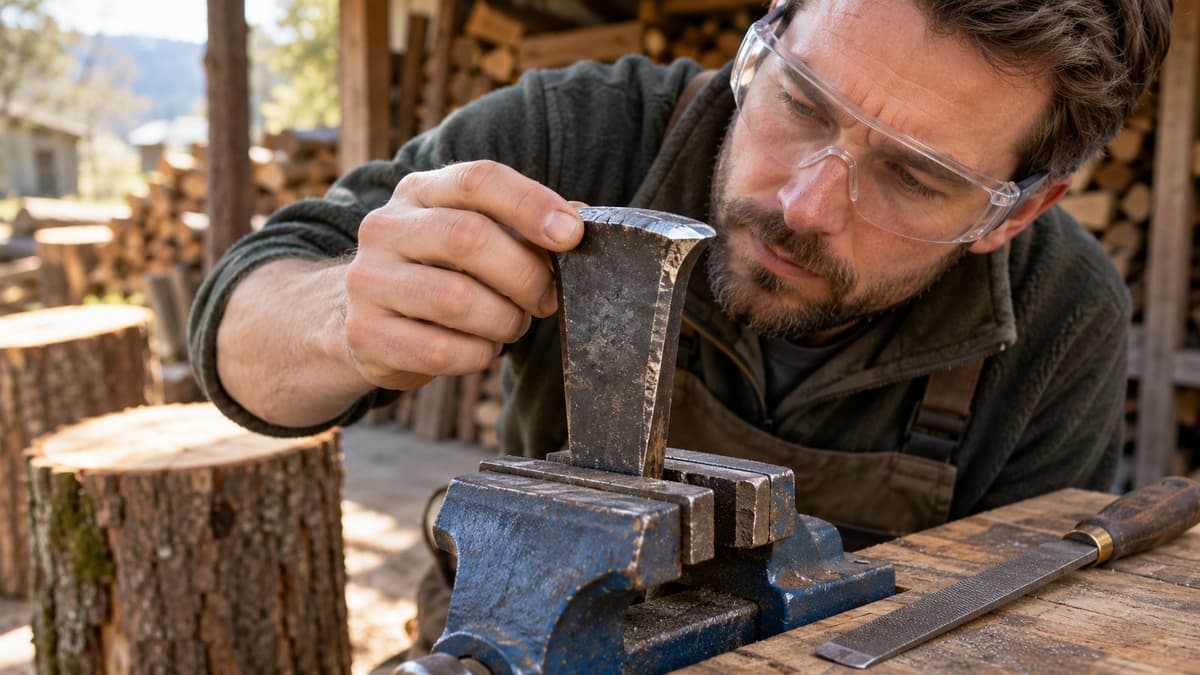
A mushroomed splitting wedge
When a spread striking face starts throwing fragments, and when filing the lip is no longer enough.

Club hammer or sledge for a wedge
What these listings name as a striker, and why an axe edge is the wrong tool on the steel.

When to call a tree surgeon
The point where a standing or hung-up tree is the wrong job for a wedge and a hammer.